




CONTENTS
- 1. ESG Disclosure | Discussions on Mandating Sustainability Disclosure and the Trend Toward Closer Linkage With Financial Information

- 2. ESG Disclosure | Status of the Adoption of Disclosure Standards at Home and Abroad
- - Discussions on the Introduction of the KSSB Sustainability Disclosure Standards
- - Linkage Between the ISSB International Standards and the Domestic Standards
- - The Financial Services Commission's Sustainability Disclosure Roadmap
- - The Significance of the Changes in the ESG Disclosure System
- 3. ESG Disclosure | Key Matters Companies Should Review
- - Securing Consistency Between Disclosed Content and Financial Information
- - Management of Greenwashing and Supply-Chain-Related Risks
- - Building an ESG Data Management and Internal-Control System
- 4. ESG Disclosure | The Assistance of the Corporate Legal Group
- - If You Receive the Assistance of the Corporate Legal Group

1. ESG Disclosure | Discussions on Mandating Sustainability Disclosure and the Trend Toward Closer Linkage With Financial Information
ESG disclosure is being discussed as an important consideration in the recent corporate management environment.
In the past, sustainability reports and ESG reports were often used as a means of introducing a company's corporate social responsibility activities.
Recently, however, investors have been using ESG-related information in their investment decisions, and the financial authorities are also reviewing the introduction of a sustainability disclosure system, so the importance of ESG disclosure has been expanding.
In particular, with the Financial Services Commission's discussions on a sustainability disclosure roadmap in 2026 and the Korea Accounting Institute's review of introducing climate-related accounting application cases, ESG disclosure is becoming closely connected with the accounting and finance fields, going beyond the disclosure domain.
Recently, the discussion that the climate risks and business-transition plans disclosed in ESG disclosure should also be reflected in the financial statements has been expanding, and as a result, companies are placed in a situation where they must review not only the accuracy of the disclosed content but also the consistency between the disclosed information and the financial information.
2. ESG Disclosure | Status of the Adoption of Disclosure Standards at Home and Abroad
The institutionalization of ESG disclosure has recently begun to be discussed in earnest in the capital markets at home and abroad.
In the past, sustainability reports and ESG reports were often used as a means of externally publicizing a company's corporate social responsibility activities and its environmentally friendly management results.
Recently, however, as the recognition has spread that climate change, supply-chain risk, human rights issues, and governance problems can affect corporate value and financial performance, ESG-related information is also being assessed as information necessary for investor decision-making.
Accordingly, the development of ESG-related disclosure standards is underway internationally, and in Korea as well, the regulatory framework is being refined to build a sustainability disclosure system.
In particular, with the Financial Services Commission's recent discussions on a sustainability disclosure roadmap and the Korea Sustainability Standards Board's (KSSB) work on developing standards, ESG disclosure is being discussed as one of the principal disclosure obligations of companies.
 Discussions on the Introduction of the KSSB Sustainability Disclosure Standards
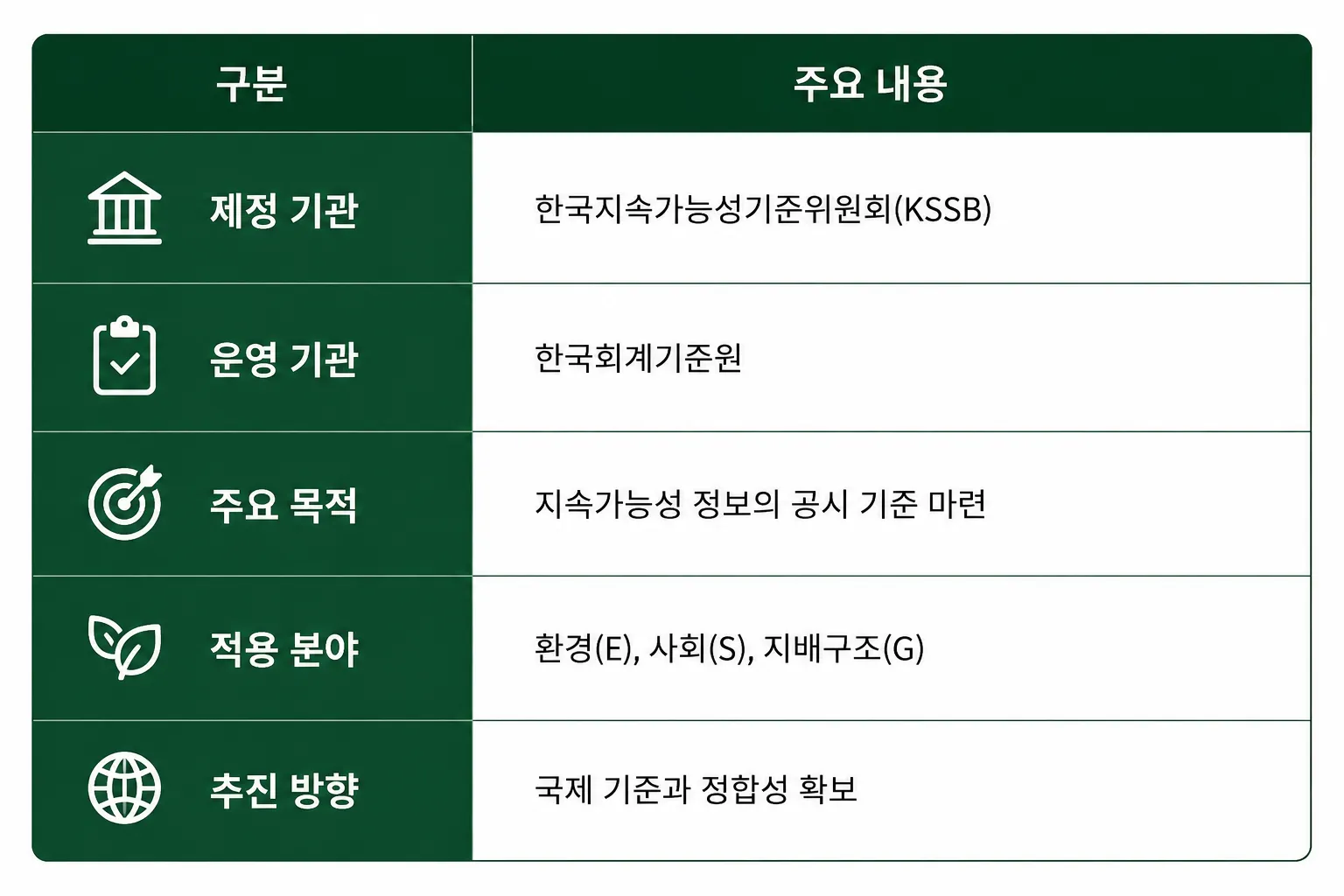
For ESG disclosure, the development of domestic standards is currently being pursued with the Korea Sustainability Standards Board (KSSB) at the center.
The KSSB, under the Korea Accounting Institute, is in the process of developing sustainability disclosure standards that secure consistency with international standards while also taking the domestic corporate environment into account.
The purpose of the KSSB standards is to provide investors with the information they need to assess a company's sustainability-related risks and opportunities, and they are being discussed as a framework that encompasses not only climate change but also social factors and governance factors.
In particular, whereas existing sustainability reports were often prepared according to each company's voluntary standards, the KSSB standards are being reviewed in a direction that enhances comparability and reliability by applying consistent criteria to the scope and content of disclosure.
Linkage Between the ISSB International Standards and the Domestic Standards
ESG disclosure is also closely connected with the standards developed by the International Sustainability Standards Board (ISSB).
In 2023, the ISSB published IFRS S1 and IFRS S2, which are international disclosure standards.
IFRS S1 sets out the general requirements for the disclosure of sustainability-related financial information, and IFRS S2 presents the disclosure standards for climate-related risks and opportunities.
A distinctive feature of the ISSB standards is that they approach sustainability information not as a concept separate from a company's financial performance but as a factor that affects corporate value.
In other words, the purpose is to enable investors to use sustainability-related information in the process of assessing a company's future cash flows and management performance.
Accordingly, in Korea as well, the ISSB standards are being used as an important reference in the process of developing the KSSB standards, and companies with a high proportion of foreign investors or those participating in global supply chains need to review international standards trends as well.
The Financial Services Commission's Sustainability Disclosure Roadmap
Category | Key Content |
|---|---|
Relevant Authority | Financial Services Commission |
Disclosure Standards | Discussion on the use of KSSB standards |
International Standards | IFRS S1, IFRS S2 |
Disclosure Purpose | Support for investor decision-making |
Method of Application | Discussion on phased mandating |
Key Disclosure Content | Sustainability-related risks and opportunities |
ESG disclosure is also related to the sustainability disclosure roadmap that the Financial Services Commission is pursuing.
While reviewing the introduction of a sustainability information disclosure system, the Financial Services Commission has been discussing a plan to pursue the phased mandating of disclosure for listed companies above a certain size.
It is also reviewing the disclosure standards, the entities subject to them, and the methods of disclosure so that investors can more accurately grasp a company's sustainability-related risks and opportunities.
Recently, discussions have continued on whether to expand the scope of the entities subject to disclosure and on the possibility of introducing a statutory disclosure framework.
The Significance of the Changes in the ESG Disclosure System
ESG disclosure is being discussed in a direction that expands the scope of the information that companies must disclose going forward.
Whereas companies could previously be examined mainly through their financial statements and business reports, going forward various types of sustainability information, such as climate-change response strategies, carbon-emission management, supply-chain risk, human-rights management, and internal-control systems, may also become subject to review.
In particular, investors tend to analyze not only a company's current financial position but also the risks and opportunities that may arise in the future, and within this trend, ESG disclosure is being used as an important means of explaining a company's management strategy and risk-management system to the outside.
Therefore, rather than viewing ESG disclosure as a separate reporting task, companies need to review it as part of a management system linked to finance, legal affairs, compliance, and management strategy.
3. ESG Disclosure | Key Matters Companies Should Review

ESG disclosure is being discussed as a management system connected with the areas of accounting, finance, supply chain, internal control, and compliance, going beyond the procedure of externally disclosing sustainability-related information.
Recently, investors have been using ESG disclosure as material for grasping a company's long-term risk factors and business strategy, and supervisory authorities are also closely examining the reliability and objectivity of disclosed information.
Accordingly, companies need to review a range of factors, from the stage of collecting sustainability information to the post-disclosure management stage.
Securing Consistency Between Disclosed Content and Financial Information
Category | Key Review Matters |
|---|---|
Business-Transition Plan | Reduction of production facilities, business realignment |
Asset Value | Possibility of an asset-impairment review |
Provisions | Review of facility-restoration costs |
Financial Assets | Credit risk and the possibility of losses |
Financial Information | Consistency with the disclosed content |
If a discrepancy arises between the content stated in an ESG disclosure and the information reflected in the financial statements, issues regarding the reliability of the disclosure may be raised.
For example, where a company has disclosed a plan to reduce production facilities or to transform its business structure in order to achieve carbon-neutrality goals, it must also confirm whether that plan is a matter that affects asset value, cash flows, provisions, and the like.
If facility-restoration costs are anticipated in the course of responding to environmental regulations, a review of provisions may be necessary, and if the company holds financial assets exposed to climate-change risk, the related factors may be considered in the credit-risk assessment process.
Therefore, it is crucial to check, from the stage of preparing the ESG disclosure, whether the business plan, the investment plan, and the direction of accounting treatment are consistent with one another.
Management of Greenwashing and Supply-Chain-Related Risks
Because an ESG disclosure is official information that a company discloses to the outside, it must be prepared on the basis of objective supporting materials.
Where a company states matters such as carbon-emission reduction targets or plans to expand the use of renewable energy, it must also manage the basis for calculating the relevant figures and the status of their implementation.
In addition, overseas business partners and investment institutions often request materials on the status of supply-chain management, human-rights-related policies, partner-company management systems, and the like, so it is advisable to manage such information systematically as well.
Building an ESG Data Management and Internal-Control System
Greenhouse-gas emissions, energy usage, occupational-safety indicators, supply-chain information, and the like are often dispersed across multiple departments, so it is crucial to clearly establish the criteria for collection and the management procedures.
It is also necessary to operate verification and approval procedures at the stage prior to disclosure and to specify the roles of each responsible department.
Because the demand for external assurance of ESG information has recently been expanding, a company may also consider building a management system in which not only the ESG department but also the finance department, the legal department, and the compliance support organization participate together.
4. ESG Disclosure | The Assistance of the Corporate Legal Group
ESG disclosure is expanding into an area connected with a company's overall systems for accounting, finance, internal control, supply-chain management, and regulatory response, going beyond the procedure of disclosing sustainability information.
In particular, the consistency between disclosed content and financial information, greenwashing risk, the response to overseas supply-chain regulations, and the building of data-verification systems are matters that companies need to review on an ongoing basis.
Daeryun Law Firm LLP, ranked the ninth-largest law firm in the Republic of Korea (based on 2025 value-added tax filings with the National Tax Service), provides advice on ESG disclosure, sustainability disclosure, supply-chain regulations, and ESG compliance through the collaboration of corporate attorneys, environmental attorneys, and finance attorneys.
If You Receive the Assistance of the Corporate Legal Group
▶ Review of the consistency among sustainability reports, ESG reports, business reports, and financial statements to examine the risk of inconsistency in disclosed information
▶ Review of the legal validity of environmental claims, eco-friendly marketing wording, carbon-neutrality declarations, and the like in order to prevent greenwashing issues
▶ Advice on responding to global ESG regulations, such as EU supply-chain due diligence, the Carbon Border Adjustment Mechanism (CBAM), and the ESG requirements of overseas business partners, and review of compliance systems
▶ Review of legal and regulatory issues arising in the course of building ESG data management systems, internal-control procedures, and verification and approval processes, together with the presentation of improvement measures
If you need a legal review or regulatory response regarding ESG disclosure, you are welcome to review a response direction suited to your company's situation through a consultation with a 🔗corporate attorney.











