
CONTENTS
- 1. Industrial Accident Insurance Act, Overview of the Case

- 2. The Industrial Accident Insurance Act Case, the Lower Court's Determination
- 3. The Industrial Accident Insurance Act Case, the Supreme Court's Determination
- - Article 80(2) of the Industrial Accident Insurance Act
- - The Equivalence of the Annuity and the Lump Sum
- - The Error in the Precedent Applied
- - The Standard for Applying the Average Wage
- 4. Industrial Accident Insurance Act, Daeryun's Strategy

1. Industrial Accident Insurance Act, Overview of the Case
Plaintiff, Respondent : the Korea Workers' Compensation and Welfare Service
Defendant, Appellant : the insurance company
Injured Worker : A
A, the injured worker, suffered an industrial accident while at work when A collided with an at-fault vehicle insured by the Defendant insurance company in a traffic accident.
After a decision to provide medical care, A was found to have recovered around February 2018. At that time, A was recognized as having an initial disability grade of Grade 8 and, in March of the same year, received a lump-sum disability compensation benefit equivalent to disability Grade 8 under the Industrial Accident Insurance Act.
Thereafter, A's disability grade was changed to Grade 6 and then changed again to Grade 5.
Because A had elected the lump-sum disability compensation benefit instead of the disability compensation annuity, the Plaintiff, the Korea Workers' Compensation and Welfare Service, around September 2020 decided to pay a disability compensation annuity calculated by applying the average wage, and asserted an indemnity claim against the Defendant, the insurer of the at-fault vehicle.
2. The Industrial Accident Insurance Act Case, the Lower Court's Determination
At the time, in the first-instance trial, the Korea Workers' Compensation and Welfare Service asserted an indemnity claim of approximately 90 million won against the Defendant insurance company, and the lower court granted the amount claimed. The Defendant insurance company immediately appealed.
This was because, in calculating the amount of the disability benefit, the calculation was based on the average wage of 68,720 won as of around September 2020.
The lower court took the view that the time of the ‘initial’ decision to pay the disability compensation annuity, rather than the lump-sum disability compensation benefit, was around September 2020, and that therefore, in calculating the lump-sum disability compensation benefit that would have been paid had the injured worker elected to receive the lump-sum disability compensation benefit instead of the disability compensation annuity, the average wage as of around September 2020 should be applied.
3. The Industrial Accident Insurance Act Case, the Supreme Court's Determination
The Defendant insurance company once again pursued a final appeal, and the Supreme Court reversed the lower judgment and remanded the case to the Seoul Central District Court. The reasons are as follows.
 Article 80(2) of the Industrial Accident Insurance Act
The first sentence of Article 80(2) of the Industrial Accident Insurance Act provides: “Where a beneficiary receives insurance benefits under this Act for the same cause, the policyholder is relieved of liability for damages under the Civil Act or other statutes to the extent of that amount.”
The latter sentence provides: “In this case, a person who is receiving a disability compensation annuity or a survivors' compensation annuity is deemed to have received a lump-sum disability compensation benefit or a lump-sum survivors' compensation benefit.”
In other words, while even a disability compensation annuity that has not yet actually been paid is treated as subject to deduction, the scope of deduction is limited to the amount equivalent to the lump-sum disability compensation benefit, thereby adjusting the interests and responsibilities of the beneficiary and the employer.(See Constitutional Court en banc, Decision of November 24, 2005, 2004 Heonba 97)
The Equivalence of the Annuity and the Lump Sum
The reason the Act establishes the equivalence between the annuity and the lump sum is to determine, promptly and clearly, the legal relationships among the beneficiary, the policyholder, the Korea Workers' Compensation and Welfare Service, and third parties.
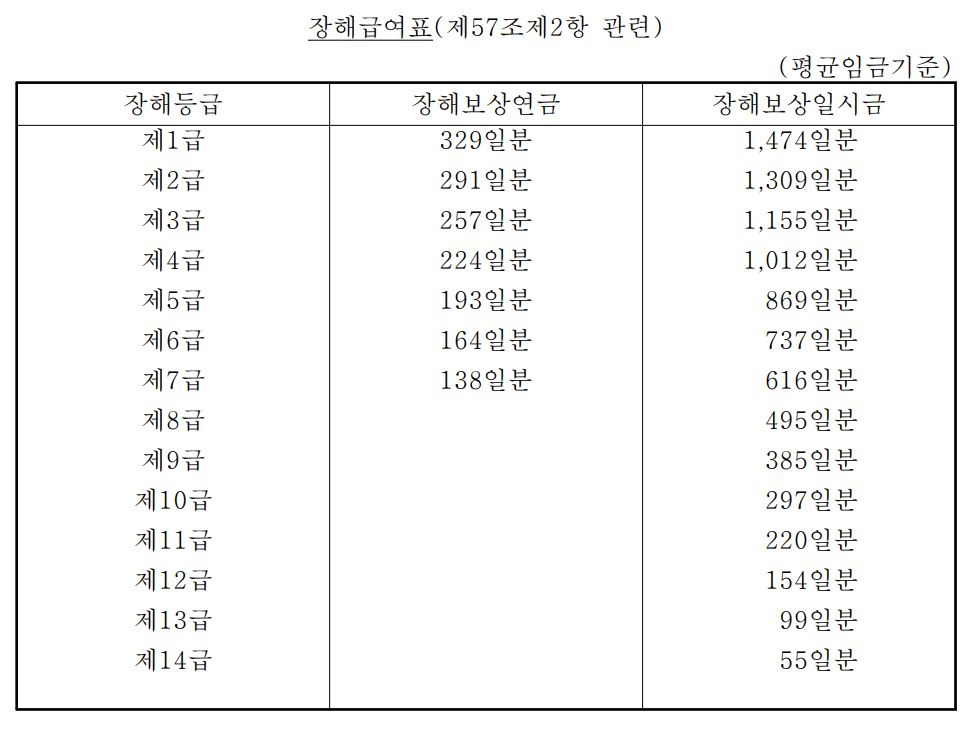
Accordingly, where a beneficiary is receiving a disability compensation annuity, it is reasonable to regard the amount of the lump-sum disability compensation benefit to be deducted under the latter sentence of Article 80(2) of the Industrial Accident Insurance Act as the amount equivalent to the lump-sum disability compensation benefit that would have been paid under Article 57(2) of the Industrial Accident Insurance Act (disability benefits shall be a disability compensation annuity or a lump-sum disability compensation benefit in accordance with the disability grade under attached Table 2, and the criteria for the disability grade shall be prescribed by Presidential Decree).
This is so regardless of the annuity period or the amount of annuity paid.(See Supreme Court, Decision of October 4, 2018, 2015 Da 253184, 253191, among others)
The Error in the Precedent Applied
The lower court also set out the legal principles of a precedent concerning the re-determination and change of a disability grade under Article 59 of the Industrial Accident Insurance Act(Supreme Court, Decision of October 4, 2018, 2016 Da 41869) and determined that around September 2020 was the time of the initial disability grade and the decision to pay the disability compensation annuity.
However, that precedent concerns a case in which, among recipients of a disability compensation annuity, the disability condition improved or worsened, so that an already-determined disability grade was re-determined and changed under Article 59 of the Industrial Accident Insurance Act.
Therefore, it is difficult to apply that precedent to this case, in which there is no evidence to establish that any re-determination under the said Act occurred with respect to A.
The Standard for Applying the Average Wage
The time at which A's disability grade was changed to Grade 5 was around July 2019. However, payment of the disability compensation annuity commenced around September 2020.
This was because the annuity was not paid for the period corresponding to the number of payment days of the disability Grade 8 lump-sum disability compensation benefit that the injured worker had already received.
Accordingly, the court held that, had A elected to receive the lump-sum disability compensation benefit, it would be correct to apply the average wage as of around March 2018, the commencement date for the application of the disability grade.
4. Industrial Accident Insurance Act, Daeryun's Strategy
Applying the legal principles set out above, the Supreme Court held that A's disability Grade 5 determination appeared to be a determination based on the time of recovery, around February 2018, and therefore that A's lump-sum disability compensation benefit should be calculated by applying the average wage of March 2018, the commencement date for the application of disability Grade 5.
The distinction between a disability compensation annuity and a lump-sum disability compensation benefit is merely a difference in the method of payment. Except in special cases, the choice between the annuity and the lump sum rests with the beneficiary's intent, so the two are regarded as having the same value as a whole.(See Supreme Court, Decision of July 13, 2001, 2000 Du 6268, and Supreme Court, Decision of June 15, 2007, 2005 Du 7501, among others)
The Labor and Industrial Accident Group of Daeryun Law Firm LLP includes attorneys who have served as advisory counsel to the Korea Workers' Compensation and Welfare Service and who have handled the litigation representation of the Korea Workers' Compensation and Welfare Service on numerous occasions. If you are pursuing legal procedures relating to an industrial accident or an indemnity claim, or are seeking ways to defend against procedures related to an insurance claim, you are welcome to request a consultation with the Labor and Industrial Accident Group.
The attorneys of our firm who handle these matters can review your circumstances and discuss possible responses.