





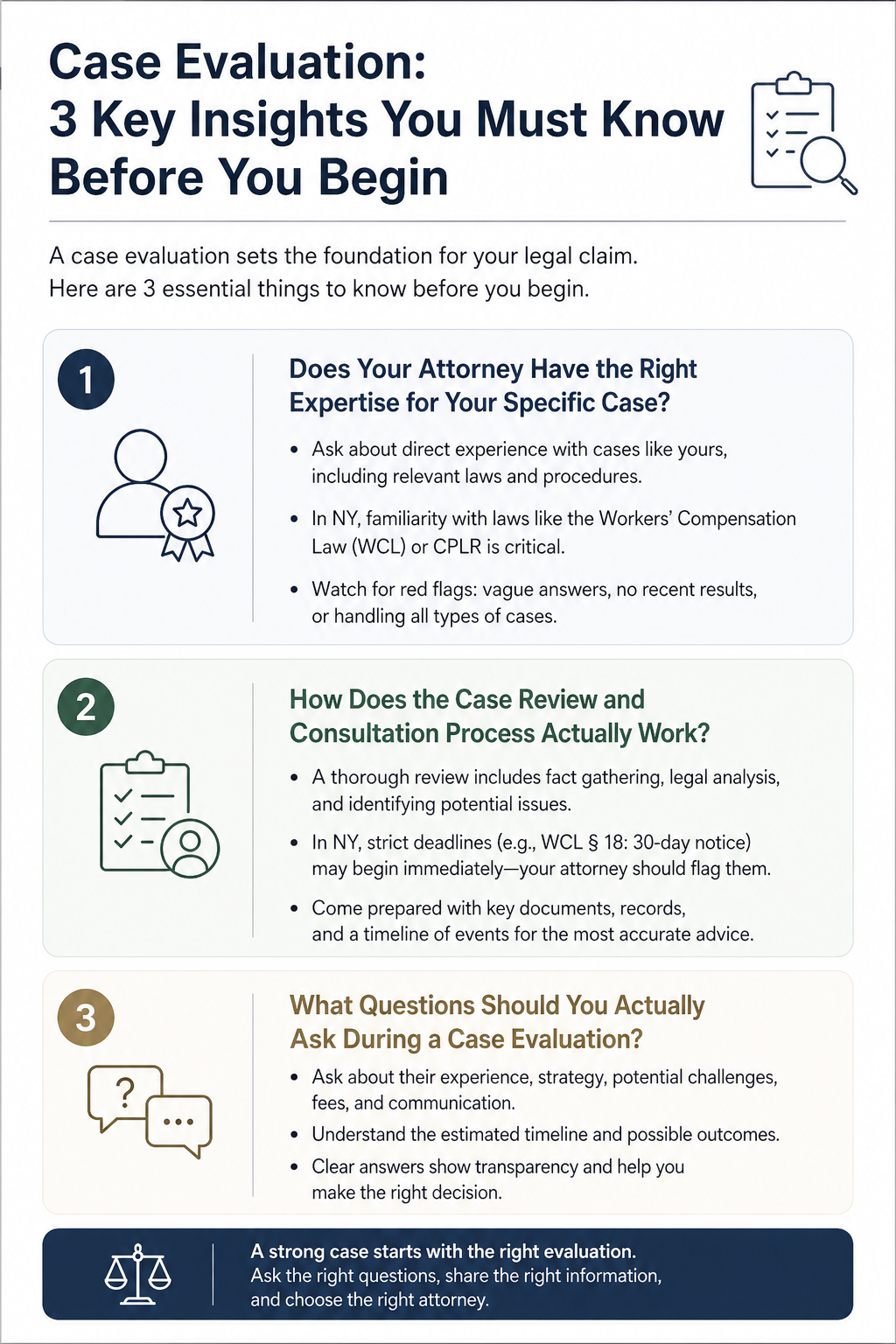
1. Does Your Attorney Have the Right Expertise for Your Specific Case?
When you seek a case evaluation, the single most important factor is not how impressive a law firm's website looks, but whether the attorney in front of you has direct, verifiable experience handling cases like yours. Legal practice areas are highly specialized, and an attorney who excels in contract disputes may lack the nuanced knowledge required for a workplace injury claim or a civil rights matter.
What "Relevant Experience" Actually Means
Relevant experience goes beyond years in practice. During a case evaluation, ask specifically about the attorney's history with cases that mirror your situation in terms of legal theory, jurisdiction, and complexity. For example, if your matter involves a workers' compensation dispute in New York, the attorney should demonstrate familiarity with the New York Workers' Compensation Law (WCL), particularly the procedural requirements under Article 2 (§§ 9–35), which govern how claims are filed, investigated, and adjudicated before the Workers' Compensation Board. An attorney unfamiliar with the Board's hearing procedures or the mandatory reporting obligations under WCL § 18 may expose your claim to unnecessary risk.
Similarly, in civil litigation matters, knowledge of New York's Civil Practice Law and Rules (CPLR) — including statutes of limitations and discovery rules — is indispensable. The case evaluation is precisely the moment to probe this depth of knowledge through direct, targeted questions.
Red Flags That Signal a Mismatch
Be alert during a case evaluation if the attorney speaks only in generalities, avoids discussing specific legal statutes or procedural timelines, or cannot cite recent case outcomes in your area of law. Equally concerning is an attorney who attempts to handle every type of matter regardless of subject matter — a practice that often signals a lack of specialized depth. You are entitled to ask about win rates, settlement outcomes, and trial experience in comparable cases. A qualified attorney will welcome these questions rather than deflect them.
For matters involving civil litigation or personal injury claims, matching the attorney's track record to the nature of your dispute is not optional — it is essential.
2. How Does the Case Review and Consultation Process Actually Work?
Many prospective clients arrive at a case evaluation with little understanding of what the process involves or what to bring. A transparent, well-structured consultation process is itself a strong indicator of a professionally run law firm — and knowing what to expect puts you in a far stronger position to evaluate the attorney fairly.
What Happens during an Initial Case Review
A thorough case evaluation typically unfolds in several structured stages. The attorney will gather background information about your situation — including the timeline of events, the parties involved, and any documentation you have already collected — before conducting a substantive legal review in which the merits of your claim are assessed, applicable legal theories are identified, and potential obstacles are flagged.
An important point that many prospective clients overlook: the attorney-client privilege and the duty of confidentiality attach from the moment you engage in a case evaluation with an attorney, even before any formal retainer agreement is signed. This means that everything you disclose during the consultation is legally protected and cannot be used against you. You should therefore feel confident sharing the full facts of your situation — including details that may appear unfavorable — so that the attorney can provide a genuinely accurate and complete assessment.
In New York, certain procedural requirements begin to run almost immediately after an incident occurs. For instance, under the New York Workers' Compensation Law § 18, an injured worker must provide written notice of injury to the employer within 30 days of the accident. Failure to comply can jeopardize an otherwise valid claim. An experienced attorney will raise these deadlines during the case evaluation itself, not weeks later — and the confidentiality of your disclosure makes it all the more important to share complete information from the outset.
What Documents and Information to Prepare
To make the most of your case evaluation, arrive prepared with a comprehensive account of the incident or dispute, all correspondence related to the matter, any existing contracts or agreements, medical records or incident reports (where applicable), and a written timeline of key events. The more organized and complete your information, the more precise and actionable the attorney's assessment will be.
For litigation consultation or criminal defense consultation, the quality of the information you provide during the case evaluation directly determines the quality of the strategic advice you receive in return. Treat the consultation not as a passive experience, but as a two-way professional exchange.
3. What Questions Should You Actually Ask during a Case Evaluation?
One of the most underutilized tools a prospective client has is the right to ask direct, well-prepared questions during a case evaluation. Many people arrive uncertain about what is appropriate to ask — or feel hesitant to challenge an attorney in that setting. In reality, asking pointed questions is not only appropriate but is the single most reliable way to assess whether an attorney is genuinely suited to represent you. The five questions below are among the most consequential you can raise.
Q1. "What Is Your Honest Assessment of the Strength of My Case and What Are Its Weakest Points?"
Why this question matters: Most attorneys will highlight the favorable aspects of your claim. The more revealing answer, however, is what they say about its vulnerabilities. An attorney who provides only reassurance without addressing risk is not giving you a complete picture.
What a strong answer looks like: A qualified attorney will identify both the legal strengths of your claim and the specific obstacles that could complicate it — whether those involve evidentiary gaps, procedural deadlines already at risk, or unfavorable precedent in your jurisdiction. Under the New York Rules of Professional Conduct, Rule 7.1, attorneys are expressly prohibited from making false or misleading statements about anticipated results. If the attorney guarantees an outcome without qualification, that itself is a red flag worth noting.
Q2. "What Is the Realistic Timeline for My Case, from Filing through Resolution?"
Why this question matters: Legal proceedings in New York vary significantly in duration depending on the venue and the nature of the claim. A case before the Workers' Compensation Board follows a different procedural calendar than a civil action in the New York State Supreme Court, and a criminal matter operates on an entirely separate track. Misunderstanding the timeline can affect financial planning, employment decisions, and personal well-being.
What a strong answer looks like: The attorney should be able to walk you through the expected procedural stages specific to your case — including filing deadlines, hearing schedules, and likely resolution pathways — rather than offering a vague estimate. For civil law consultation or wrongful termination consultation, timeline clarity at the case evaluation stage allows you to make genuinely informed decisions about pursuing litigation versus settlement.
Q3. "How Are Your Fees Structured, and What Additional Costs Might Arise during the Case?"
Why this question matters: Fee arrangements vary widely across practice areas and firms. In personal injury and workers' compensation matters, contingency arrangements are standard — meaning the attorney is paid only upon a successful outcome — but the specific percentage and the scope of reimbursable costs differ. In other matters, hourly billing or flat-fee structures may apply. Surprises in billing are among the most common sources of client dissatisfaction after representation begins.
What a strong answer looks like: A transparent attorney will explain the fee structure clearly, specify what expenses (filing fees, expert witness costs, deposition transcripts) are charged separately, and confirm these terms in a written retainer agreement. For criminal case mediation or other specialized proceedings, fee arrangements can be more complex, and understanding them fully during the case evaluation prevents misalignment later.
4. Your Case Evaluation Is a Decision Point — Treat It That Way
The final and perhaps most important insight is this: a case evaluation is not a commitment, and it is not a formality. It is an informed decision point, and you are entitled to walk away without obligation if the attorney is not the right fit. The legal outcome of your matter may rest significantly on the quality of representation you choose, and that choice begins in the evaluation room.
A Summary of What to Take Away
After a well-conducted case evaluation, you should leave with clear answers to the following: the attorney's candid assessment of your claim's strengths and weaknesses, a realistic outline of the procedural path ahead, an understanding of how fees and costs are structured, and a clear sense of who will represent you and how communication will be managed throughout the process.
New York's legal landscape is procedurally demanding. Statutes such as the Workers' Compensation Law Chapter 67 and the New York Penal Law (for criminal matters) impose strict timelines and filing requirements that begin running from the date of the incident — not the date you retain counsel. A qualified attorney will flag these requirements during the case evaluation itself, not after the window has closed.
A case evaluation conducted with the right preparation and the right questions is one of the most powerful tools available to anyone navigating the legal system. Use it well. For matters involving administrative cases, employment litigation, or awarding damages in civil cases, the insights gained in a thorough case evaluation can set the entire course of your legal journey.
30 Apr, 2026
