Press Coverage

Numerous media outlets recognize the expertise of Daeryun Law LLC.
Explore interviews, legal commentary, and columns by Daeryun lawyers.

Gyeonggi Ilbo
2026-01-02
[기고] 소니 판례로 본 쿠팡 소송, 심판대 오른 '데이터 보안 거버넌스'
[Contribution] Coupang lawsuit seen in Sony precedent, ‘data security governance’ up for judgment
In 2014, the federal court in the Southern District of California made a historic ruling in the history of data leak lawsuits in the 'Sony Gaming Networks Data Security Breach Litigation (In re Sony Gaming Networks)'. This is because the court at the time clearly ruled which legal claims would survive and which would be dismissed, and presented a 'basic textbook' for future similar lawsuits to refer to. In the ongoing Coupang, Inc. class action lawsuit, it is expected that a more detailed and sophisticated legal battle will unfold based on this precedent. The most critical difference between the Sony and Coupang cases lies in the framing that defines the cases. The Sony incident arose from a situation in which the PlayStation Network (PSN) was hacked in 2011, causing the information of about 77 million users to be leaked and service to be interrupted. At the time, the lawsuit was all focused on ‘data leak’. The main concern was whether there was an external intrusion itself and whether Sony implemented technically reasonable security measures. On the other hand, the Coupang incident essentially has 'governance failure' as its core issue. Beyond the technical negligence of failing to prevent external attacks, it deals with the overall failure of the global operating system and security management structure centered on US corporations. The level of litigation has expanded to the area of ​​management responsibility, which examines who was responsible for making security decisions and whether there was structural neglect. In the U.S. federal court, the first hurdle in a personal information leak case is whether standing as a plaintiff is recognized under the Constitution. In the previous Sony case, the court focused on the objective fact that personal information was violated and opened the door to plaintiff eligibility widely, but applied very strict standards at the stage of determining liability for compensation. It was believed that the abstract risk of instability due to information leakage alone did not meet the requirements for compensation. At the time, the court dismissed a number of claims that lacked provable "realistic damages," such as actual misuse of personal information or attempted fraud, as well as specific cost expenditures and time losses. In other words, the key issue given by Sony's precedent is that the outcome of a personal information case depends not on whether a leak incident occurred, but on how to structure and prove the specific damage caused by it. Therefore, the success or failure of this Coupang lawsuit can also be seen as depending on how realistic damages, such as identity theft management costs or damages caused by leaks such as actual monetary losses, are logically specified. The legal approach also needs to change. At the time of the Sony decision, the court dismissed a large number of pure negligence (Negligence) claims on the grounds that “in principle, economic damages are the domain of contract law.” On the other hand, many claims based on the California Consumer Protection Act (UCL, FAL, CLRA) were acknowledged. This is because the Consumer Protection Act focuses on the presence of deceptive practices by companies. The court judged based on what statements the company made about its security level, whether those statements conflicted with the security status or risk perception recognized within the company at the time, and whether consumers were reasonably misled as a result. This trend is expected to remain effective in the Coupang lawsuit as well. The key issue will be whether the company deceived consumers by failing to keep its promises of 'industry standard encryption' or 'reasonable security', rather than liability for negligence, which has a low probability of winning. In other words, linking consumer deception and failure of security governance can be seen as the core link of this lawsuit. What should be noted above all is the qualitative expansion of Discovery. If the discovery of the past Sony incident was limited to confirming the adequacy of technical security measures, the scope of the Coupang incident should be expanded to include the board of directors and management. This is because we need to go beyond simply ‘whether a security system was in place’ and investigate ‘who left the vulnerable system unattended and under what organizational structure?’ A close understanding of the executive reporting line, security budget allocation, and decision-making structure at the U.S. headquarters will be the key to this lawsuit. In the end, the Coupang lawsuit is expected to not only follow the textbook precedent of the Sony case, but will use this as a stepping stone to develop into an advanced legal struggle to hold the global company's headquarters responsible. This lawsuit, which seeks responsibility for governance beyond technical negligence, will become a new judicial standard that redefines the scope of data security responsibility of global companies in the future. ● Contributions by external writers may differ from the editorial direction of this magazine. Reporter Kim Dong-sik kds77@kyeonggi.com[View full article] [Contribution] Coupang lawsuit based on Sony’s precedent, ‘data security governance’ up for judgment (Go here)
international newspaper
2025-12-31
방송사 음악감독 사칭, 17억 원 편취한 혐의 30대 여성 징역 4년 선고
A woman in her 30s was sentenced to four years in prison for impersonating a music director at a broadcasting company and embezzling 1.7 billion won.
The court sentenced a woman who swindled about 1.7 billion won from people around her by telling her that she was a music director at a broadcasting company by tricking her acquaintances into buying them at a low price through sponsorship for two years. The 11th Criminal Division of the Cheongju District Court sentenced A, a woman in her 30s, to four years in prison last November. Ms. A had 16 people, including her acquaintance B, work on OSTs for famous dramas for two years from 2023. He introduced himself as a participating music director and was accused of embezzling approximately 1.7 billion won over 381 occasions. In this process, Mr. A deceived the victims by receiving sponsorship from a broadcasting company and offering to buy goods for them at a low price. When he was investigated, Mr. A reportedly told the victims, “I will not pay back money to the person who sued me.” Accordingly, Mr. B petitioned for severe punishment, claiming that Mr. A had even induced infighting among the victims. The court sentenced Mr. A to four years in prison. The court stated the reason for sentencing, saying, “Considering the nature and method of the crime committed by the defendant, the number of victims, the number and period of the crime, and the scale of the defrauding, the guilt is very serious,” and “He was not forgiven by many victims except for some victims.” Attorney Lee In-jun of Daeryun Law Firm, who represented Mr. “We emphasized that Mr. A had an intention to deceive from the beginning, based on the fact that he has never worked at a broadcasting station and that the broadcasting station does not sell separate sponsorships,” he said. Digital News Reporter[View full article] Woman in her 30s sentenced to 4 years in prison on charges of embezzling 1.7 billion won by impersonating a music director at a broadcasting company (link)
2 places including KBC Gwangju Broadcasting
2025-12-31
"부동산 투자로 수익 내줄게" 동료들 상대로 사기 친 40대 징역 17년
Man in his 40s sentenced to 17 years in prison for defrauding colleagues by saying, “I will make a profit through real estate investment”
Mr. A, embezzling investment funds from colleagues... Damage amount to at least KRW 10 billion Court says, "The scale of the crime is very large and intelligent...severe punishment is inevitable" A person in his 40s who committed fraud against his long-time co-workers and stole over 10 billion won was sentenced to severe punishment. On the 14th of last month, the 12th Criminal Division of the Daejeon District Court sentenced A, a woman in her 40s, to 17 years in prison, who was indicted on charges of fraud, forgery of private documents, and use of forged documents under the Aggravated Punishment Act for Specific Economic Crimes. He is accused of stealing investment funds from dozens of company colleagues, including Mr. B, saying, "I will make profits through real estate auctions," for about five years since 2019. The amount that Mr. A swindled from victims is known to be approximately 10 billion won. In addition, Mr. A used documents containing personal information such as his colleagues' ID cards, power of attorney, and employment certificates to open mobile phones in other people's names and write false real estate rental contracts. It was confirmed that he had even received a lease loan. In the process, Mr. A even recruited manpower to act as a fake lessor and lessee when signing a contract and committed the crime systematically. The court sentenced Mr. A to 17 years in prison. The court said, "Many victims whose names were stolen are suffering from serious pain, such as debt demands from financial institutions, etc. due to loans made without their knowledge," and "Due to the defendant's crime, there was a breakdown in loan contracts between many victims and financial institutions. He pointed out that "legal disputes over validity and invalidity are continuing." The court then pointed out, "The scale of the crime was very large, and the method of the crime was not only very bold and intelligent, but the nature of the crime was very bad in that it was committed by creating a new method that had been difficult to access until now." He added, "Considering the defendant's self-reliance, we took into consideration the fact that the possibility of recovery from damage does not seem to be high." Byun Gwan-hoon, a law firm representing the victim B, Daeryun The lawyer explained, "Mr. A's crime has greatly disrupted the financial order, and caused great social and economic damage, with victims embroiled in various legal disputes. He emphasized that there is a high possibility of criticism, especially since he exploited the goodwill of his co-workers to continue his crime." #real estate investment #fraud in his 40s #misconception of 10 billion won #accident Park Seok-ho (haitai2000@ikbc.co.kr)[View full article] KBC Gwangju Broadcasting - 40-year-old sentenced to 17 years in prison for defrauding colleagues by saying, "I will make a profit through real estate investment" (Shortcut) Kukje Newspaper - “We will make a profit through real estate investment”... 40-year-old sentenced to 17 years in prison for fraud against coworkers (link)
Financial News
2025-12-31
일상 파괴하는 도박죄...가정 파탄과 사기 피해 막으려면
Gambling is a crime that destroys everyday life... To prevent family breakdown and fraud
A man in his 20s who lost tens of millions of won in gambling after being discharged from the military and borrowed money from acquaintances and did not pay back was recently shackled on charges of fraud. Surprisingly, it was his parents who stopped him. The parents, unable to watch their son struggling in the swamp of gambling, directly requested police arrest and investigation. Adding to the shock was the fact that the suspect was said to have been gambling on his smartphone at the moment of his arrest. Gambling addiction has gone beyond an individual's deviance and is becoming a serious social problem. According to data submitted by the Gambling Industry Integrated Supervision Committee to the office of Representative Min Hyeong-bae on the 31st, the number of gambling addicted patients increased by 127% in five years from 1,491 in 2019 to 3,391 in 2024. This year, in just August, the number of patients has already surpassed last year's total. Gambling can lead to the destruction of a person's life and family, as well as criminal punishment. In relation to this, attorney Cho Ik-cheon of Daeryun Law Firm said, "Gambling is difficult to quit through one's own will alone, and in most cases, it leads to additional crimes such as fraud or theft to raise funds." He added, "Even for first-time offenders, it is difficult to avoid imprisonment if habituality is recognized or the scale of gambling is large, so it is difficult to avoid imprisonment, so it is difficult to avoid a prison sentence from the beginning of the investigation along with professional response. "That's important," he said. The following is a Q&A with Attorney Cho. -How is the level of punishment different between simple gambling and habitual gambling? ▲According to Article 246 of the Criminal Act, a person who gambles with money is subject to a fine of up to 10 million won. However, exceptions are made when it is only temporary entertainment. However, if ‘recidivism’ is recognized, the punishment becomes much more severe. Habitual gambling can be punished by imprisonment for up to 3 years or a fine of up to 20 million won. - How is habituality judged? ▲ Habituality is determined by comprehensively considering the number, period, scale, and criminal history of gambling. If you make a living through gambling without a job, or if you bet a large amount of money over a short period of time, you are likely to be considered a habitual gambler. Recently, cyber gambling such as illegal sports Toto has become prevalent, and this is a violation of the National Sports Promotion Act and is subject to stronger punishment, such as imprisonment for up to 5 years or a fine of up to 50 million won. -Why is borrowing money to finance gambling, as in this case, considered a fraud? If you deceived and borrowed money even though you did not have the ability or intention to repay at the time of borrowing, it is a fraud. In particular, lying about the intended use is the core of deception. In the case above, it is clear that the victim would not have lent the money if he had known that it would be used for gambling, so this is a crime of fraud that defrauded the victim and stole his property. Fraud is punishable by imprisonment for up to 10 years or a fine of up to 20 million won, and can be punished aggravatedly as a concurrent crime with gambling. - Can you avoid punishment if you gambled on a site with an overseas server? ▲It is impossible. Korean criminal law follows the secularism principle, so even if a Korean gambles using an overseas server, he or she will be punished under domestic law. Recently, investigative agencies are using advanced investigative techniques such as account tracking, IP tracking, and digital forensics to track and arrest not only operators but also simple users. - When a family member is addicted to gambling, what is the most helpful way to respond? ▲Gambling addiction is both a disease and a crime. In many cases, it is difficult to resolve the issue by persuading family members or paying off the debt on their behalf. Rather, once the debt is paid off, the person returns to gambling, repeating the vicious cycle. In addition, the most important thing when involved in a related crime is to objectively prove the ‘will to prevent recidivism’. A statement of reflection that simply says “I will never do it again” is ineffective. It is helpful to receive counseling from a specialized organization, such as the Korea Gambling Problem Prevention and Treatment Center, and submit sentencing materials containing a certificate confirming that you are faithfully participating in the treatment program and a detailed supervision plan for your family. Reporter Kwon Byeong-seok (bsk730@fnnews.com)[View full article] Gambling crime that destroys daily life...To prevent family breakdown and fraud (Go here)
Pharmacy Newspaper
2025-12-31
[기고] 2025년 제약바이오 분야 주요 판례, 개정 법률 정리
[Contribution] Summary of major precedents and revised laws in the biopharmaceutical field in 2025
Attorney Daeryun Lee Il-hyung "Confronting a rapidly changing regulatory environment,When a quick response is required" 2025Changes in major precedents and laws that shook the pharmaceutical and bio industry throughout the year are summarized in detail through four key tables of contents.. 1. institutional change – Enforcement of the Digital Medical Products Act 2025Fully implemented in ‘Digital Medical Products Act’Breaks away from the existing hardware-centered medical device law system, It has great legislative significance in that it is the world's first independent bill that reflects the unique characteristics of digital technology.. In practice, AimMed's 'Soames(Somzz)'Digital therapeutics such as(DTx), Despite the emergence of innovative products such as Lunit's diagnostic assistance software,, We have experienced a lot of confusion due to being bound by outdated medical device law regulations.. This legislation is evaluated as a result of resolving these difficulties in the field and proactively reflecting the trend of the times called digital transformation.. This law provides for digital medical devices., Digital convergence medicine, Clarify the classification system with digital medical health support devices, Regulations were rationalized to suit the characteristics of digital products.. What is especially noteworthy is the flexibility of the licensing and follow-up management system.. Establishment of new component performance evaluation regulations, Regulations have been relaxed to allow products to be provided to medical professionals for performance evaluation in actual clinical settings., GMP The screening process has also been adapted to the digital environment.. This provides companies with the opportunity to create new data-based business models beyond simple regulatory compliance., It will become a key foundation that determines the global competitiveness of countries and companies in the digital medical field.. 2. patent field – 13Pneumococcal vaccine ruling 2025Important precedents in the pharmaceutical and bio patent field include Pfizer and SKbetween biosciences '13A. Pneumococcal vaccine(Prevenar13) Concentrate export'There is a Supreme Court ruling regarding. of patent law ‘Principle of completeness of components’In principle, if only parts are exported, there is no infringement on the finished product patent.. However, the Supreme Court 2019Year Ensign ‘suture ruling’Even if only parts are exported, finished products are produced through∙If the finished product can be viewed as virtually identical to the exported product, ‘Direct infringement’He said he could admit it., After Pfizer-SKBioscience incident 1The trial court invoked the above legal principles and ruled that the plaintiff(Pfizer) acknowledged the party's claim of direct infringement.. however 2planted 1Overturned the trial ruling and sided with the defendant.. This Supreme Court ruling 2Reaffirming the validity of the trial decision, It is significant in that it presents clear guidelines on whether this can be considered an infringement of domestic patent rights when parts or raw materials of a patented invention produced domestically are exported overseas and turned into a finished product.. To be specific,, In the target decision, the Supreme Court SKBioscience denied both direct and indirect infringement in its act of supplying raw vaccine solution to a Russian pharmaceutical company for research purposes.. The court ruled that the mixing process to produce the finished vaccine product, pH, On the basis that it is a complex process that must meet difficult conditions such as temperature,, concentrate(part) The technical effect of the patented invention can be realized through supply alone. 'production'It was decided that it could not be seen as. especially "According to the principle of territoriality, the production of a patented product means completion within the country., Export of semi-finished products scheduled for assembly overseas is not subject to patent rights."made it clear that. The export is for clinical trials and analysis. 'Conducted for research or testing'By acknowledging that this is an exception that limits the effectiveness of the patent right., It has resolved many of the legal risks that domestic bio companies may have in the process of global research cooperation and technology export.. 3. Human resources and labor – A meaningful ruling that reflects the special nature of the biopharmaceutical production site in a case of irregularities in the dispatch relationship of night-cleaning workers at a bio factory. 2025attracted the attention of the industry in. global bio CMO In a lawsuit to confirm the worker dispatch relationship brought by workers of a partner company who performed night cleaning work in the company's clean room, the court ruled against the plaintiff.. The point of the trial is GMP Standard work instructions provided by the contractor for compliance(SOP)The question was whether it corresponded to actual work commands and orders.. Considering the special characteristics of the pharmaceutical and bio industry, the court, To maintain the cleanliness of the bio process SOPare only essential guidelines for safety and quality., It was judged that it could not be viewed as a specific instruction on how to perform work.. He also denied illegal dispatch, acknowledging that cleaning work is an independent specialized area separate from the main body production process.. This case provided legal justification for designing a contract structure based on business expertise and special features of facility management for bio companies that need to manage the risk of outsourcing production lines.. 4. Compliance field – CSO Establishment of reporting system and strengthening of rebate punishment for sales promotion business operators(CSO) reporting system 2025Over the course of the year, transparency in the pharmaceutical distribution order was improved as it fully settled into the market.. especially CSOAs expenditure reports providing economic benefits prepared by, Health authorities are expected to regularly conduct data-based investigations using this in the future.. Now, pharmaceutical companies go beyond simply outsourcing sales., Trustee signature CSOWe are now responsible for monitoring and providing education on compliance with laws and regulations in real time.. The regulatory network to block illegal rebate structures at the source is becoming tighter than ever.. Accordingly, in the future pharmaceutical and bio industry, compliance is expected to go beyond the scope of the legal team and become a key element of management directly related to the survival of the company.. 5. sintering 2025I think this year will be remembered as a year with more changes than ever before.. In the face of a rapidly changing regulatory environment, This is a time when the pharmaceutical and bio industry also needs a quick response.. [View full article] [Contribution] Summary of major precedents and revised laws in the biopharmaceutical field in 2025
Money Today
2025-12-31
'규제에서 문화로'…게임법 개정안, 기업이 챙겨야 할 리스크 관리
‘From regulations to culture’… Amendment to the Gaming Act, risk management that companies must take care of
The industry's expectations for changes in the gaming industry law are rising with the overall revision of the Game Industry Promotion Act (hereinafter referred to as the Game Act Amendment). In the past, when the law was enacted in 2006, games were viewed as objects of ‘regulation and management,’ but this amendment recognized games as creative works and shifted the paradigm to ‘culture and promotion.’ However, paradoxically, the transition period when the system changes rapidly is also the most dangerous time for companies. If you look at the details, conflicts with other existing laws or ambiguity in interpretation still remain as legal gaps or risks. The first thing to watch out for is the conflict between the expansion of autonomous classification and the Youth Protection Act. The revised bill seeks to expand the scope of private autonomous rating classification to include games not available to youth, but Article 7 of the current Youth Protection Act (Review and Decision on Media Harmful to Youth) grants the authority to review media harmful to youth to a national agency (Youth Protection Committee). Even if a company starts a service through its own rating classification in accordance with the revised Game Act, if it violates the Youth Protection Act or is judged to be ineligible for a rating, it may fall into the trap of double regulation in which the responsibility lies solely with the company. Changes in the standards for judging gambling should also be kept in mind. While the existing gaming law regulated all games in an integrated manner, the revised bill divided the regulatory system into 'digital games' and 'specific location-type (arcade) games'. The intention is to strictly manage arcade games with high risk of gambling, while relatively easing digital games. The problem arises here. Even if it is a digital game, there is a separate definition for games that simulate gambling activities such as Go-Stop and Poker. Even if it is a general RPG or casual game, there is still a risk that it will be classified as a regulated 'game imitating gambling' if the probability item presentation or mini-game method is judged to be simulating gambling. The deletion of the 'prohibition of providing prizes' clause that applied to digital games is also an opportunity and a trap. The amendment allows the provision of prizes only for digital games, enabling various business models. However, the key is convertibility (possibility of converting into cash). This is because the moment the given prize is traded for cash through an item trading site, etc., it can be considered gambling. In such uncertainty, companies must not only thoroughly prevent legal disputes, but also establish a detailed defense strategy that can prove that there was no intent or fault. First, in order to resolve the risk of autonomous rating classification, a self-rating deliberation committee must be established within the company and the discussion process must be kept in detailed meeting minutes. This proves that the company has faithfully fulfilled its duty of care based on the content of a thorough review in accordance with the standards of the Game Management Committee. Additionally, in order to prepare for speculative issues, a probability verification report must be prepared from the planning stage and managed in conjunction with the server log. In particular, before launching, it is a good idea to obtain a legal opinion regarding the BM (profit model) structure from an external law firm or professional organization stating that the system does not constitute a gambling simulation game. This serves as a strong shield for the company to defend in the future that it was not aware of the illegality. Lastly, in order to prevent the risk of exchanging prize money, it is not enough to simply include a prohibition clause in the terms and conditions. A technical lock-in device must be put in place, such as attaching items given as prizes to an account to block transactions at source or restricting the use of items. In addition, if you constantly monitor item brokerage sites and regularly produce operational action reports that sanction accounts that attempt to exchange currency, you can avoid charges of aiding and abetting gambling that may arise in the future. It is welcome that the law recognizes changes in the industry and eases regulations. However, lowering the regulatory barrier also means that the area for which companies are responsible has expanded. Preparing objective data and documented evidence to support an aggressive strategy for business expansion. This will be the surest survival strategy for the gaming industry facing a regulatory transition. Small and Medium Business Team[View full article] ‘From regulations to culture’… Gaming Act Amendment Bill, Risk Management that Companies Must Take Care of (Shortcut)
5 places including EToday
2025-12-30
쿠팡 5만 원 보상안, 미국에서 통할까?
Will Coupang’s 50,000 won compensation plan work in the United States?
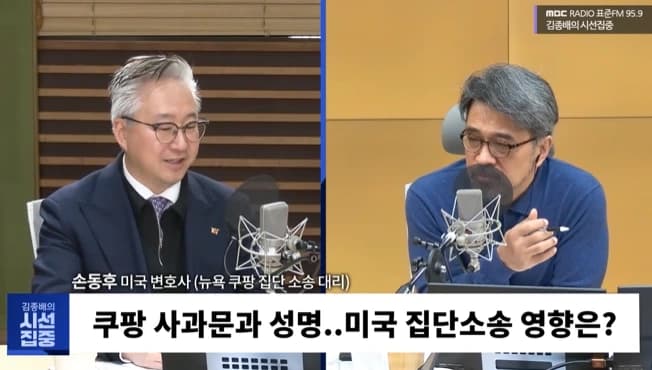
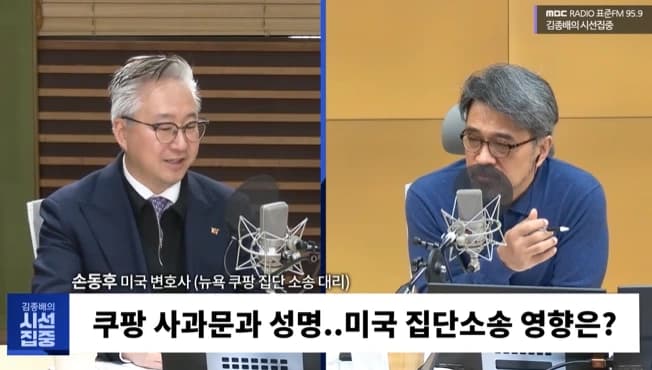
While Coupang Chairman Kim Beom-seok announced an apology and a so-called “compensation plan” a day before the hearing, U.S. attorney Son Dong-hoo, who is representing the U.S. class action lawsuit, said that the measure will be handled separately from the determination of legal responsibility. Attorney Son said on ‘Kim Jong-bae’s Focus’ on the 30th, “It is said to be 50,000 won compensation, but from a practical perspective, this part appears to be in response to crisis management and to prevent customer defections, so it is difficult to see it as providing any kind of compensation in legal terms.” Currently, the U.S. class action lawsuit against Coupang is scheduled to proceed in federal court. Attorney Son explained, “From the perspective of the U.S. federal court, these measures will not be viewed as compensation or closure of recovery for damages, but will be viewed separately from the determination of legal responsibility,” and “We will not judge that a reduction is given because the person committed an act for which he or she is responsible.” Regarding Chairman Kim Beom-seok's apology and Coupang's statement, the difference between the Korean and English versions was pointed out. Attorney Son said, “The Korean version appears to be aimed at the public and the National Assembly hearings, and the English version is aimed at American investors and American courts.” He added, “In the English version, the subjects were limited to ‘Coupang Korea’ and ‘Korean People.’” He continued, “We believe it was a statement made to appeal as much as possible to the court that this matter had nothing to do with the parent company, Coupang Inc.” Regarding Coupang's stock price rising more than 6% on the New York stock market, he said, "It can be seen as a big upward trend in the short term, but it is difficult to say that the problem has been resolved." He added, "The stock market largely responds to the reduction of company uncertainty." However, he added, “The volatility of the stock price may be significant depending on the progress of the court trial.” Coupang expressed concern about the mention of ‘government instructions’ in its statement. Attorney Son said, “It is a very dangerous strategy to use the word ‘government’ without specifying what kind of government or ministry it is,” and added, “This kind of reaction does not enter into the court’s judgment, but it can increase anxiety in the investment market and Korean victims.” A line was drawn regarding the possibility that public opinion in the United States could influence the lawsuit. He said, “Coupang is adopting a strategy that defines itself as a small and medium-sized business in the United States and requires protection and development,” and added, “I have no concerns that public opinion will change to the extent that it will affect the trial.” He continued, “In the United States, Coupang has been described as a ‘small and middle business’ in lobbying reports and public announcements.” Regarding Chairman Kim Beom-seok's non-attendance at the hearing, he said, "I understand that sufficient legal judgment was made." Also, regarding the impact of the hearing and the results of the government investigation on the U.S. lawsuit, he emphasized that “the fixity of the statement is more important than influencing the judgment,” and that “a statement made at a hearing becomes an official statement that is difficult to overturn in a later court.” Regarding the status of the U.S. class action lawsuit, he said, “The complaint has been prepared, and the process is ongoing due to the issue of representative plaintiff eligibility,” and “Plaintiff participation can continue even after submission of the complaint.” Regarding the current number of plaintiffs, he said, “It appears that there are more than a few thousand in the United States alone.” Attorney Son added, “As it is a federal court lawsuit, it may take a long time,” and “Due to the nature of class action lawsuits, it takes time to select a date and the discovery process.”[View full article] EToday - Will Coupang’s 50,000 won compensation plan work in the United States? (Shortcut) YTN - Coupang actually says something different from the US... "They say it's a small business that needs to be protected" (Shortcut) Hankook Ilbo - Coupang's U.S. litigation lawyer says, "Coupang's compensation plan will not be viewed by U.S. courts as compensation or settlement" (Go to link) Hankook Ilbo - Coupang looks more at the U.S. stock market than Korean customers... Controversial “3,000 leaks” announced in the U.S. (Click here) Rotalk News - Coupang, Korea Line's "Global Leader"... “Small and medium-sized businesses in need of protection” in the US? (Shortcut)
MBC
2025-12-30
[시선집중] 美 변호사 "쿠팡, ‘정부 지시’ 언급하며 한미 갈등 프레임 동원…‘위험한 전략’ 美 소송 영향 없다"
[Focus] U.S. lawyer, “Coupang mentions ‘government instructions’ and mobilizes conflict frame between Korea and the U.S.… ‘Dangerous strategy’ has no impact on U.S. lawsuit”
<Son Dong-hoo, American attorney (Represented New York Coupang class action lawsuit)>- Compensation plan, For crisis management and customer defection prevention..Not related to reduction of liability in U.S. lawsuit- apology letter, Korean language is the domestic opinion, The English text is aimed at US investors and courts.- ​English name, damage ‘korea’limited to..CoupangInc Intent to reduce responsibility- public opinion war, Coupang will only lose its credibility...Little effect on U.S. court decisions- ​Coupang, In America ‘Small and medium-sized enterprises/fostering target’He spreads the logic of protection, saying,​- Hearing Remarks, It will remain an official statement that cannot be overturned in a U.S. lawsuit. ■ broadcast : MBC radio standardFM 95.9MHz <Kim Jong-bae's attention>(07:05~08:30)■ progress : Kim Jong-bae, current affairs critic■ talk : Son Dong-hoo, American attorney (Represented New York Coupang class action lawsuit)◎ host > Coupang Chairman Kim Beom-seok suddenly issued an apology.. Yesterday, a day before the hearing, ‘Compensation plan’They also put out something called. There is also an interpretation that this is a move to lessen the legal burden in U.S. lawsuits.. We have invited Attorney Son Dong-hoo of Daeryun Law Firm, who is representing us in class action lawsuits in the United States.. Let's talk about it. Welcome.◎ Son Dong-hoo > hello.◎ host > First of all, I think I should ask for your evaluation of this. ‘Compensation plan’This term gets caught, but, I honestly don't know if this should be considered compensation, but anyway. 1per person 5I gave this worth 10,000 won.. How do you rate it??◎ Son Dong-hoo > As someone involved in the trial, it is difficult for me to even evaluate it, but what you said was 5It is said to be compensation of 10,000 won, but from a practical perspective, this part appears to be a part of responding to crisis management to some extent and also a part to prevent customer defection, so it is difficult to see it as any kind of compensation from a legal perspective..◎ host > Then wouldn’t the scope be narrowed and the lawsuit proceed??◎ Son Dong-hoo > yes.◎ host > What impact could this have as the lawsuit progresses?, in the results?◎ Son Dong-hoo > Since I will be litigating in a U.S. federal court, from the perspective of the U.S. court, I will not see this action as any compensation or closure of recovery for damages, but rather will view it separately from the determination of legal responsibility..◎ host > In America?◎ Son Dong-hoo > yes.◎ host > The sentence is reduced because he committed certain responsible acts., For example, I wouldn't make a judgment like this.. in american court?◎ Son Dong-hoo > yes.◎ host > is it so. Isn’t there an apology issued by Chairman Kim Beom-seok?? Then Coupang's statement came out.. So what effect will the content have??◎ Son Dong-hoo > I saw it from both sides too.. I've seen both the Korean and English versions, so I think you can think of it this way.. I think we need to think more about the audience for the statements released by Chairman Kim Beom-seok at Coupang.. The Korean version is for our people., And it appears to have been targeted at a National Assembly hearing.. And in the English version, this part is actually for investors in the United States., And since it is intended for US courts, the US statement is more limited., It's narrowed down.. range.◎ host > The expression is a little different..◎ Son Dong-hoo > yes.◎ host > That's how you read it, Even the lawyer?◎ Son Dong-hoo > Since I had to read it as a lawyer rather than emotionally, I focused on how it would be read in court.. The expression was a little different..◎ host > I'm not sure about the exact wording, but in any case, the English version doesn't contain information about suspicions, measures, etc. that are taking place in Korea. ‘It is based on false facts’ I mean, I wrote it now with this nuance..◎ Son Dong-hoo > Moreover, the subject itself ‘Coupang Korea’ and ‘Korean People’ In this way, we limited the target to Korea.. Actually CoupangIncThe parent company is an American company, and the English version released in the United States is also a statement that was clearly intended to limit the victims to Korea..◎ host > Lawyer, what you said is ‘CoupangIncIt has nothing to do with it.’ Are you saying you emphasized this??◎ Son Dong-hoo > As much as possible in court, I think it was a statement made to appeal as much as possible to the fact that they also recognized that..◎ host > Then, according to American legal principles, is there any room for that to work??◎ Son Dong-hoo > At what point did they become aware of it?, I knew to some extent, How much damage, Limiting it to Korea is in line with your persuasive legal logic when you make a statement..◎ host > For example, the results of a self-investigation were released, followed by a statement and an apology.. Then, Coupang's stock price rose on the New York Stock Exchange. 6%They say it has risen above the level, but how should this be interpreted?. ate, It was effective, Should I look at it like this??◎ Son Dong-hoo > In the short term, obviously 6%The number is a very large increase, so it can be done, but it does not mean that it worked, but rather that the actual problem itself has been solved. However, the same may be true in Korea, but stock investors and the investment market itself, The stock market considers the uncertainty of CEOs and companies to be the biggest risk factor, so when we see that the company is responding to this to some extent, the stock market itself can react stably to this.. But our price rises according to the progress of the court trial., There is a risk factor that the downtrend can fluctuate sufficiently..◎ host > Perhaps Coupang made an announcement ‘This is according to government instructions’You said. According to the announcement.◎ Son Dong-hoo > yes, yes.◎ host > However, there is a controversy over the authenticity of this in Korea, so I would like to ask you about my interpretation.. If the government is brought into this, this will become a government-to-government issue, opening the way for the U.S. to respond at the government level., Is there any room for interpretation like this?. how do you see it?◎ Son Dong-hoo > That's what I think of as Robert O'Brien, Trump in the past 1The person who was the National Security Advisor during the ‘X’I think it's related to the content I posted.. We did not consider this to be Coupang Korea's mistake in leaking damage to the government, and did not specify which government it was by using the word "government.". It is a very dangerous strategy to write this part in a statement in such a way that it is making an American company participate in an investigation by the government in Korea without saying which department did this..◎ host > a risky strategy? What do you mean by dangerous??◎ Son Dong-hoo > A person who was a high-ranking official in the previous administration ‘X’It was a long but very influential statement.. Such a response will not enter into the legal judgment of the trial at all in court.. Instead, the investment market and Korean victims become more anxious.. Trust in Korean Coupang will be lost even more.. That's why I think it's a risky strategy..◎ host > Remarks by some American media and some influential figures telling people not to mess with Coupang, How should the phenomenon being claimed be interpreted??◎ Son Dong-hoo > ‘Don't mess with Coupang’I don't think I read that part very well.. In this way, as you said, the Korean government's intervention in this specific case by American corporations could have negative consequences for President Trump's efforts to make the relationship between Korea and the United States friendly so far., I confirmed that there were parts that were expressed in a roundabout way like this.. It's very unfortunate that Coupang is causing it this way.. However, I don't think you need to worry about that because it won't have much of an impact on the court's decision..◎ host > is it so. But the picture goes like this.. When an accident occurred, Coupang conducted a sincere investigation following the instructions of the Korean government, and isn't there some measure that will be taken by the Korean government later?. Nevertheless, the Korean government took this action and caused damage to Coupang., Suppress Coupang, If the narrative is structured in this way, isn't there a possibility that it will affect public opinion in the U.S. and that public opinion created in that way may also affect lawsuits in the U.S.?. how do you see it?◎ Son Dong-hoo > Coupang's parent company is located in Delaware, USA, and these are the contents disclosed by these companies. 10-KIf you look at the annual report or lobbying reports submitted to the Senate, Coupang's American company is considered a very small company., It is expressed as a small business and as a small company, it must be protected and fostered.. It's a very different strategy from Korea..◎ host > in the united states?◎ Son Dong-hoo > yes, yes.◎ host > Since it is a small and medium-sized business, it is subject to fostering..◎ Son Dong-hoo > yes.◎ host > We need to protect?◎ Son Dong-hoo > In order to protect the e-commerce platform, I lobby a lot and hire many U.S. citizens, so I am taking a strategy as a corporation to protect it.. It's a different strategy from the very aggressive one in Korea..◎ host > Are you saying that Coupang is pursuing that strategy in the United States??◎ Son Dong-hoo > yes. Therefore, how does American public opinion change regarding Coupang?, Public opinion changes enough to affect the trial., We do not address these concerns..◎ host > Only lobbying money for several years. 150I mean, I spent close to a billion won..◎ Son Dong-hoo > That's why I studied the Senate lobbying report.. Sometimes we do it quarterly, but sometimes we do it once a lot. 100more than ten thousand dollars, 15There were times when it was more than a billion won, but as I said each time, Coupang's business is a small and medium business, and since it is a small and medium-sized business, we need to foster it and foster e-commerce, so please protect it. We will also develop the local economy by doing this., Because we have continued to lobby for this purpose, it is very different from the investment business strategy in Korea..◎ host > The reason Chairman Kim Beom-seok gave for not appearing at the hearing was that Coupang is a global company., Didn’t you put it this way because you have a lot of schedules around the world??◎ Son Dong-hoo > Also, I plan my personal schedule....◎ host > In the U.S., they call themselves a small business, but in Korea, they call themselves a global company. That seems very different, so I asked..◎ Son Dong-hoo > I'm not sure why they keep delaying it like this, but I hope you come..◎ host > Please understand what kind of person Chairman Kim Beom-seok is.?◎ Son Dong-hoo > I'm also in trial, It is inappropriate to directly evaluate the person involved in the lawsuit.. We also have such a governance structure and various statements like this., And looking at the situation so far, he is a person who has invested very aggressively and achieved success in Korea, but I hope that in addition to lobbying at the US headquarters, he will also do a lot of good work and donate a lot in Korea.. I am that part.◎ host > I wish I had donated a lot, not a lot.?◎ Son Dong-hoo > yes, I hope you do a lot in Korea too..◎ host > All right. By the way, is the recruitment of litigants over?, what happens?◎ Son Dong-hoo > no. Litigants participating in U.S. federal courts, We can continue to collect manuscripts even after we submit the complaint..◎ host > Even after submitting the complaint?◎ Son Dong-hoo > You can continue to attend later.. So, unlike Korea, we do not have to continuously attach and submit litigants, so the number is continuing to increase. Please understand that there is a delay due to the fact that we have to appear in federal court to designate a representative plaintiff..◎ host > What is the size of the lawsuits raised so far??◎ Son Dong-hoo > I'm not involved in the Korean Coupang lawsuit, so I don't know much about it because I'm an American lawyer, but it seems like there are more than a thousand people in the U.S. alone..◎ host > thousands or more. So when do you plan to submit the complaint??◎ Son Dong-hoo > ASAP, The intestines are all ready.. As you said, I continued to contact people in the area until early morning today regarding eligibility as a representative plaintiff..◎ host > We had an interview with the CEO once before, and he said he would likely submit it within the year, but if it is within the year, it would be by tomorrow..◎ Son Dong-hoo > okay.◎ host > How is this possible within the year?, Submission of complaint?◎ Son Dong-hoo > We will do our best to make it possible..◎ host > It's civil now.? this.◎ Son Dong-hoo > yes.◎ host > It takes a long time. lawsuit?◎ Son Dong-hoo > The lawsuit itself takes a long time because it is in federal court..◎ host > How much do you expect?, until the results come out?◎ Son Dong-hoo > As I said, plaintiffs can continue to participate even after the complaint is submitted.. Because it is a class action lawsuit, The purpose itself is the same for most of the plaintiffs, but since there are several sporadically, it will take a long time to select the date itself.. Afterwards, the discovery procedure, This is why we do it in the US, but this process takes time..◎ host > All right. The hearing will be held for two days starting today.. It is highly likely that a government investigation will be conducted afterwards.. Looking at the current movements of Korean politics,. Can the results of the hearing or the results of the government investigation serve as reference material for litigation in the United States or have an impact on the court's judgment?, How about?◎ Son Dong-hoo > Rather than influencing judgment, what is important to us is the consistency of the statement., statement, The remarks and attitudes you made at the hearing cannot be overturned in court, rather than being accepted as is..◎ host > It's an official statement..◎ Son Dong-hoo > yes.◎ host > Then, the reason why Chairman Kim Beom-seok did not appear at the hearing may have taken that into account.. Although it is an area of ​​interpretation.◎ Son Dong-hoo > I understand that you have made sufficient legal judgment..◎ host > I guess it's something like that.?◎ Son Dong-hoo > yes.◎ host > There is ample room for interpretation that way.. All right. I think this is where we should listen to what the lawyer says today.. Thank you.◎ Son Dong-hoo > thank you.◎ host > We were joined by attorney Son Dong-hoo of Daeryun Law Firm..[When citing content MBC <Kim Jong-bae's attention>Please indicate that this is an interview with.] [View full article] [Focus] U.S. lawyer says, “Coupang mobilizes conflict frame between Korea and the U.S., mentioning ‘government instructions’… ‘Dangerous strategy’ has no impact on U.S. lawsuit” (Shortcut)
Global Epic
2025-12-30
AVMOV 회원가입만 해도 수사 대상일까…가중처벌 피하려면
Am I subject to investigation just by registering as an AVMOV member? To avoid aggravated punishment
Recently, 'AVMOV', an illegal video sharing site called 'the second Soranet', is causing a big social stir. As the number of registered members reportedly reaches 540,000, investigative agencies also appear to be paying close attention. The police are narrowing down the tracking network by launching a large-scale mandatory investigation, including securing the IP list and payment details of paid members as well as the site operator. After the identity of AVMOV was reported, those who accessed the site or watched the video simply out of curiosity will inevitably suffer from extreme anxiety. You might console yourself by saying, ‘I used a VPN so I’m safe’ or ‘I’m not guilty because I just watched it streaming without downloading it.’ However, the core of this incident lies in the nature of the distributed video. Unlike general adult content, videos filmed or distributed without the consent of the person concerned are subject to the crime of possessing, purchasing, storing, or viewing video footage filmed using a camera, etc., pursuant to Article 14, Paragraph 4 of the Special Act on the Punishment of Sexual Crimes, etc. Simple viewing or possession can result in imprisonment for up to 3 years or a fine of up to 30 million won, so you can face uncontrollable legal liability. Many people protest, saying, "I didn't know it was an illegal video," but since the N Room (Doctor's Room) incident in 2021, the court has relatively broadly recognized the intent of non-filming by considering whether the file title contains words suggesting it is an illegal video, whether payment or remittance was made, and the nature of the category on the site. It's a trend. If torrenting is used in the process, the problem becomes more serious. Due to the nature of torrents, where file fragments are downloaded and uploaded at the same time, the crime of 'distribution' can be applied regardless of the person's intention and can result in aggravated punishment. Therefore, uploaders, downloaders, and continuous viewers need to be prepared to be contacted by investigative agencies and examine the contents more carefully. In the case of large illegal site cases, in most cases, the investigative agency issues a summons notice after already securing a large amount of evidence. At this time, hastily destroying evidence or emotionally denying the charges can lead to irreversible consequences, such as arrest and investigation. In particular, since the level of punishment for sex crimes has been greatly strengthened after the N Room incident, a complacent response is absolutely prohibited. Seung-jin Ahn, a sex crime lawyer at Daeryun Law Firm, said, "Immediately after being contacted by an investigative agency is the only 'golden time' that can change the outcome of the case. Rather than an unconditional denial or confession, the key is to explain the circumstances of the person's access and whether it was intentional with objective evidence." “The response strategy must change, and we must prepare sentencing materials and legal defense logic to prevent unfair punishment,” he advised. Global Epic CP Lee Soo-hwan / lsh@globalepic.co.kr Am I subject to investigation just by registering as an AVMOV member? To avoid aggravated punishment (Shortcut)
Money Today
2025-12-30
"리뷰 1건당 7000원" 맛집인 척 '별 다섯개'...판치는 조작
"7,000 won per review" pretending to be a good restaurant and giving it '5 stars'...it's a manipulation
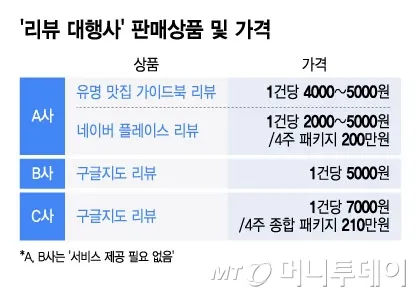
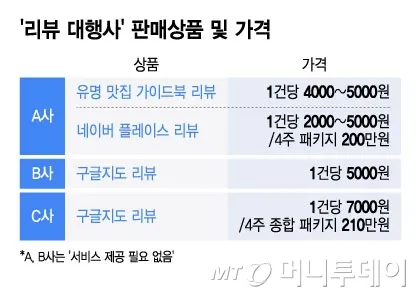
The practice of advertising and marketing agencies registering false reviews of restaurants on platforms such as Naver has not been eradicated. It is pointed out that it not only disables the review function but also reduces consumer trust. Experts warned that there is a high possibility that false reviews could be illegal, such as violating the Labeling and Advertising Act. According to related industries on the 30th, some marketing agencies are selling products that register reviews desired by business owners such as restaurants in exchange for money. They targeted major platforms such as Naver and Google, and in some cases, they sold review products of restaurant guides claiming to be Korea's Michelin Guide. The price was up to 7,000 won per review. It is known that reviewers receive 1,000 to 2,000 won in return. Agency A received 4,000 to 5,000 won per review. The business owner can convey the desired review text to the business within 300 characters. However, the number of review registrations was limited to 1 to 2 per day. This appears to be because they were conscious of the response of the platform company that monitors reviews. An official from agency A said, “Even if you write 10 reviews a day, there are many cases where they are not exposed (by the platform company).” Another agency B also sold a product that paid 5,000 won per Google Maps review. The product description said, "For new companies or industries that need to expand exposure, increasing star ratings and securing reviews is very advantageous in forming initial competitiveness," and "Automatic reflection begins within 5 to 20 minutes on average after ordering." Agencies advertise that they are based on 'actual users', but this does not mean actual products or store users. Agency B also explained that there was no need to prepare actual food. When asked whether food should be provided to the reviewer, an official from Agency B said, "A review is literally just something to make it look pretty," and "If you are not hosting a review event, you don't have to provide (food)." Possibility of violation of the Labeling and Advertising Act... Problem with ‘Poomasi’ There are also quite a few ‘Review Poomasi’ where business owners register reviews as if they were customers. On this day, hundreds of business owners gathered in a group chat room called ‘Reservation Review Marketing Study’ and exchanged reviews. There were also rules, such as having to delete records such as cache after completing the review. Woo Jin-jin, an attorney at Daeryun Law Firm, said, “Listing false advertisements for each company also has the potential to be subsumed by economic interests.” According to the Fair Trade Commission, “false reviews” by some agencies are highly likely to be a violation of the Labeling and Advertising Act. The act of requesting a review between an advertising and marketing agency and a business owner such as a restaurant is not a problem in itself, but the review writer must meet conditions such as △ specifying that financial compensation was received △ and △ actual use of the service. Violation of this constitutes deception or false advertising. There are also cases that have led to punishment. In September of this year, Mr. C, an internet consulting business, was sentenced to a fine of 10 million won by the Seoul Central District Court on charges of interfering with the business of a restaurant advertising and order brokerage platform company. He planned a business to register false reviews by receiving 1,800 won per review from restaurant owners, and paid 1,200 won per review to part-time workers who participated in the project. An official from the Fair Trade Commission said, "If the amount of false reviews is large and malicious, a fine will be imposed. If not, corrective measures such as deleting false reviews will be taken." An obligation to prohibit repetition of false reviews is also imposed. If you violate this, you may be reported to the prosecution and subject to criminal punishment. False reviews can lead to consumer distrust. Baek Gwang-hyeon, a lawyer at Barun Law Firm, said, “Complying with the Labeling and Advertising Act regulations should be viewed as the first step to gaining overall trust in customers and consumers rather than thinking of it as an effort to avoid sanctions or punishment from the Fair Trade Commission,” and added, “It is better to protect the overall brand value through trust rather than increasing short-term sales through manipulation.” Reporter Park Jin-ho (zzino@mt.co.kr)[View full article] "7,000 Won per review" Pretending to be a good restaurant and giving it '5 stars'... a fraudulent manipulation (Click here)
Quick Menu

Chat