


Client Reviews
Requirements for Defamation | Thanks to the Attorney, We Concluded the Case Well
ⓘThe client reviews posted on this page are selected from clients who were satisfied with their case outcomes and consented to publication. New reviews will be added on an ongoing basis.
If you would like to learn more specific details, you may review them during an in-person consultation, within the scope of de-identified personal information.

A Client Who Requested a Consultation on the Requirements for Defamation
The client who requested a consultation on the requirements for defamation was a parent with a middle-school child.
While talking with fellow students at the same school, the client's child came to talk about a student with whom relations had generally not been good.
Afterward, the other student, claiming that their reputation had been damaged as their story spread to other friends, reported the client's child to the police.
The parents, who grew concerned upon learning that their child—suddenly subjected to a police investigation—could even face criminal punishment, requested a consultation with an attorney to respond to the case.
The attorney reviewed the content of the conversation at the time and the scope of its dissemination, and set the direction of the response centered on whether it met the requirements for defamation.
As a Result of Arguing the Requirements for Defamation, a Decision Not to Refer
The attorney focused on the point that, to meet the requirements for defamation, it is not enough merely to have talked about the other person; the specific statement of fact, identifiability, and publicity, among others, must be recognized.
After reviewing the conversations and message content the students exchanged at the time, there were circumstances making it difficult to conclude that the client's child had spread specific facts to multiple people for the purpose of lowering the other party's social evaluation.
Accordingly, the attorney specifically demonstrated, together with relevant materials, the situation in which the conversation took place, whether the other party could be identified, whether the statements actually stated facts, and whether there was a possibility of dissemination to unspecified or multiple persons.
The attorney also emphasized that the client's child had not repeatedly disseminated content to slander a particular student, along with the actual scope in which the conversation took place.
As a result, the investigative authorities judged that it was difficult to view the matter as satisfying the requirements for defamation and issued a decision not to refer the case.
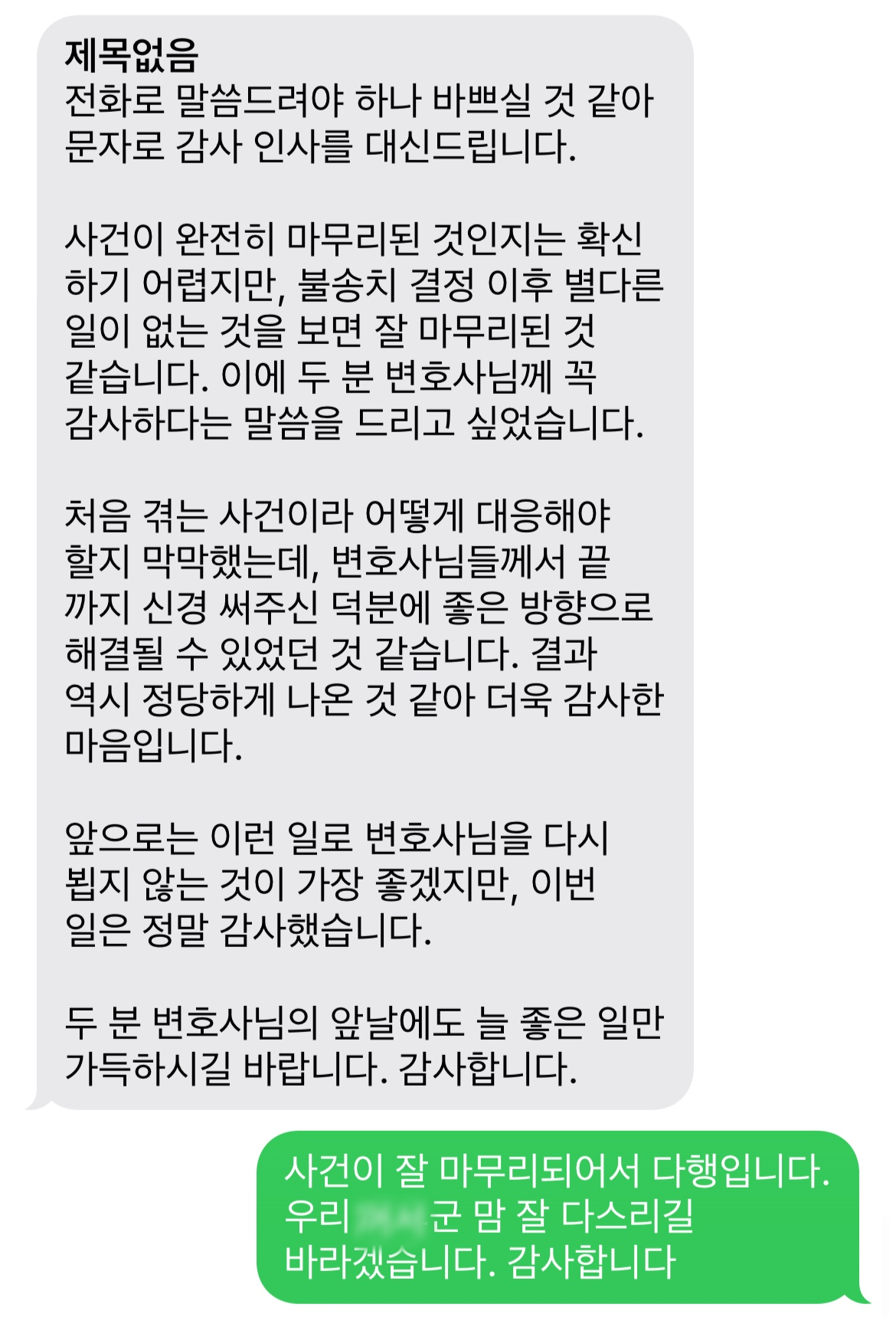
The client, who had felt at a loss as to what to explain and what materials to prepare while their child was caught up in criminal proceedings, expressed gratitude, saying they were able to conclude the case after responding by specifically organizing the circumstances of the case and the content of the statements.
Even in cases that begin with words between students or online messages, once a defamation charge is raised, the judgment may vary depending on the actual content of the statements and the scope of their dissemination.
If you find yourself in a similar situation, we encourage you to review the direction of your response together with Daeryun, Korea's 9th-largest law firm (based on 2025 VAT filings with the National Tax Service).
🔗Learn About the Requirements for Defamation and the Punishment Standards and Response Methods for Stating False Facts
⚠️Advertising using false or fabricated client reviews is subject to strict sanctions and penalties under the Korean Bar Association's regulations.
If you suspect a review is false or fabricated, please verify its authenticity and report it to the relevant authorities. This is an important step in maintaining trust in the legal services market.
Consult in other languages


Popular Columns
View moreThe Meaning of Non-Referral, and Are There Differences Among the Types of Decisions?

Establishment of the Crime of Fraud: Determining the Requirements, Case Analysis, and Sentencing Guidelines
Criminal Record Inquiry and Expungement: How to Avoid Disadvantages
The Police Investigation Process, Methods of Response, and Tips for Giving Statements
Criminal Cases: Litigation Procedure, Types of Dispositions, and How to Respond


Do you have more questions?






In-Person Consultation Booking
If you have legal concerns, consult with a specialist attorney at the nearest office.
