


Deals & Cases
Non-Return of a Jeonse Deposit | Case of Non-Return of a Jeonse Deposit, Full Favorable Judgment for 180 Million Won
This is a case in which a client whose payment of the balance for a move was disrupted by the non-return of a jeonse deposit obtained legal assistance from an attorney specializing in real estate, won the lawsuit, and secured a deposit of 180 million won.
1. Non-Return of a Jeonse Deposit | Background of the Case
The non-return of a jeonse deposit is a serious matter that undermines a tenant's housing stability and causes substantial economic loss.
The client (plaintiff) in this case was the tenant of an apartment who had entered into a lease with the landlord (defendant) for a deposit of 180 million won.
The lease was subsequently renewed implicitly on two occasions under the Housing Lease Protection Act.
As the client came to purchase a new apartment, the client clearly notified the landlord of the intent to terminate the lease through several telephone calls and text messages.
However, after receiving the notice of termination, the landlord gave no response whatsoever regarding the return of the deposit and began deliberately avoiding the client's attempts to make contact.
The client requested help from an attorney specializing in real estate, stating, "The balance payment date for purchasing the new apartment is approaching, but the landlord will not even take my calls, and I am extremely anxious and uneasy that I may not get my deposit back."
2. Non-Return of a Jeonse Deposit | Assistance Provided by the Attorney Specializing in Real Estate
To resolve the non-return of the jeonse deposit, the attorney specializing in real estate determined that it was necessary to bring a claim in advance even before the due date for performance arrived, and established a strategy of filing a "suit for future performance."
Establishing the Need to Claim in Advance
Relying on Supreme Court precedent, the attorney specializing in real estate pointed out that the landlord was evading any response to the request for the return of the deposit and was not taking calls.
In addition, by objectively proving that the landlord had no intent to perform the obligation, for example, by not listing the property as a new rental, the attorney secured the legitimacy of the claim for future performance.
Presenting the Landlord's History of Default
To highlight the risk of non-return of the jeonse deposit, the attorney specializing in real estate examined the certified copies of the registry for other real estate owned by the landlord.
The examination revealed a history in which, at a nearby apartment as well, a tenant's lease registration order had been recorded because the landlord had failed to return the deposit to other tenants.
Through this, the attorney persuasively presented to the court that there was a high likelihood that the defendant would arbitrarily fail to return the deposit in this case as well.
Systematizing the Evidence and Completing the Legal Framework
The attorney specializing in real estate systematically organized the materials around the ‘legality of the notice of termination of the lease’ and the ‘circumstances of the landlord's refusal to return the deposit,’ which are central to a case involving the non-return of a jeonse deposit.
By arranging in sequence the evidence generated during the process of terminating the lease and demanding the return of the deposit, such as text messages, call records, and content-certified mail, and by completing the legal framework in accordance with Article 6-2 of the Housing Lease Protection Act and the requirements for a suit for future performance, the attorney strengthened the persuasiveness of the case.
3. Non-Return of a Jeonse Deposit | Outcome of the Assistance, ‘Full Acceptance of the Claimed Amount of 180 Million Won’
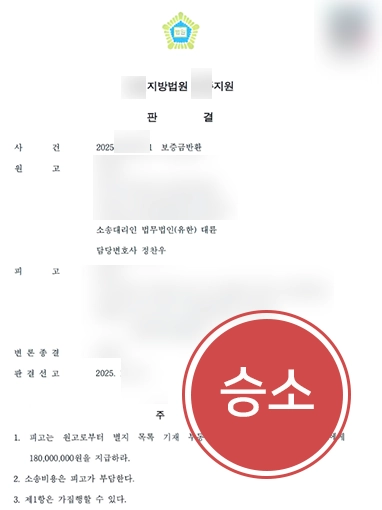
As the outcome of the lawsuit concerning the non-return of the jeonse deposit, the court accepted all of the attorney specializing in real estate's arguments and rendered a judgment in the client's favor.
The grounds for the court's decision were as follows.
-The plaintiff's notice of termination was lawfully delivered, and the termination took effect upon the lapse of three months.
-Because the defendant is avoiding contact and has a past history of failing to return deposits in similar cases, the need to file a suit for future performance is recognized.
-The defendant is obligated to pay the deposit of 180 million won simultaneously with receiving delivery of the real estate from the plaintiff.
-The defendant shall bear all litigation costs, and provisional execution may be carried out.
Immediately after the judgment, the client expressed deep relief, stating, "I was at a loss as to how to deal with a landlord I could not even reach, but thanks to the prompt action of the attorney specializing in real estate, I was able to pay the balance for the move without trouble, and I am truly relieved."
Legal Information on the Non-Return of a Jeonse Deposit
Under the Housing Lease Protection Act, the standards for the right of termination during an implied renewal and for a suit for future performance are as follows.
| Category | Key Content | Relevant Statute |
|---|---|---|
| Termination during implied renewal | The tenant may give notice of termination at any time, and it takes effect three months after the notice | Article 6-2 of the Housing Lease Protection Act |
| Suit for future performance | May be filed even before the due date for performance where it is clear that the obligor will refuse to perform | Article 251 of the Civil Procedure Act |
| Lease registration order | A means of maintaining the opposing power when a tenant must move out after the lease ends without having received the deposit | Article 3-3 of the Housing Lease Protection Act |
In a situation involving the non-return of a jeonse deposit, the matter is often not resolved as simply as “sending content-certified mail and that is the end of it.”
In practice, a process is required that extends from filing a lawsuit to securing a judgment and then to compulsory execution, which calls for considerable time and preparation.
In particular, a case involving the non-return of a jeonse deposit requires the systematic organization of a range of materials, such as the contract, remittance records, evidence of vacating the premises, and whether a lease registration has been made, and if legal measures are missed during the process, the likelihood of recovery may decrease.
In addition, through a system of collaboration among field-specific attorneys, such as attorneys specializing in real estate and attorneys specializing in debt collection, this firm provides support so that cases involving the non-return of a jeonse deposit can proceed smoothly from the litigation stage through to the debt collection stage.
We hope you will obtain help with a non-return of a jeonse deposit issue by 🔗booking a legal consultation.
This content is based on actual cases handled by Daeryun Law LLC and has been partially adapted. All copyrights belong to Daeryun Law LLC.
Unauthorized reproduction, copying or distribution may result in legal action under applicable laws.


Return of deposit: Want a faster, more detailed consultation?
Consult aspecialized attorney
Related Information
Explore legal information related to this case.
Villa Rental Fraud: Procedures for Recovering the Deposit and Legal Responses When Harm Occurs
Response Strategies and Legal Remedy Procedures for Victims of Newly Built Villa Sale Fraud
Attachment Procedures and Response Methods Under the Enforcement Decree of the Civil Execution Act
Daeryun's Key Strengths


Litigation strategy using Daeryun's own AI & IT technology

More than 240 key members

1,200+ cases handled per month
* 2025년 월평균 기준
Complies with Korean Bar Association Advertising Regulations Article 4 (1)
more strengths

Book a legal
consultation with an attorney
All consultations are reviewed by a specialized attorney first,
so they are conducted by appointment only.
Phone consultation
1800-7905
Available 24 hours a day, 365 days a year


Online consultation
We provide tailored
legal services for our clients.

Chat consultation
KakaoTalk channel
Daeryun Law LLC Attorneys
Related Members
View more
JungKyu Park
T. 070-7510-2014
Experience as a judge in the Construction Department of the Seoul High Court and as a chief judge in the Ansan branch of the Suwon District Court.




Key Case Studies
View more- Favorable Judgment
Lease Deposit Return Lawsuit Won With the Assistance of a Uijeongbu Real Estate Attorney

- Favorable judgment
Full Recovery of a 100 Million Won Deposit through the Assistance of a Real Estate Law Office
- Winning the case (favorable judgment)
Through a Gwangju Legal Consultation, the Full Deposit Was Recovered in a Deposit Return Lawsuit
Related Practice Areas
View moreConsult in other languages


Popular Columns
View moreGuide to the Procedure for a Jeonse Funds Return Lawsuit, Securing Evidence, Points to Note, and How to Pursue Compulsory Execution
Standards and the Punishment Provisions for Violations of the Fair Transactions in Subcontracting Act
What Is the Procedure for Applying for an Order to Register a Lease Right When the Deposit Is Not Returned?
Procedure for Demolition of an Illegal Building: How to Respond if There Is an Illegal Building on Your Land
Guide to the Procedure for Applying for a Provisional Injunction Prohibiting Disposal of Real Estate and Methods for Assessing the Requirements

Previous
Case Defending Against a Ten Categories of Gross Negligence Charge | Non-Prosecution of a Client Who Caused a Crosswalk Traffic Accident
Next
Punishment for Defamation | A Strategy That Led to a Finding of No Suspicion of Crime in a Complaint Over an Internet Post
View list
Do you have more questions?






