


Deals & Cases
Fraud Punishment Defense Case | A Non-Referral Decision for a Client Accused of Fraud Over Unrepaid Funds
The client, who faced the risk of punishment for fraud, ran into difficulty because a loan was not repaid in the course of operating a business, but with the assistance of a criminal defense attorney the client received a non-referral decision.
1. The Client Who Sought a Criminal Defense Attorney Amid the Risk of Fraud Punishment

Ahead of the fraud punishment issue, the situation the client faced was as follows.
While the client took over and operated a gas station, funds of approximately 1.4 billion won became necessary for a loan, acquisition and registration taxes, and the like. When even the fuel costs payable to some business partners fell short, the client came to borrow a portion of the amount from acquaintances.
On top of this, as a business partner withdrew from the operation of the gas station and an equity settlement amount also had to be paid, the client needed more funds, and the client received additional funds from the complainants on the condition of paying a portion of the operating gas station's proceeds each month.
The client thereafter paid the promised sums, but as fuel costs and labor costs rose, operation of the gas station grew increasingly difficult, and as the client's health also declined, the client was placed in a situation in which normal operation was difficult.
Ultimately, when the client became unable to pay the promised sums, the creditors filed a complaint against the client on suspicion of fraud, saying, “Wasn't it that you had no intention or ability to repay the money from the beginning?”
Accordingly, facing the fraud punishment issue, the client sought out a criminal defense attorney in order to obtain the attorney's help.
2. The Criminal Defense Attorney's Strategy for Responding to the Fraud Punishment Case
In this case, in which fraud punishment was at issue, the strategy was established centering on whether the client actually had the intention and ability to repay at the time of borrowing the money, and whether there was any fact of deceiving the counterpart and obtaining a pecuniary benefit.
Accordingly, the criminal defense attorney proceeded with securing related materials by using the Evidence Investigation Center, examining whether there was repayment ability at the time of borrowing, and conducting legal reviews of the elements for the establishment of the crime of fraud.
Arguing That There Was an Intention and Ability to Repay at the Time of Borrowing
The criminal defense attorney emphasized that, at the time the client borrowed the money, the client was actually operating the gas station and had a plan to repay the borrowed amount through the operating proceeds.
A Supreme Court decision (Supreme Court Decision 95Do3034, March 26, 1996) also holds that whether the crime of fraud by obtaining a loan through deception is established must be judged as of the time of the borrowing.
In addition, the attorney argued that the client had subsequently been unable to perform the obligation owing to sharp management difficulties, and that this amounts only to a civil default and must be distinguished from the crime of fraud.
The specific holding of the above precedent can be found below in the part regarding the level of punishment for the crime of fraud.
Establishing How the Borrowed Funds Were Used Through the Evidence Investigation Center
The complainants were in a position asserting that the client had no intention of repaying the money from the beginning.
However, in order to establish the fact that the client had actually paid the fuel costs arising in the course of operating the gas station to the business partners and had thereafter also been paying the principal and interest each month, the criminal defense attorney cooperated with the Evidence Investigation Center and submitted account records and the like as evidence.
Along with this, the attorney also explained that, in the course of the gas station's operation actually growing difficult, the client's health also deteriorated, making normal operation of the business difficult.
The attorney secured related materials such as an outpatient treatment confirmation and a confirmation of medical treatment, and established the point that normal operation of the gas station had been difficult after a diagnosis of acute myocardial infarction.
Review of the Investment-Funds Argument
Some of the complainants asserted that all of the sums transferred to the client's account were borrowed funds.
As a result of confirming the transaction records in response, the client had promised to pay a portion of the business proceeds to the counterpart and had actually been paying it, so the relevant amount was understood not as a simple loan but as funds in the nature of an investment.
Accordingly, the attorney actively argued that it was difficult to find the fact that the client had initially deceived the complainants in order to fraudulently obtain money, and that there had not even been any intent to deceive.
3. The Result of Assisting the Client Facing Fraud Punishment: A Non-Referral Decision Was Secured
In a situation in which fraud punishment was anticipated, the criminal defense attorney actively argued that at the time of borrowing the client was actually operating a business and that an intention and plan to repay existed.
In addition, in cooperation with the Evidence Investigation Center, the attorney argued where the funds were actually used and the difficulty of operating the business owing to the deterioration of health.
As a result, the investigative authorities judged that it was difficult to find that the client had an intent to deceive, and issued a non-referral decision on the suspicion, so the client was able to avoid fraud punishment.
A Case in Which the Deceptive Act in the Crime of Fraud Was at Issue
The main issue in this case was whether the client, having no intention of repaying the money, deceived the complainants and borrowed the money.
A person who obtains the delivery of property or acquires a pecuniary benefit by deceiving another shall be punished by imprisonment for not more than 20 years or a fine not exceeding 50 million won.
In addition, Supreme Court precedent actually sets out the following elements for its establishment.
The crime is established by deceiving another, causing that person to fall into a mistake, inducing a disposal act, and thereby obtaining the delivery of property or acquiring a pecuniary benefit, so there must be a causal relationship among the deception, the mistake, and the property disposal act.
Meanwhile, whether a certain act amounts to a deceptive act that causes another to fall into a mistake, and whether there is a causal relationship between such a deceptive act and the property disposal act, must be judged generally and objectively by considering the specific circumstances at the time of the act, such as the situation of the transaction and the counterpart's knowledge, character, experience, and occupation.
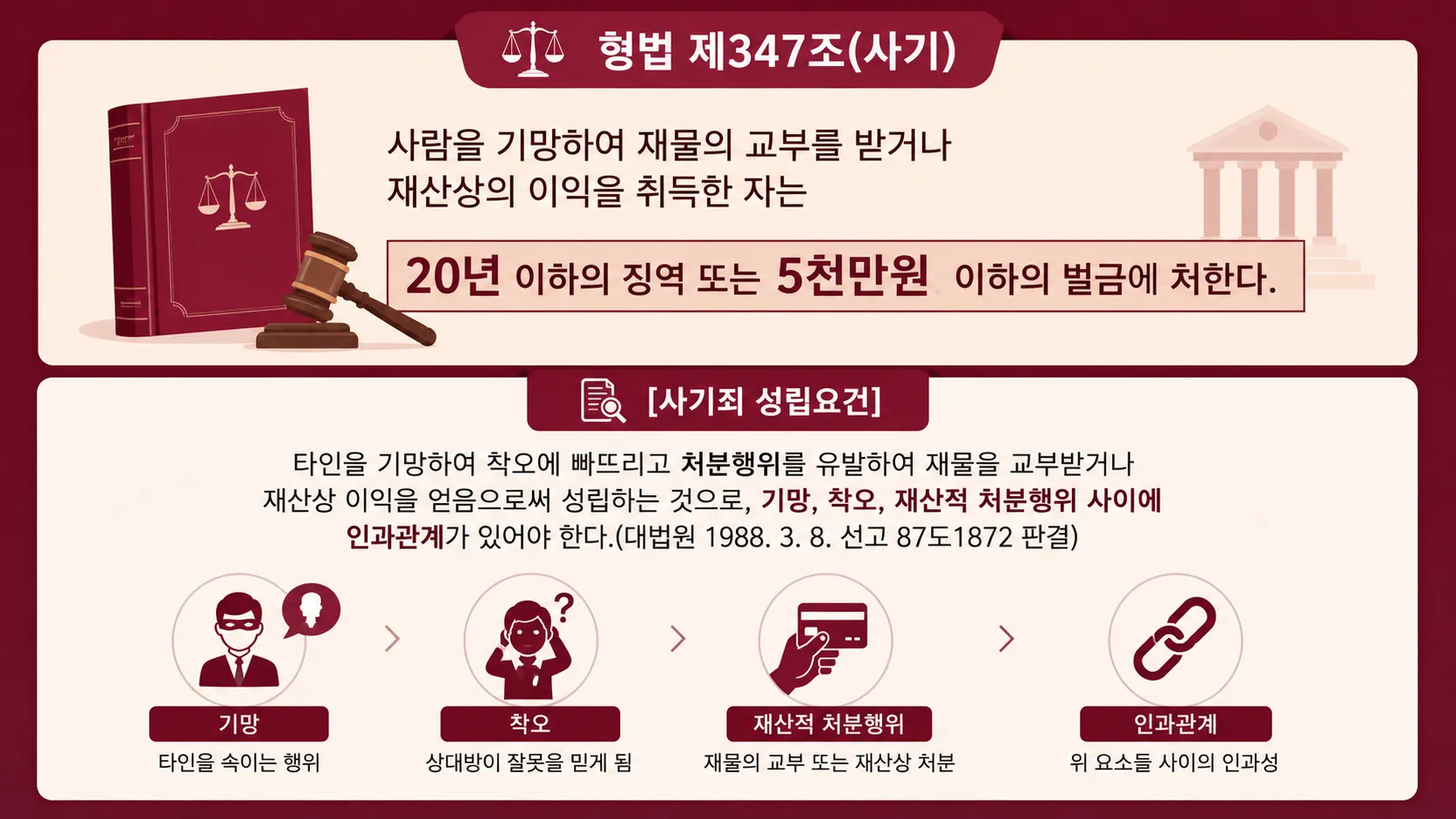
In this case the client faced fraud punishment, but by confirming how the funds were actually used and whether the principal and interest were paid, it was judged that there had been no fact of deception by the client.
In this way, when fraud punishment is anticipated, a process of securing related materials in detail and setting out the actual circumstances in a concrete manner is necessary.
4. Frequently Asked Questions When Facing Fraud Punishment
Q. Does fraud punishment apply in every case where a person borrows money and then fails to repay it?
A. No. Fraud punishment is not determined solely by the result that the money was not repaid. It is judged by comprehensively reviewing whether there was no intention or ability to repay from the time of borrowing the money, and whether there was any fact of deceiving the counterpart in order to borrow the money.
Q. In a fraud punishment case, if the money was actually used for the business, is it possible that the suspicion is not found?
A. Yes, when judging whether fraud punishment applies, how the borrowed funds were used can also be an important factor in the judgment. If it is confirmed that the money was used for actual business operation or investment purposes, along with the record of principal and interest payments and the circumstances of the transaction, this can be taken into account in judging whether there was a deceptive act or an intent to fraudulently obtain.
Daeryun, the ninth-largest law firm in Korea (based on 2025 value-added tax filings with the National Tax Service), not only provides tailored legal services but also closely analyzes cases through statement rehearsals before police and prosecution questioning, accompanied questioning with a criminal defense attorney, and collaboration with evidence-investigation experts holding investigator qualifications.
If you are in a situation requiring a response to police questioning or criminal proceedings related to fraud punishment, 🔗reserve a legal consultation to review the facts of your current case and the direction of your response.
This content is based on actual cases handled by Daeryun Law LLC and has been partially adapted. All copyrights belong to Daeryun Law LLC.
Unauthorized reproduction, copying or distribution may result in legal action under applicable laws.


Crime of fraud: Want a faster, more detailed consultation?
Consult aspecialized attorney
Related Information
Explore legal information related to this case.
How to Respond When Detected for Voice Phishing, Explained by a Chinese Consultation Attorney
What Are the Requirements for the Crime of Disclosure of Secrets and the Response Strategy When Occupational Secrets Are Leaked?
Requirements for the Crime of Forgery and Uttering of a Private Document, the Statute of Limitations for Forgery of a Private Document, and Responses to Criminal Punishment
Daeryun's Key Strengths


Litigation strategy using Daeryun's own AI & IT technology

More than 240 key members

1,200+ cases handled per month
* 2025년 월평균 기준
Complies with Korean Bar Association Advertising Regulations Article 4 (1)
more strengths

Book a legal
consultation with an attorney
All consultations are reviewed by a specialized attorney first,
so they are conducted by appointment only.
Phone consultation
1800-7905
Available 24 hours a day, 365 days a year


Online consultation
We provide tailored
legal services for our clients.

Chat consultation
KakaoTalk channel
Daeryun Law LLC Attorneys
Consult in other languages


Popular Columns
View moreThe Meaning of Non-Referral, and Are There Differences Among the Types of Decisions?

Establishment of the Crime of Fraud: Determining the Requirements, Case Analysis, and Sentencing Guidelines
Criminal Record Inquiry and Expungement: How to Avoid Disadvantages
The Police Investigation Process, Methods of Response, and Tips for Giving Statements
Criminal Cases: Litigation Procedure, Types of Dispositions, and How to Respond

Previous
Lawyer for the Crime of Fraud | A Fraud Complaint Was Filed Over Unpaid Supply Payments, but the Case Concluded With a 'Non-Referral'
Next
Fraud Under the Act on Aggravated Punishment of Specific Economic Crimes | A Case in Which a Criminal Defense Lawyer Led a Client Suspected of an 800 Million Won Investment Fraud to a Non-Referral
View list
Do you have more questions?






