


Deals & Cases
Lawsuit for Return of Unjust Enrichment | Assisting a Client Who Was the De Facto Caregiver to Recover the Deceased's Property
This concerns a client who requested assistance with a lawsuit for the return of unjust enrichment.
We assisted the client, who had been the de facto caregiver of the deceased, and succeeded in recovering part of the deceased's inherited property.
1. The Client Who Requested a Lawsuit for Return of Unjust Enrichment
This is the story of how we assisted a client who requested a lawsuit for the return of unjust enrichment.
The client was the deceased's uncle, who had served as a de facto father figure.
After the deceased suddenly passed away, the deceased's biological mother, whom the client had never once met, came to inherit the deceased's property.
The client argued that it was unjust for the defendant (the deceased's biological mother) to inherit all of the deceased's property, and he requested advice from a Daeryun attorney.
The Daeryun attorney advised that, through a lawsuit for the return of unjust enrichment, they recover part of the deceased's property, and the attorney assisted the client and set about preparing the lawsuit.
The Circumstances of the Client Who Requested Assistance With the Unjust Enrichment Lawsuit
The story of the client who requested assistance with the return of unjust enrichment is as follows.
The client was the deceased's uncle. After the client's older brother divorced, the brother asked the client to raise the deceased, who was then a newborn, and left as if fleeing, so the client and his wife came to take sole charge of raising the deceased.
At the time, the defendant said to the client, "Tell the child that his mother is dead. I do not have the means to raise him, so put him in an orphanage," and then cut off all contact.
So that the deceased would not feel the absence of his biological parents, the client and his wife devotedly cared for him for twenty-five years.
However, the deceased suddenly passed away in a traffic accident.
The deceased's biological father had already passed away, and under current law the defendant, who had fled as if abandoning the deceased, was the first-priority heir, so the defendant came to inherit all of the deceased's property.
The client felt that it was not right for the defendant, who had abandoned and left the deceased, to inherit all of the property, and he resolved to recover a portion through a lawsuit for the return of unjust enrichment.
What Is a Lawsuit for Return of Unjust Enrichment?
A lawsuit for the return of unjust enrichment is a lawsuit that legally seeks the return of a benefit from a person who has obtained a benefit by using another's property or labor without a legal cause.
A lawsuit for the return of unjust enrichment is a lawsuit that arises in various areas of everyday life.
What is important in a lawsuit for the return of unjust enrichment is proving that loss occurred through the use of my property or real estate, beyond the fact that the other party obtained a benefit.
In other words, to bring a lawsuit for the return of unjust enrichment, the following requirements must be met: ▲there is no legal cause, ▲loss occurs to me, ▲the other party obtains a benefit, and ▲there is a causal relationship between the two.
Even though there was the defendant as the person entitled to inherit, the client bore all of the deceased's funeral expenses and the like.
The attorney in charge emphasized that the defendant has an obligation to return those expenses to the client, who had paid the funeral expenses and the like on the defendant's behalf.
2. Assistance for the Lawsuit for Return of Unjust Enrichment
The attorney set about providing assistance for the lawsuit for the return of unjust enrichment.
Arguing That the Client Had Been the De Facto Caregiver of the Deceased
The attorney argued that the client had been the de facto caregiver of the deceased.
The attorney submitted as evidence past photographs taken by the client and his wife while raising the deceased over the years, along with the fact that the contact details of the client and his wife had always been listed as the deceased's emergency contacts at his school and elsewhere.
In addition, through the testimony of the deceased's friends, the attorney submitted as further evidence the fact that the deceased had grown up in the home of the client and his wife and that they were no different from his actual parents.
Arguing That the Defendant Had No Qualification to Inherit
The client's attorney argued that, based on the restriction of inheritance rights for a person disqualified from inheritance, the defendant had no qualification to inherit.
On August 28, 2024, the so-called Gu Hara Act, which strips the inheritance rights of a parent who has abandoned the duty to raise a child, passed the plenary session of the National Assembly and is scheduled to take effect in 2026.
Cases arising after the Constitutional Court's ruling of nonconformity with the Constitution regarding the legally reserved portion (April 25, 2024) may also have the Gu Hara Act applied to them.
The act, commonly known as the Gu Hara Act, is a statute that restricts the inheritance rights of a person disqualified from inheritance who has not fulfilled the duty to raise a child.
Under the amendment, if a parent abandons or abuses a child and fails to fulfill the duty of care, the parent may lose the right of inheritance.
Previously, there was insufficient basis to restrict inheritance rights, but with this amendment it has become possible to restrict inheritance rights where a person has abandoned a familial duty.
This means that not merely inheritance based on blood ties, but whether the duties of care and responsibility have been performed has been included in the criteria for determining inheritance.
The client's attorney argued that the defendant, as a mother, had not cared for the deceased at all, and emphasized that the defendant had no qualification to inherit the deceased's property.
3. The Result of the Lawsuit for Return of Unjust Enrichment: Success in Recovering Part of the Deceased's Claimed Property
As a result of the lawsuit for the return of unjust enrichment, the client succeeded in recovering part of the claimed property of the deceased.
As with the client in the case above, there are cases where a parent who has not fulfilled the duty of support claims inheritance rights upon the sudden death of a child.
Before the case of the late Ms. Gu, there was the controversial case in which the biological mother of a soldier, A, who died in the 2010 Cheonan ship incident, appeared after twenty-eight years and demanded inheritance of the survivors' compensation.
If a dispute arises regarding the inheritance of a deceased person's property in a situation like the above, it is recommended to review the case from a legal perspective through a consultation with an attorney and to devise an appropriate response.
At Daeryun Law Firm, attorneys provide response strategies tailored to the client's situation by using AI that has learned from hundreds of thousands of precedent data points.
If you are seeking a referral to an attorney in connection with unjust enrichment, we hope you will turn to Daeryun Law Firm.
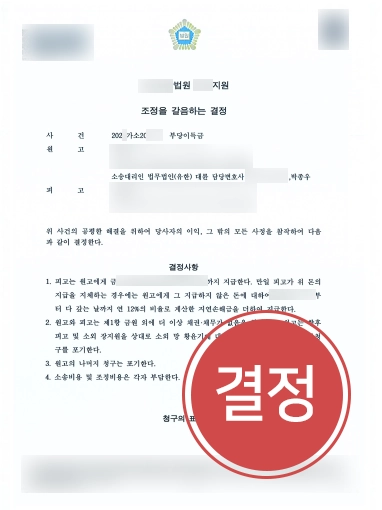
This content is based on actual cases handled by Daeryun Law LLC and has been partially adapted. All copyrights belong to Daeryun Law LLC.
Unauthorized reproduction, copying or distribution may result in legal action under applicable laws.


Unjust Enrichment: Want a faster, more detailed consultation?
Consult aspecialized attorney
Related Information
Explore legal information related to this case.
Villa Rental Fraud: Procedures for Recovering the Deposit and Legal Responses When Harm Occurs
Response Strategies and Legal Remedy Procedures for Victims of Newly Built Villa Sale Fraud
The Inheritance Procedure, the Scope of Heirs, and What Documents Are Required for Filing?
Daeryun's Key Strengths


Litigation strategy using Daeryun's own AI & IT technology

More than 240 key members

1,200+ cases handled per month
* 2025년 월평균 기준
Complies with Korean Bar Association Advertising Regulations Article 4 (1)
more strengths

Book a legal
consultation with an attorney
All consultations are reviewed by a specialized attorney first,
so they are conducted by appointment only.
Phone consultation
1800-7905
Available 24 hours a day, 365 days a year


Online consultation
We provide tailored
legal services for our clients.

Chat consultation
KakaoTalk channel
Daeryun Law LLC Attorneys
Related Members
View more
Key Case Studies
View moreRelated Practice Areas
View moreConsult in other languages


Popular Columns
View moreAssessing the Requirements for a Claim to Return the Reserved Portion: The Procedure and How to Secure Evidence

Inheritance and Gift: The Concepts and How to Calculate and File Inheritance Tax and Gift Tax
Proposed Tax Law Amendments: Reasons for the Amendments and Key Amended Provisions
Guide to the Procedure for Applying for an Adult Guardian: How Do You Prepare the Documents?
Renunciation of Inheritance and Qualified Acceptance, Explained by an Attorney Handling Renunciation of Inheritance

Previous
Bucheon Law Office Assistance | Representation of an Insult Victim in Filing a Complaint, Offender Sentenced to a Fine
Next
Busan Criminal Attorney | Busan Attorney Assists Client Who Assaulted a Friend, Concluding the Case With a Minor Fine
View list
Do you have more questions?






