Case Analysis / Legal Updates
United States Supreme Court, Trump's Broad Imposition of Tariffs Based on the International Emergency Economic Powers Act Is 'Unlawful'
The United States Supreme Court rendered a judgment holding that the imposition of tariffs by the U.S. administration on the basis of the International Emergency Economic Powers Act is unlawful and must be invalidated. (Decision of February 20, 2026)
1. Overview of the United States Supreme Court's Judgment Holding Trump's Tariffs Unlawful and Void
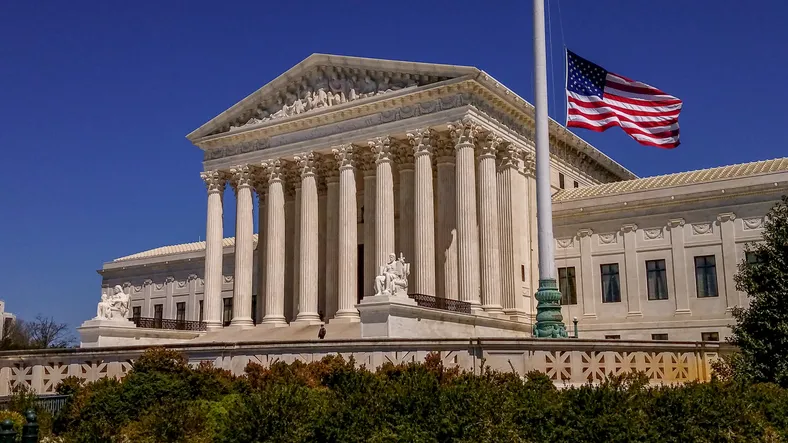
On February 20, 2026 (local time), the United States Supreme Court held that the broad tariffs imposed by the U.S. administration on the basis of the International Emergency Economic Powers Act lacked a sufficient constitutional and statutory basis and were therefore unlawful and void.
This ruling was issued in a case concerning the lawfulness of the tariffs that the U.S. administration had imposed since 2025 on imports from Canada, Mexico, and China, citing reasons such as a response to fentanyl smuggling, as well as the reciprocal tariffs first announced on April 3, 2025, and revised several times thereafter.
The majority opinion was written by Chief Justice John Roberts, and six justices joined it. By contrast, three justices issued a separate dissenting opinion.
Main Issue
The core of this case was straightforward.
The issue was whether the fact that the International Emergency Economic Powers Act states that the President "may regulate importation" can be read to mean that the President also holds the authority to impose tariffs.
2. The United States Supreme Court's Determination
The principal points of the majority opinion in the United States Supreme Court's judgment were as follows.
The "Authority to Levy Taxes" Rests, in Principle, with Congress Alone
The Supreme Court held that under the U.S. constitutional framework, the authority to levy taxes (the taxing power) is, in principle, a power granted to Congress alone.
Accordingly, the Court's position is that, for the President or the administration to levy a tax, Congress must clearly delegate that authority by statute.
The Phrase "to Regulate Importation" Alone Does Not Create Tariff Authority
The statutory provision at issue merely grants the President authority to the effect that he "may regulate importation," yet the Supreme Court held that this language cannot be construed expansively to encompass the imposition of tariffs.
In other words, the Court concluded that, because a tariff is ultimately a tax imposed on imported goods, because the authority to levy taxes is constitutionally vested exclusively in Congress, and because the International Emergency Economic Powers Act contains no express provision delegating to the President the power to impose tariffs, the administration cannot impose tariffs on the basis of that statute.
Conclusion: Tariffs Based on the International Emergency Economic Powers Act Are Unlawful and Void
Accordingly, the Supreme Court held that the tariffs that the U.S. administration imposed on the basis of the International Emergency Economic Powers Act on imports from Canada, Mexico, and China, as well as the reciprocal tariffs directed at the entire world, were all unlawful measures that exceeded its authority and were therefore void.
Meanwhile, because one of the two cases had been brought before a court that lacked jurisdiction, the Supreme Court held that, as to that case, the lower judgment should be reversed and the action itself should be dismissed.
Key Substance of the Dissenting Opinion
The justices who issued the dissenting opinion stated that the legal doctrine restricting the administration's discretion is difficult to apply as such in the areas of foreign affairs and trade, and that if the President holds "the authority to restrict or adjust importation," there is room to view the imposition of tariffs, which is a less forceful measure, as also being permissible.
They also expressed concern, to the effect that, under the majority opinion, significant confusion could arise in the process of refunding tariffs already collected.
3. The U.S. Administration's Response Immediately After the Judgment Holding the Tariffs Unlawful and Void
Immediately after the judgment was issued, President Trump held a press conference and suggested that he might not voluntarily refund the reciprocal tariffs already collected.
At the same time, the U.S. administration announced that, on the basis of Section 122 of the Trade Act, it would temporarily impose an additional 10% tariff on imports from around the world beginning at 12:01 a.m. (U.S. Eastern Time) on February 24, 2026, and the following day it corrected this to state that it would raise the rate to 15%, the maximum level permitted by law.
The administration also made clear that, even after this judgment, its tariff policy would continue to be maintained by changing its legal basis, that it would introduce a new tariff system within the coming months, and that the trade agreements already concluded would remain valid.
However, the 15% tariff under Section 122 of the Trade Act is subject to the limitation that, without congressional approval, it is valid only for 150 days from its effective date, so it is highly likely that, before then, the administration will continue the tariffs on a different legal basis.
In this process, the administration also directed the Office of the United States Trade Representative to conduct an investigation into unfair trade.
The Effect and Scope of the Judgment
The significance of this judgment is that the U.S. administration will find it difficult to continue using, in the same manner, the tariff card based on the International Emergency Economic Powers Act, which it had used effectively in trade negotiations.
That said, the scope addressed by this judgment is limited to the question of "whether tariffs may be imposed on the basis of the International Emergency Economic Powers Act."
Accordingly, what becomes void as a result of this judgment is tariffs based on the International Emergency Economic Powers Act, and tariffs imposed on the basis of other statutes, or those that may be imposed in the future, are not automatically affected.
Points Related to Refunds
The Supreme Court did not separately determine how the tariffs already collected are to be refunded.
Accordingly, an importer who has already paid tariffs may, if the import declaration has not yet been finalized, pursue a subsequent correction procedure, and if the import declaration has been finalized, pursue an objection procedure by filing an objection within 180 days from the date of finalization.
However, unless the U.S. authorities establish a separate expedited refund procedure, processing the many applications appears likely to take a long time.
Step-by-Step Response

For import and export companies, to whom a tariff refund accrues may vary depending on the terms of the transaction (for example, the party making the import declaration, special agreements on bearing the tariff and on subsequent settlement, and the like), so they should conduct their review according to the following steps.
- To receive a refund from the U.S. customs authorities on or after February 6, 2026, registration of an electronic refund account is required.
- Identify the import entries on which tariffs based on the International Emergency Economic Powers Act were actually imposed and paid, and prepare the customs clearance documents.
- Confirm whether the import declaration has been finalized, and review the procedure appropriate to the period before or after finalization (correction or objection).
- Coordinate the timing and strategy by considering together the follow-on risks, such as temporary tariffs, additional product-specific tariffs, and tariffs resulting from unfair trade investigations, along with the practical benefit of a refund.
In addition, where the tariff increase has been passed on to prices in the course of distribution, refund demands may arise from consumers and others, and in that case the question of to whom the refund benefit accrues and the matter of subsequent settlement may vary depending on the contractual relationship.
Because there is considerable uncertainty as to which legal basis future tariffs may be added under and which tariffs may be added, it is advisable to continue monitoring developments while reflecting matters such as the method of allocating the tariff burden in the contract terms.
At our firm, a customs specialist who holds a licensed customs broker qualification works in collaboration with international trade attorneys and the local U.S. law firm SJKP to provide client companies with the advice they need.
If you need assistance, you are welcome to schedule a 🔗legal consultation with a customs attorney.
Related Information
Explore legal information related to this case.
Responding to International Organization Investigations: Global Regulation and Corporate Response Strategy
Causes of Customs Duty Arrears, and a Response Strategy for Delinquency Dispositions
Foreign Trade | Import Customs Clearance Procedures Under the Foreign Trade Act and the Systems for Declaration Correction and Objection
Daeryun's Key Strengths


Litigation strategy using Daeryun's own AI & IT technology

More than 240 key members

1,200+ cases handled per month
* 2025년 월평균 기준
Complies with Korean Bar Association Advertising Regulations Article 4 (1)
more strengths

Book a legal
consultation with an attorney
All consultations are reviewed by a specialized attorney first,
so they are conducted by appointment only.
Phone consultation
1800-7905
Available 24 hours a day, 365 days a year


Online consultation
We provide tailored
legal services for our clients.

Chat consultation
KakaoTalk channel
Daeryun Law LLC Attorneys
Related Members
View more





Related Practice Areas
View moreConsult in other languages


Popular Columns
View moreHawala-Style Methods Constituting a Violation of the Foreign Exchange Transactions Act: The Level of Punishment and How to Respond

How to Calculate the Taxes Imposed on Overseas Direct Purchases
Aggregate Taxation on Overseas Direct Purchases and Refund Rules for Returns
International Trademark Registration: Methods, Procedure, and Duration
Foreign Exchange Transactions: Which Third-Party Payment Transactions Are Permitted Without Reporting?

Previous
Hospital Rehabilitation | A Hospital With 6.2 Billion Won in Debt Restructures 58% of Its Obligations Through Medical Corporation Rehabilitation and Rebuilds
Next
Antidumping Duty | Major Jurisdictions Such as the United States, India, and the European Union Actively Use Antidumping Investigations...Domestic Antidumping Investigations Reach a Record High of 13 Cases
View list
Do you have more questions?