




Review of policy debate on assistive technology for the disabled using AI technology

2023-10-31
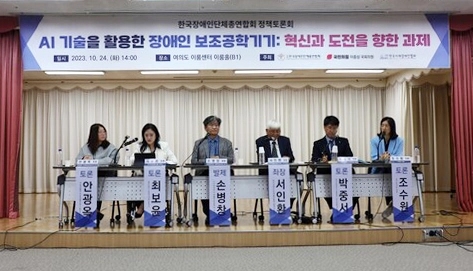
At 2 p.m. on the 24th, a policy debate was held at the Irum Hall of the Irum Center in Yeouido, Seoul under the theme, “Assistive technology for the disabled using AI technology: tasks toward innovation and challenge.”
This event was co-hosted by the Korean Federation of Persons with Disabilities, the office of National Assembly member Jong-seong Lee, and the Korea Association for the Physically Disabled, and was held online and offline.
It was a policy discussion to look at examples of how recent big data such as Chet GPT and innovative technologies such as robot technology and artificial intelligence are applied to assistive technology for the disabled, and to promote independence and changes in the quality of life of the disabled through development, distribution, and market revitalization to promote innovative change.
Professor Son Byeong-chang of the Department of Rehabilitation and Medical Engineering at Nazareth University gave a presentation on the topic, “Assistive technology devices using AI technology: current usage and challenges.”
Professor Son said that he first asked Chet GPT whether he was a strong artificial intelligence or a weak artificial intelligence, and he answered that he was a strong artificial intelligence. When asked again if it was weak artificial intelligence, I said it was strong artificial intelligence. When asked again if it was lying, I answered that it was not lying. Chet GPT said that he was good at lying and that he needed to learn how to use it.
The concept of AI was already advocated in the 1950s, and AI was said to be a new opportunity and challenge for people with disabilities. AI (artificial intelligence) can increase accessibility for the disabled by utilizing technologies such as two-way voice conversation, image recognition, and virtual reality, and for the visually impaired, document recognition and image recognition are expected to be of great help in accessing knowledge and recognizing the environment. Citing the OrCam MyEye artificial intelligence object recognition device as an example, he said that it is possible to recognize faces of objects or others and read documents.
We introduced the impressions of a user published in ‘IT Chosun’ who said that they were amazed by the ability to read text quickly, read the text by pointing to it with a finger, and have a function that notifies you when a pre-memorized face appears and a function that tells the date and time by showing the back of your hand.
Hearing impaired people said that XPERT is providing an automatic voice-text-subtitle translator, and Soboro Tab Business and Tikita Captions are also being used as communication tools. Currently, sign language is provided by sign language interpreters on Zoom, but automatic sign language interpreters are currently being technologically advanced and will become a reality in the near future.
Systems that provide tactile notification of emergency situations are also commercially available in foreign countries. Applications of artificial intelligence technology for people with speech disabilities include products such as Dream Phone, which supports language training and long-distance communication.
Artificial intelligence technologies for people with physical disabilities include technologies that control the environment through voice commands, such as Amazon Alexa, Google Assistant, and Apple Siri, and products that use artificial intelligence to operate wheelchairs are said to be accelerating the development of technology for autonomous driving of artificial intelligence robot wheelchairs, such as Hyulim Robot.
Artificial intelligence technologies for the disabled with brain lesions include communication devices such as Tobii Dynavox, Grid3, and Snap Core First, and rehabilitation digital treatments using virtual reality such as Neofect are also available. Meanwhile, at SKT, artificial intelligence software has been developed to observe the challenging behavior of people with developmental disabilities.
He said that the future use of artificial intelligence will also require technology to protect personal information and understand and control artificial intelligence algorithms. In the development of artificial intelligence assistive technology devices, reflection of user opinions and policies to support purchase costs due to expensive products should also be implemented in parallel. Although the technical idea of the product is great, there are many cases where the convenience of actual users or the environment is not considered, and the low awareness of the developed product is also pointed out as an obstacle to the commercialization of new assistive technology devices for the disabled.
Gwang-ok Ahn, a researcher at the National Rehabilitation Center, said that the global assistive technology market is currently worth 40 trillion won and is growing at 6 percent every year, and technology using artificial intelligence is growing at 17 percent, three times faster. Accordingly, the National Rehabilitation Center also said that its research and development project to commercialize assistive devices for independent living of the elderly and disabled is reflecting user needs and focusing on innovation of assistive devices and advancement of open platforms.
He also gave examples of five development projects as development plans. “Smart safety control devices applicable to a variety of mobility”, “Connected mobility and service platform using IoT technology”, “Development of adaptive mobility aids for growing children with disabilities”, “Development of bladder capacity monitoring wearable device for urination management”, “Development of smart glasses and situational awareness assistance service using AI” were introduced.
Attorney Choi Bo-yoon of Daeryun Law Firm said in a discussion titled “There must be improvement to a consumer-centered system,” that user intervention is necessary in the process of research and development, manufacturing, certification registration, supply, use, and evaluation.
It was pointed out through video examples that systematic management is difficult due to the lack of a control tower for research, the speed of the certification process, scattered related laws, lack of rental activation, and lack of information on assistive devices suitable for me, etc. It was argued that a plan for a living map is included in the 6th Comprehensive Policy for Persons with Disabilities, and that a consumer-centered platform is necessary.
Park Jung-seo, director of the Assistive Technology Center at the Korea Employment Agency for the Disabled, said in a discussion that the support of assistive devices in the working environment increased job performance accuracy by 49.3%, work performance speed by 49.3%, productivity by 46.6%, and overall job satisfaction by 47.2%.
Center Director Park introduced the representative products of assistive technology devices being supported and said that voice recognition-based height-adjustable beds are gaining great popularity among visually impaired massage industry workers in the 22-year project with research and development support.
In addition, they introduced a smart vest with anxiety stress relief function, implementation of two-way voice calls for disabled and non-disabled people, IoT technology-based customized stoma care package, on-device real-time image recognition, motion recognition smart Braille DP, intelligent safety management smart care system, and image recognition guide robot. He also said that research is underway on ways to apply the latest technology based on an AI robot convergence platform to expand employment of the disabled.
In the discussion, Jo Soo-won, CEO of TwoArt, which is releasing products called Sullivan Plus and Sullivan A that incorporate artificial intelligence technology for the visually impaired, discussed the difficulties of being a developer, such as the weak economic feasibility of investment due to a small market and the high cost even if users have government support. He also discussed the difficulty of hitting the ‘Wow Point’ well.
At first, people exclaim ‘Wow!’ at the new attempts and possibilities, but when they actually use them, they are turned away because they are inconvenient and fall below expectations. He also expressed his determination to resolve various challenges in the future and to continue to try new things in cooperation with related organizations and consumers.
Most of the listener inquiries were about solving problems in development and distribution to lower the price and popularize the product, and ideas such as whether small and medium-sized companies would be able to withstand the problem of lack of profitability if large corporations participate, and whether good product development would be achieved if government support and large corporations join hands were raised.
However, since large corporations have a complex and slow decision-making structure, little interest in assistive technology for the disabled, and abundant innovative technologies, there was a counter-argument that it would be more desirable for large corporations to provide technology to small and medium-sized enterprises as a social contribution and for the government to support specialized small and medium-sized enterprises to develop well.
[View full article] - Review of policy debate on assistive technology for the disabled using AI technology


Do you have more questions?






In-Person Consultation Booking
If you have legal concerns, consult with a specialist attorney at the nearest office.
