




Government: "Prohibition of collective action"...Order to start work → Punishment expected

2024-02-12
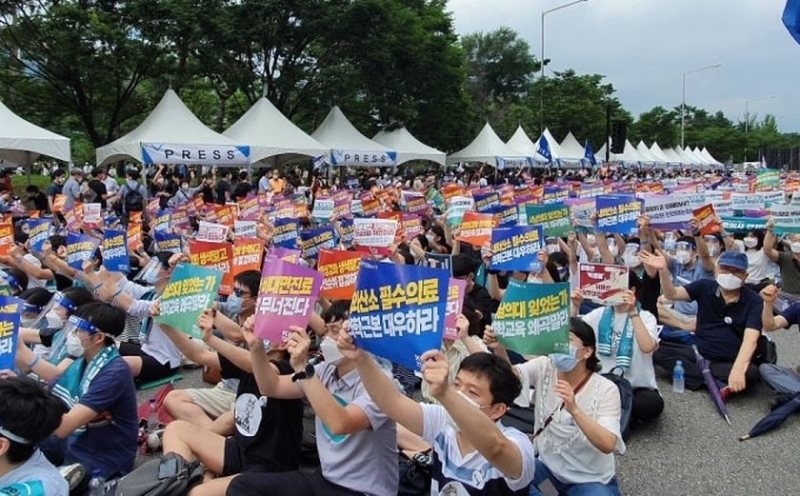
There is extreme interest in whether the doctor's license cancellation law applies... "Strike is not legal, but cancellation is unlikely to be easy."
[Reporters Seo Dong-jun and Lee Seul-bi] As the crisis of a general strike in the medical industry becomes visible due to the division of medicine in 2000, telemedicine in 2014, expansion of medical schools and establishment of public medical schools in 2020, and the confirmation of an increase in medical schools by 2,000 in 2024, attention is focused on the level of punishment of doctors due to strikes.
In 2000 and 2020, the government issued a ‘business start order’, but this time, it is even more so because the government issued a ‘collective action prohibition order’ even before the strike began. However, the situation has become more complicated in that it is now tied to the ‘license’, which is like a doctor’s life.
The extreme scenario in which a person's license may be revoked if he or she is sentenced to imprisonment or heavier punishment under the 'Medical Person License Cancellation Act,' which came into effect in November last year, cannot be ruled out, raising tensions about how far the 'strong vs. strong' confrontation between the government and the medical community will lead to punishment.
The government takes a ‘hard-line response’, including deploying a dedicated team and cooperating with the police. Punishment is expected for failure to comply with orders to start work.
Even before the announcement of an increase in the number of medical schools on February 6, as an atmosphere for collective action was created in the medical community, such as voting to participate in a general strike of residents, the government made it clear that collective action by doctors was illegal.
Park Min-soo, Second Vice Minister of Health and Welfare, said, “No matter what the number of medical school quota expansion is, the medical community will protest.” He added, “Unions have three labor rights, but doctors, both private practitioners and salaried workers, do not have such authority, so collective action itself is illegal.”
In fact, after the announcement of the medical school increase at 3 p.m. on the same day (the 6th), the government issued an ‘order banning collective action and teachers of collective action’ to the executive branch of the medical association. The Ministry of Health and Welfare has established a dedicated team for each training hospital and has even prepared to cooperate with the police at some hospitals.
Currently, orders to commence work for medical personnel, which can be issued when medical residents and other doctors go out into the streets ‘without justifiable grounds’ and their treatment is stopped, are also based on the Medical Service Act.
Article 59 (Guidance and Orders) of the Medical Service Act stipulates that “an order to commence work may be issued if it is determined that it has caused or is likely to cause significant disruption.” If you violate the order, you may be subject to suspension of license, obstruction of business under the Criminal Act, or imprisonment for up to 5 years and a fine of up to 15 million won as an abettor or abeter.
After the announcement of the medical school quota, the Korean Medical Association Chairman Lee Pil-soo and the executive team resigned, shaking the center of the general strike.
However, the scale of the strike may increase as each training hospital across the country conducts a vote for or against the strike, led by the Korean Medical Residents' Association, along with the formation of the Korean Medical Association's Emergency Committee.
The problem is that the revision to the Medical Service Act, which focuses on the Medical Personnel License Cancellation Act, which revokes the licenses of medical practitioners who have been sentenced to imprisonment or worse, has been in effect since November of last year, putting doctors at great risk by participating in the strike.
It appears that this is related to the current atmosphere in some teaching hospitals where not only residents, but also salaried and commissioned doctors are seeking new forms of strike measures to avoid government punishment, such as submitting leave and preparing for resignation after the Lunar New Year holiday.
“Opposition to government policy, not a legal strike” vs. differing opinions on punishment higher than imprisonment
Meanwhile, there is an opinion that the application of the law may be determined depending on how the conditions for activating the medical law business start order, ‘without justifiable grounds’ and ‘fear of serious harm to public health’, are interpreted, but conflicting opinions are also suppressed.
Choi Hyeon-deok, a lawyer at Daeryun Law Firm, said, “If a doctor goes on strike and refuses treatment under Article 15 of the Medical Service Act, he or she may be punished for up to a year or a fine of up to 10 million won.”
He added, “If you occupy a medical institution or interfere with the medical practice of other doctors, you may be punished by imprisonment for up to 5 years or a fine of up to 50 million won for violating Article 12 of the Medical Service Act.”
If the government issues an order to commence work ‘with valid reasons’ but the order is not followed, the person may be punished by imprisonment for up to 3 years or by a fine of up to 30 million won for violating Article 59 of the Medical Service Act.
Attorney Choi explained, “If you fall into any of these three cases, you may be fined, but if you are sentenced to imprisonment or higher, your license may be revoked. The same applies even if you are sentenced to probation or a suspended sentence.”
On the other hand, there is an analysis that although this medical strike cannot be considered a legal strike, it is unlikely to lead to actual license cancellation.
Jeong Hye-seung, a representative attorney at Banwoo Law Firm, predicted, “A strike that is not a strike that occurred at the workplace but in opposition to the government’s policy is not a legal right to strike granted under the Labor Standards Act, and an order to commence work may be issued accordingly.”
At the same time, he analyzed, “Those who received prison sentences for the doctors’ strike in 2000 were the heads of the local organizations that led the strike,” and “If residents enter the hospital and interfere with medical treatment, the level of punishment could be increased for obstruction of business, but such a thing does not seem possible. It is highly likely that nothing more than a prison sentence will be imposed.”
There is also a Supreme Court precedent (decision made in 1992) that in cases where there are multiple purposes pursued in actual industrial action and some of them are unjustified, the legitimacy of the industrial action is judged based on whether the ‘main’ purpose is right or wrong.
Government order to commence work and order prohibiting acceptance of resignation letter... “We need to look into whether it is unconstitutional.”
Meanwhile, there has been controversy over whether the business start order is unconstitutional. In fact, the head of the emergency medicine department at Seo Regional Medical Center protested on his personal SNS, saying, “How can we have more faith in a government that ignores Article 21 of the Constitution (freedom of assembly and association)?”
Regarding this, lawyer Jeong Hye-seung said, “It is true that the matter in question is a restriction of basic rights, but the unconstitutionality of the related matter is judged by considering the violation, not just the simple restriction.” He added, “It is the responsibility of the Constitutional Court to interpret it by considering the reasons and consequences at once.”
There is also a need to consider the constitutional elements of the ‘order banning the acceptance of residents’ collective resignations’ that the government recently issued to teaching hospitals across the country.
Attorney Choi Hyeon-deok said, "A medical institution can file a constitutional appeal against an order prohibiting the acceptance of collective resignations. Article 59 of the Medical Service Act states, 'If it is necessary for health care policy or if serious harm to public health occurs or is likely to occur, necessary guidance and orders may be given to medical institutions or medical personnel.' We must examine whether acceptance of resignations really applies in this case."
He added, “As far as I know, there has been no case of criminal punishment for violating the order to commence work or the order prohibiting acceptance of resignation letters,” adding, “It is unclear whether the government can lead to criminal punishment in the absence of precedent.”
He also predicted, "Constitutional petitions are long-term battles that take at least several years to reach a decision. The claims of the government and the medical community are conflicting, but in the end, neither side can easily take legal action."
[View full article] - Government: "Prohibition of collective action"...Order to start work → Punishment expected


Do you have more questions?






In-Person Consultation Booking
If you have legal concerns, consult with a specialist attorney at the nearest office.
