




‘Freedom of movement for all’ proposal to the U.S. government

2023-01-31
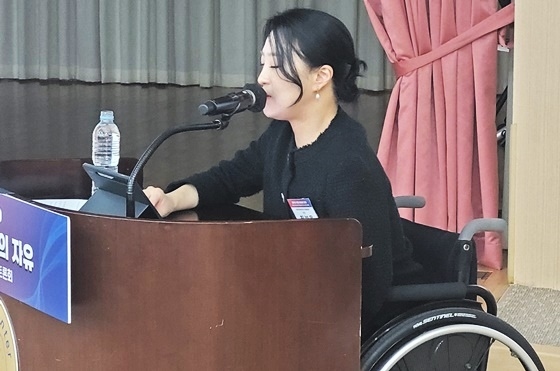
‘Special Committee on Promoting Convenience of Mobility for Persons with Disabilities’ identified six policy tasks
Contents such as spreading awareness of improving transportation convenience for disabled people, awareness of improving transportation convenience, etc.
The ‘Special Committee on the Promotion of Convenience of Mobility for the Disabled’ (hereinafter referred to as the Special Committee) proposed policy tasks to the government for freedom of movement for all, including spreading awareness of the promotion of disability-friendly mobility and improving individual transportation means.
The Presidential National Integration Committee held an ‘explanation and discussion on the proposal of the Special Committee for the Promotion of Mobility Convenience for the Disabled’ at the Irum Center in Yeouido, Seoul at 2 pm on the 30th.
The special committee, which was launched on September 26 last year, is composed of experts from various fields, including people with disabilities, their families, and law, medicine, and social welfare, and has continued its activities for about four months, including preliminary preparations and deliberations, and 17 regular meetings.
As a result, six policy tasks were derived, including ▲ improving special transportation (call taxis for the disabled) ▲ universal design of public transportation ▲ improving individual transportation ▲ creating a safe walking environment ▲ strengthening the construction and use of information on transportation convenience and accessibility for the disabled ▲ converting awareness of the promotion of disability-friendly transportation convenience.
Chairman Bang Seok of the special committee said, “Accessibility of special transportation and public transportation is the issue that needs to be resolved most urgently from the perspective of the disabled,” and emphasized, “The special committee, composed of various people, looked at the issue of mobility rights for the disabled, which had been promoted from the supplier’s perspective, from the perspective of the consumer and sought to resolve blind spots. When the disabled can move freely without barriers and discrimination prejudice, we will be able to move toward a healthy society.”
**“Improving policies and laws is important, but awareness education on mobility rights for the disabled must be a priority”**
Special committee member Maria Gong (Professor of Rehabilitation Psychology at Daegu University) explained, “Bicycles, etc., placed on Braille blocks without much thought by ordinary citizens are like a wall to the visually impaired. Also, people who sympathized with disabilities after watching the strange lawyer Woo Young-woo, who gained sensational popularity last year, often had a negative view of what actually happened.”
He added, “Improvement of policies and laws is important, but I think what should take priority is awareness education. Because awareness of disability affects the lives of disabled people in various areas of society,” he added, “However, even though disability awareness is being improved in our country, it has been difficult to find awareness education on the right to mobility for disabled people.”
Accordingly, Special Committee Member Gong proposed public service advertising to improve awareness of the right to mobility for the disabled targeting the general public and conducting training on improving awareness of the right to mobility for the disabled for workers and public officials related to the mobility of the disabled.
**30% use of ‘private car’ transportation‥Urgent support for purchase and renovation not only for workers but also for the disabled**
Special committee member Choi Bo-yoon (attorney at Daeryun Law Firm) said, “Disabled people use mobility aids such as wheelchairs for short distances, and use transportation to move long distances,” and added, “The legal system regarding the status of pedestrians with mobility aids must be improved.”
He continued, “Mobility assistance devices include medical electric wheelchairs, medical scooters, and wheelchair auxiliary power devices, but the enforcement rules of the Road Traffic Act do not recognize pedestrian status for wheelchair auxiliary power devices, so disabled people who use them are in a traffic safety blind spot.”
In addition, he added, "Private cars account for 30% of transportation use by people with disabilities, but private cars are not covered in major measures for the disabled. Support for the purchase and modification of private cars is provided only to workers by the Korea Employment Agency for the Disabled, and support is poor for families with disabled family members and disabled students."
Lastly, he said, "Disabled people have a large economic burden because they have to purchase additional products compared to the daily movement of non-disabled people. Accordingly, we need to expand benefits through public support and provide other diverse and flexible support to meet the needs of disabled people," and added, "We need measures to improve the certification system, establish a research control tower, and strengthen cooperation between related ministries so that disabled people are not left out in the rapidly changing development of new technologies."
**Proposal to ‘provision information on access and transportation convenience for the disabled’ to improve mobility rights for the disabled**
Hong Yoon-hee, a special committee member (chairman of the cooperative Muui), said, "Korea's law well guarantees the right to access facilities and the right to movement for people with disabilities. In principle, the law stipulates that people have the right to freely access facilities, equipment, and information, but there are some shortcomings, such as prohibiting the installation of convenient facilities through exception clauses."
He continued, “The BF certification system, which evaluates and certifies the installation and management of convenience facilities to ensure that there is no inconvenience when accessing and using individual facilities such as buildings and cities, is also limited to public and some private facilities, so there are significant restrictions on our ability to actually go to local pharmacies, convenience stores, and restaurants.”
Accordingly, Special Committee Member Hong said, "Access and mobility information, such as wheelchair accessible places, must be provided so that the mobility rights of people with disabilities can be improved," and emphasized, "However, in Korea, a lot of public data, such as transportation convenience facility information, building accessibility facility information, and subway elevator and elevator step information, is distributed depending on the entity that generates and manages it. Therefore, it is necessary to manage transportation convenience and accessibility data as nationally important public data and link and combine private data and public data."
View full article - ‘Freedom of movement for all’ proposal to the U.S. government


Do you have more questions?






In-Person Consultation Booking
If you have legal concerns, consult with a specialist attorney at the nearest office.
