




“If the head of a large company is your neighbor, do you have to endure noise pollution?” [All That Check]

2024-11-01
Residents express grievances over nuisance protest in front of CEO's home
“Children can’t sleep because of the loudspeaker noise that continues day and night.”
Recently, as ‘nuisance protests’ have increased in front of the homes of high-ranking public officials and businesspeople, including banners with provocative content, swearing, wearing mourning clothes and singing dirges, nearby residents are suffering.
In the middle of this year, some union members in Cheonan, South Chungcheong Province held a demonstration in front of the home of a company head in Samseong-dong, Seoul, protesting against an increase in construction costs, and the Hyundai Transys union held a protest in front of the home of Hyundai Motor Group Chairman Chung Eui-sun. There was even a protest targeting empty houses in front of Samsung Electronics Chairman Lee Jae-yong's home.
In various online communities, there are many posts by residents who have suffered damage due to protests in front of their homes complaining of damage, saying, “There is no help other than reporting the noise,” “It is so annoying that it makes daily life difficult,” and “I am afraid that my children will hear the swear words.”
In this way, residents criticize protests in residential areas for disrupting their peaceful lives and may be considered ‘illegal acts’, while protesters counter by claiming that they are exercising their legitimate ‘freedom of expression’.
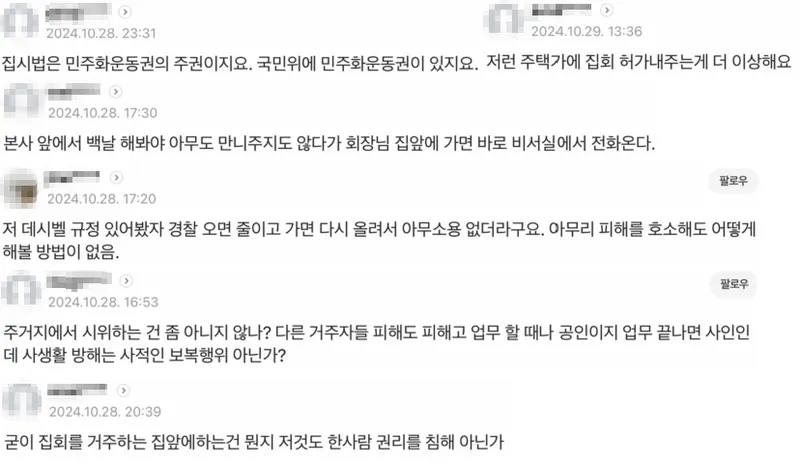
Netizens are also giving mixed reactions to this. some are“Assemblies in residential areas should be banned at the source.”, “What on earth are you doing in front of your home?”, “Not in a residential area, but maybe in front of a factory?”, “Along with the freedom of assembly, all ordinary citizens have the right to live quietly and as human beings without being disturbed.”He claimed that
also“Freedom of expression must be protected”, “The Protest and Demonstration Act is the sovereignty of the pro-democracy movement”, “Even if you protest in front of the headquarters for hundreds of days, no one will meet you, and when you go to the chairman’s house, the secretary’s office will immediately call you. This is a protest culture created by corporate culture.”There was also a response supporting the rights of the protesters.
What is the reason for going to your home and protesting?
Professor Kwak Geum-joo of Seoul National University's Department of Psychology said, "At work, there are security guards and high alerts, but at home it is not so, so the protestors can feel a direct and serious threat." He added, "Home is a private space, more threatening to others and a place where messages are delivered directly," and analyzed that the intention is to make the protestors feel a stronger sense of responsibility.
In particular, Professor Kwak added, “Company protests are divided into multiple responsibilities, but protests in front of houses are entirely the responsibility of the individual, so greater psychological pressure can be felt.”
Article 21, Paragraph 1 of the Constitution guarantees freedom of assembly and demonstration to all citizens, and under the Assembly and Demonstration Act (Assemblies and Demonstrations Act), protests are operated through a reporting system, not a permit system. However, Article 37, Paragraph 2 of the Constitution stipulates that this right may be restricted only when necessary to maintain public order and safety, allowing some restrictions in cases where there may be a threat to national security or public order.
In other words, it is difficult to ban protests in front of one's home, but it is possible to limit the noise level and time zone.
Last August, the revised Enforcement Decree of the Housing and Urban Development Act further strengthened the noise standards in residential areas, lowering the equivalent noise standard to 60 dB during the day, 50 dB at night, and 45 dB during the night (midnight to 7 a.m.), and lowered the maximum noise standard to 80 dB during the day, 70 dB at night, and 65 dB at night.
According to standards such as the World Health Organization (WHO) and the U.S. Environmental Protection Agency (EPA), 80dB is the noise level of a passing subway, 65dB is the noise level of conversations in a crowded cafe, and 60dB is the noise level of conversations with people in an office. The Ministry of Environment in Korea sets a noise level of 65dB or less as the daytime noise standard for residential areas, and believes that exceeding this level may result in increased inconvenience to residents.
Is there no way for residents to stop protests in their residential areas?
Attorney Choi Hyeon-deok of Daeryun Law Firm explained, “There is virtually no way to completely block protests in residential areas. If residents want to receive compensation for damage caused by noise, they must file a civil lawsuit, and this is only possible when the standard decibel level set by the Assembly and Demonstration Act is exceeded.”
He emphasized, “If 65 dB persists, it can be quite uncomfortable, so I think we need to lower the decibel standard further in the future or ban the use of loudspeakers in residential areas.”
[View full article] - “If the head of a large company is my neighbor, do I have to endure noise pollution?” [All That Check] (Shortcut)


Do you have more questions?






In-Person Consultation Booking
If you have legal concerns, consult with a specialist attorney at the nearest office.
