




Noise damage due to prolonged ‘impeachment rally’ in Hannam-dong… “Residents’ right to housing must also be guaranteed.”

2025-01-10
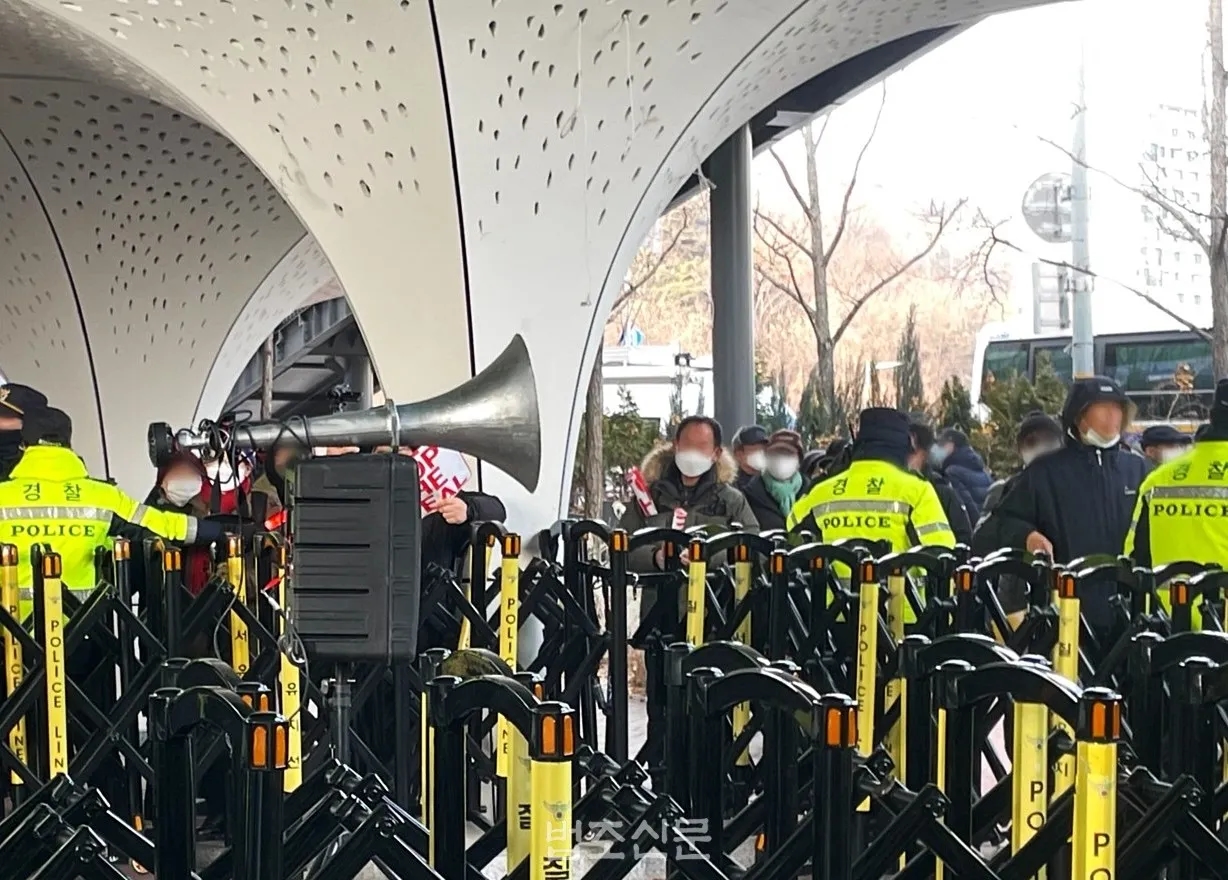
On the 7th, the number of protesters increased after the President's arrest warrant was issued again.
Noise continues for 24 hours... Resident: “I can’t even sleep at dawn”
“High decibels do not guarantee freedom of expression.”
“If the noise measurement results exceed the standard, appropriate action will be taken.”
As protests related to the impeachment of President Yoon Seok-yeol prolong near the presidential residence in Yongsan-gu, Seoul, noise damage is increasing. Accordingly, the legal community is pointing out that measures such as sanctions are needed for noise that exceeds legal standards.
After the ‘December 3 martial law incident’, the area near the official residence in Hannam-dong, Yongsan-gu, Seoul is filled with protesters every day. After the arrest warrant for President Yoon Seok-yeol was reissued on the 7th, more people began to gather. Supporters of President Yoon Seok-yeol are holding rallies on the northern and southern roads centered around his official residence in Hannam-dong, while civic groups in favor of impeachment are continuing their rallies near the Volvo Building in Hannam-dong. Protesters turned on loudspeakers and continued to say things like “Arrest Lee Jae-myung” and “Execute Yoon Seok-yeol,” and swear words and shouts were exchanged between protesters with different opinions.
As the protests continue, residents' complaints about noise are growing. Mr. A, who runs a restaurant alone near the presidential residence, complained, “It is mentally difficult because the loud noise continues all day.”
Mr. C, in his 20s, who has been living right next to the official residence for a year, confessed, “When I first protested, it was quiet in the early morning, but recently, the noise has gotten so bad even in the early morning that I can’t sleep.” He added, “I have filed complaints with the Yongsan-gu Office several times, but it only gets quiet for a while and then repeats itself, making it difficult to continue my daily life.”
Mr. Choi, in his 50s, who lives near Hannam Elementary School, said, “I don’t know what the children will see and learn when there is so much swearing. It is shameful that there are children living around here even when school is on vacation.”
At Hannam Elementary School, located close to the official residence, slogans such as “Impeachment is invalid” are loudly echoing. A police fence was installed around the main gate, and an employee dispatched from the Office of Education stood guard. Currently, Hannam Elementary School is on vacation, but about 70 students who use care classes, Neulbom School, winter camp, and kindergarten are going to and from school.
Police have installed noise meters and are measuring noise from gatherings. There were places that exceeded the regulatory standards, with the ‘equivalent noise level’ recording 79.8 decibels (db) and the ‘highest noise level’ recording 91.2 decibels (db).
Equivalent noise level is the average value of noise during the measurement time. If the maximum noise level exceeds 90 decibels (db) more than three times an hour, it is considered to be in violation of the regulations. According to the enforcement ordinance of the ‘Assembly and Demonstration Act (Assemblies Act)’, rallies held during the day in residential areas, schools, general hospitals, and public libraries are regulated to have an average noise level of 60 decibels (db) or less measured over 5 minutes, and for other areas, the average noise level measured over 10 minutes is 70 decibels (db) or less.
The legal community points out that a protest may be dispersed if the noise exceeds the specified decibel (db).
Choi Hyeon-deok (bar exam taken 8th time), lawyer at Daeryun Law Firm, explained, “According to Article 14 of the Assembly and Demonstration Act, the head of the competent police station may restrict the use of devices such as loudspeakers, drums, gongs, etc. if the use of devices such as loudspeakers, drums, gongs, etc. exceeds the standard decibels for each time zone and target region specified in the enforcement ordinance.” He added, “If the use continues to be exceeded, an order to disperse can even be issued.”
He then pointed out, “Failure to follow this constitutes obstruction of official duties,” and “If you injure a public official or interfere with the execution of official duties by using a dangerous object, it may be considered special obstruction of public duties.”
He said, “Police must take action according to the results of the noise meter,” and “If the police do not take appropriate action even though the equivalent noise level continues to exceed, it will be considered dereliction of duty.”
However, it is not easy to sanction rallies where noise from multiple groups is mixed, even if they exceed the permitted standards. There are no provisions in the current law to separate, calculate, and crack down on duplicate noise.
Attorney Choi explained, “If there are multiple rallies and protest groups and noise is generated simultaneously, it is difficult to find the person responsible for the noise,” and “Nevertheless, the only legal way to reduce the noise problem is to further lower the decibel level stipulated by the Enforcement Decree of the Assembly and Assembly Act.”
He said, “Freedom of expression is not guaranteed just because you use a loudspeaker to express your opinion at a high decibel.”
A lawyer from Seocho-dong said, “Assemblies are often held in plazas or public places,” and expressed concern, “Because Hannam-dong is close to general residential areas, the residents’ right to housing and freedom of assembly are in direct conflict.”
He said, “It may not be possible to ban assemblies, but (police) need to guarantee the housing rights of nearby residents by regularly informing them of excessive decibels and lowering the decibel level.”
Juhyeon Cheon (48th bar exam), a lawyer specializing in criminal law, explained, “According to the Assembly and Demonstration Act, the punishment is somewhat low, with up to 3 years for disorderly conduct and threats of violence, and up to 6 months for violating the ban on the use of loudspeakers,” adding, “The punishment provisions are set low to ensure ‘freedom of assembly’ as much as possible.”
He continued, “The intention is to strengthen the basic constitutional right of freedom of assembly and association by ensuring that most acts receive low punishment even if they are broadly interpreted as disrupting order.”
“However, if unrest or violence occurs, the purpose of broadly guaranteeing freedom of assembly may be lost,” he said. “We must guarantee freedom of assembly as much as possible, but if it is judged to be detrimental to public peace and order, we must be able to take appropriate measures.”
Meanwhile, the Presidential Office appears to have strengthened its alert posture to prevent arrests. The entrance to the official residence was blocked by several minibuses, blocking the view, and a new barbed wire fence was installed. Security personnel frequently patrolled near the police line and immediately stopped citizens who stopped for a moment or took pictures. Reporters are also allowed to film only outside the designated lines.
Reporter Oh In-ae (olive@koreanbar.or.kr)
[View full article]
Noise damage due to prolonged ‘impeachment rally’ in Hannam-dong... “Residents’ right to housing must also be guaranteed” (Shortcut)

Do you have more questions?






In-Person Consultation Booking
If you have legal concerns, consult with a specialist attorney at the nearest office.
