




Daeryun Law Firm successfully completed seminar on ‘Compliance issues and practices in the pharmaceutical field’

2025-03-13
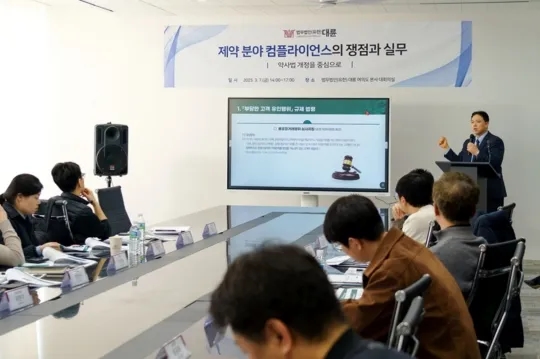
Focusing on revision of the Pharmaceutical Affairs Act, introduction of CSO reporting system and disclosure of expenditure reports, etc.
On the 7th, a seminar with the theme of ‘Issues and Practices of Compliance in the Pharmaceutical Sector’ was held at the headquarters of Daeryun Law Firm in Yeouido, Seoul.
This seminar was prepared to explore response strategies for related companies amid strengthening regulations on illegal rebates in the pharmaceutical industry, such as the implementation of the pharmaceutical sales sales operator (CSO) reporting system in October last year following the revision of the Pharmaceutical Affairs Act.
The seminar, which was held online and offline, was attended by about 80 executives and employees from the legal, compliance, and audit departments of top domestic pharmaceutical companies, bio and healthcare companies affiliated with large corporations, and global pharmaceutical companies, reflecting the industry's keen interest.
This seminar, which consisted of a total of four sessions, was attended by attorney Yoonjeong Choi of Daeryun Medical Pharmaceutical Group, Gyejun Son of the Corporate Legal Group, advisor Myeongsoon Choi, and tax accountant Jeongoh Lim. In the first session, Attorney Choi Yoon-jeong introduced the CSO reporting system and the expenditure report disclosure system on the provision of economic benefits, which has been in full effect since this month.
Attorney Choi said, “With the implementation of the CSO reporting system, drug and medical device sales promotions have become obligated to report, and pharmaceutical companies, etc., will no longer be able to entrust sales promotion work to CSOs that have not reported.” In addition, regarding the expenditure report, he advised, “Since CSOs are also included in the preparation, it is necessary to check and respond to the regulations on the entity providing the allowable economic benefits, the scope and content, storage of related data, etc.” He also advised, “You should be aware that criminal punishment as well as administrative measures are possible in case of violation of the above reporting and expenditure report-related regulations.”
In the second session, Attorney Kyejun Son, head of the Corporate Legal Group, conducted an in-depth analysis of the pharmaceutical industry's rebate regulations and the Fair Trade Compliance Program (CP). Attorney Son analyzed cases of sanctions from the Fair Trade Commission and presented CP construction strategies for each pharmaceutical company.
He advised, "CP grading follows the evaluation criteria specified in the regulations on operation and evaluation. It is a system in which grades are assigned based on the calculated scores, and companies with excellent grades can receive benefits such as reduced fines and corrective actions. Many pharmaceutical companies are already responding by forming a dedicated department. It is necessary to set a target grade, establish a CP operation plan, and inspect it through a checklist."
In particular, Attorney Son said that although the efforts of the working-level staff are important, the CEO's will and support also account for a large portion of the evaluation items, so it is necessary to strengthen the capabilities of the dedicated department. As a solution to this, it was proposed to analyze best practices and discover areas for improvement through inspection by external experts.
The third presentation was made by Advisor Choi Myeong-soon, who served as the head of the Gwangju Branch of the Health Insurance Review and Assessment Service (HIRA). When Advisor Choi served as the director of the Pharmaceutical Management Information Center, he established the first ‘Pharmaceutical Distribution Management Team’ in Korea and contributed to managing the pharmaceutical distribution system and establishing the basis for the rebate investigation system.
From a practical perspective, he analyzed the characteristics and status of the domestic and international pharmaceutical markets and administrative measures for drugs that disrupt distribution order. Advisor Choi analyzed, “The domestic pharmaceutical industry is centered on generic drugs, and as a result of excessive sales competition centered on the domestic market, rebates that provide unfair profits to medical institutions have become prevalent,” and introduced the pharmaceutical industry’s rebate investigation and investigation cooperation system, HIRA’s follow-up management of drug supply details and actual status investigation of expenditure reports, and practice of administrative disposition of rebate drugs.
Concluding his presentation, he suggested, “For the development of the pharmaceutical, wholesale, and distribution industries, an environment for new drug development and quality improvement must be created.”
In the last session, Jeong-Oh Lim, a tax accountant who has provided tax adjustment and advice to hospitals, clinics, and manufacturing companies, appeared as a presenter. Tax accountant Lim explained tax issues that may arise when rebates are discovered and corporate response measures.
Tax accountant Lim emphasized, “In the past, tax investigations were limited to imposing corporate tax on providers due to structural constraints in the pharmaceutical market and limitations in rebate tracking manpower and time. However, the recent trend of tax investigations is to focus on revealing the attribution of income and taxation. Therefore, if you are investigated, you must check and respond to every detail.”
Here, Tax Accountant Lim explained that caution is required as rebate providers can be subject to imprisonment and fines (necessary sentences of two or more punishments at the same time are possible).
CEO Kook-il Kim said, “In the pharmaceutical industry, the importance of compliance in operating a company stably is increasing day by day,” and added, “We will continue to hold regular seminars so that we can have time to think about the difficulties within the industry together, so please give us your interest.”
Meanwhile, Daeryun Medical & Pharmaceutical Group has a Pharmaceutical, Bio, and Healthcare Center under its umbrella, and provides services such as advisory, litigation, and legal consulting to help companies minimize legal risks.
In addition, the group is led by group leader Jin-seong Song, a former doctor, and is led by center director Seo-hyung Lee, who advises organizations such as the Ministry of Health and Welfare and the Korea Disease Control and Prevention Agency; Il-hyung Lee, an attorney with experience at Celltrion and a patent law firm; So-young Yoon, an attorney with experience at the Ministry of Health and Welfare and the HIRA; Yun-jeong Choi, an attorney who advises companies such as pharmaceutical companies; and Myeong-soon Choi, an advisor who served as the Gwangju branch director of HIRA.
Reporter Park Jun-sik (parkjs@wowtv.co.kr)
[View full article]
Korea Economic TV - Daeryun Law Firm, ‘Pharmaceutical Compliance Issues and Practice’ Seminar Successfully Completed (Go)
Law News - Daeryun, 'Pharmaceutical Compliance Issues and Practices' Seminar Successfully Completed (Go to)

Do you have more questions?






In-Person Consultation Booking
If you have legal concerns, consult with a specialist attorney at the nearest office.
