




Battery Industry Association holds ‘U.S. OBBB Law and Visa Response Strategy Briefing’

2025-07-22
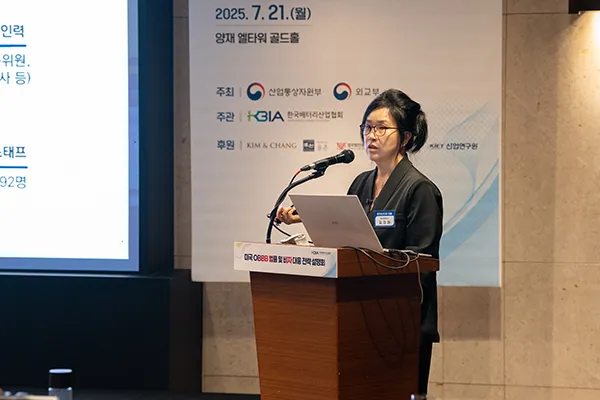
Presentations by lawyers from law firms such as Daeryun, Kim & Chang, and Yulchon
As the U.S. administration led by President Trump implemented strong immigration policies, including restrictions on entry of foreigners and crackdowns on illegal immigrants, the domestic industry was also put on alert. Amid the strengthening of U.S. visa screening, an information session was held on July 21 at El Tower in Yangjae, Seoul to explore corporate response measures following the enactment of the so-called 'One Big Beautiful Bill Act (OBBBA)', which reflects President Trump's major national agendas such as tax cuts and strengthened crackdown on illegal immigration.
At the 'U.S. OBBBA legal and visa response strategy briefing session' held by the Korea Battery Industry Association, lawyers from several law firms, including Kim & Chang Law Firm, Yulchon Law Firm, Daeryun Law Firm, and American law firm Covington & Burling, appeared as presenters and shared know-how on visa interviews and tax credit compliance.
U.S. attorney Mia Kim introduces B1/B2 visa interview know-how
Mia Kim, an American lawyer at Daeryun Law Firm, noted, "Recently, there has been an increasing number of cases where visa approval is delayed or denied in cases where there are replaceable human resources in the U.S. or there is a history of repeated entry through ESTA and a long-term stay," and introduced interview know-how for B1/B2 visas, which Korean companies frequently apply for but face difficulties among the major types of U.S. visas. The B1 non-immigrant visa is for short-term business purposes in the United States, and the B2 is for tourism, medical treatment, etc. Both visas are short-term visits and the length of stay is limited to 6 months.
Attorney Kim explained, “You must prepare a specific and consistent business trip or research plan focusing on content directly connected to your professional field, such as career experience, business trip plan, research plan, and job relevance,” and “If the business trip is for the purpose, the specific schedule and work details must be revealed.”
Foreign lawyer Koo Ja-min of Covington & Burling, foreign lawyer Hong Wook-seon of Yulchon Law Firm, and accountant Jeong Hyun explained the main contents of OBBB Law's tax reform in the battery sector. In addition, he said that eligibility requirements and compliance standards will be specified through the Ministry of Finance's enforcement regulations in accordance with the OBBB Act, and shared a tax credit compliance checklist, including eligibility review, construction start requirements, tax credit calculation and transfer, compliance obligations and sanctions related to Prohibited Foreign Entity (PFE), and contract and legal risk management.
Foreign lawyers So-yeon Park, Yeon-woo Lee, and Eui-hyun Kim of Kim & Chang Law Firm presented the newly introduced definition of PFE, material assistance requirements, and corporate compliance matters for PFE to regulate supply chains in specific countries. If a PFE from a covered nation, such as China, North Korea, Russia, or Iran, invests, manufactures, and produces in the United States, it cannot receive tax credits such as the Advanced Manufacturing and Production Tax Credit (AMPC), Clean Power Investment Tax Credit (ITC), and Production Tax Credit (PTC).
Legal Times Reporter Eunjae Lee (eunjae@legaltimes.co.kr)
[View full article]
Legal Times - Battery Industry Association holds 'U.S. OBBB law and visa response strategy briefing' (link)
Korea Economy - US visa screening becomes stricter... “A strategic approach is needed to reduce entry risk” (Shortcut)
Naeoe Economy TV - "US Visa, now a strategy is needed"... Companies are on high alert due to strengthened screening (Shortcut)

Do you have more questions?






In-Person Consultation Booking
If you have legal concerns, consult with a specialist attorney at the nearest office.
