




"7,000 won per review" pretending to be a good restaurant and giving it '5 stars'...it's a manipulation

2025-12-30
The practice of advertising and marketing agencies registering false reviews of restaurants on platforms such as Naver has not been eradicated. It is pointed out that it not only disables the review function but also reduces consumer trust. Experts warned that there is a high possibility that false reviews could be illegal, such as violating the Labeling and Advertising Act.
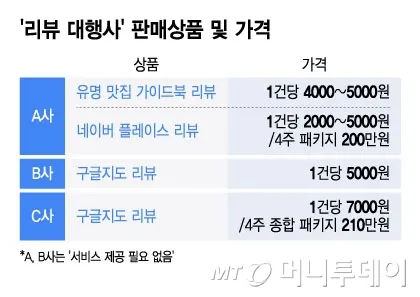
According to industry sources on the 30th, some marketing agencies are selling products that register reviews desired by restaurant owners in exchange for money. They targeted major platforms such as Naver and Google, and in some cases, they sold review products of restaurant guides claiming to be Korea's Michelin Guide. The price was up to 7,000 won per review. It is known that reviewers receive 1,000 to 2,000 won in return.
Agency A received 4,000 to 5,000 won per review. The business owner can convey the desired review text to the business within 300 characters. However, the number of review registrations was limited to 1 to 2 per day. This appears to be because they were conscious of the response of the platform company that monitors reviews. An agency official said, "Even if you write 10 articles a day, there are many cases where they are not exposed (by the platform company)."
Another agency B also sold a product that paid 5,000 won per Google Maps review. The product description said, “For new companies or industries that need to expand exposure, increasing star ratings and securing reviews is very advantageous in forming initial competitiveness,” and “Automatic reflection begins within 5 to 20 minutes on average after ordering.”
Agencies advertise that they are based on 'actual users', but this does not mean actual product or store users. Agency B also explained that there was no need to prepare actual food. When asked whether food should be provided to the reviewer, an official from Agency B said, "A review is literally just something to make it look pretty," and "If you are not hosting a review event, you don't have to provide (food)."
Possibility of violation of the Labeling and Advertising Act... ‘Poomasi’ is also a problem
There are also quite a few 'review poomasi' where business owners register reviews as if they were customers. On this day, hundreds of business owners gathered in a group chat room called ‘Reservation Review Marketing Study’ and exchanged reviews. There were also rules, such as having to delete records such as cache after completing the review. Woo Woo-jin, an attorney at Daeryun Law Firm, said, “Listing false advertisements for a company can also be included as an economic interest.”
According to the Fair Trade Commission, 'false reviews' by some agencies are likely to constitute a violation of the Labeling and Advertising Act. The act of requesting a review between an advertising and marketing agency and a business owner such as a restaurant is not a problem in itself, but the review writer must meet conditions such as △ specifying that financial compensation was received △ and △ actual use of the service. Violation of this constitutes deception or false advertising.
There are also cases that led to punishment. In September of this year, Mr. C, an internet consulting business, was sentenced to a fine of 10 million won by the Seoul Central District Court on charges of interfering with the business of a restaurant advertising and order brokerage platform company. He planned a business to register false reviews by receiving 1,800 won per review from restaurant owners, and paid 1,200 won per review to part-time workers who participated in the project.
An official from the Fair Trade Commission said, "If the amount of false reviews is large and malicious, a fine will be imposed. If not, corrective measures such as deleting false reviews will be taken." An obligation to prohibit repetition of false reviews is also imposed. If you violate this, you may be reported to the prosecution and subject to criminal punishment.
Fake reviews can lead to consumer distrust. Baek Gwang-hyeon, a lawyer at Barun Law Firm, said, “Complying with the Labeling and Advertising Act regulations should be viewed as the first step to gaining overall trust in customers and consumers rather than thinking of it as an effort to avoid sanctions or punishment from the Fair Trade Commission,” and added, “It is better to protect the overall brand value through trust rather than increasing short-term sales through manipulation.”
Reporter Park Jin-ho (zzino@mt.co.kr)
[View full article]
"7,000 won per review" Pretending to be a good restaurant and giving it '5 stars'... a harsh manipulation (link)

Do you have more questions?






In-Person Consultation Booking
If you have legal concerns, consult with a specialist attorney at the nearest office.
