




Daeryun, AI basic law response strategy seminar..."Inspection of high-impact AI regulation and responsibility structure"

2026-01-30
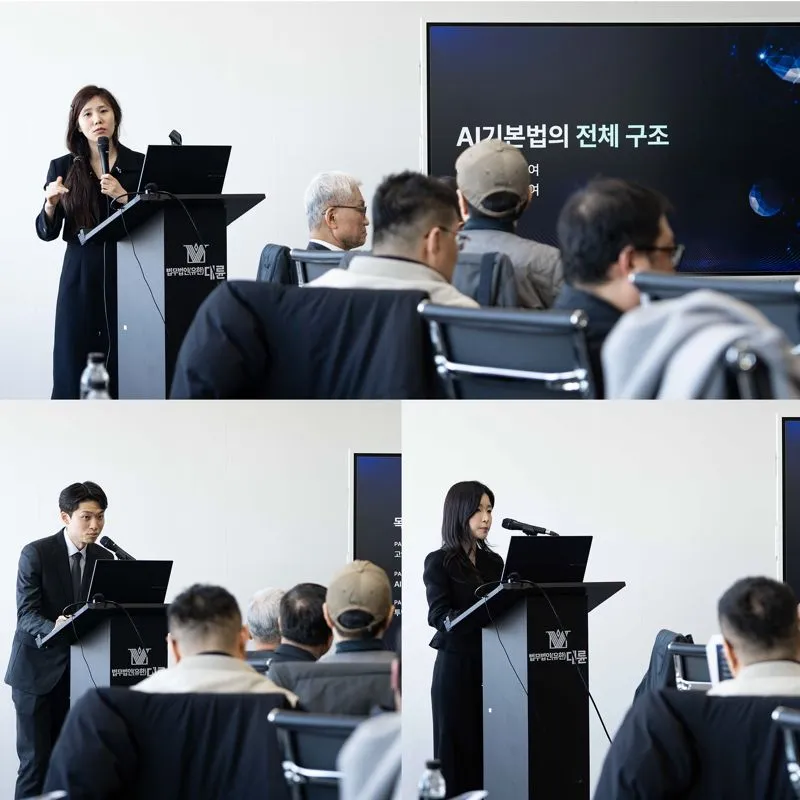
Daeryun Law Firm announced on the 30th that it successfully completed a seminar on the theme of ‘Artificial Intelligence (AI) Basic Law-Corporate Response Strategy’.
This seminar, held on the 29th, was held jointly with the Korea Artificial Intelligence Association. It was designed to examine changes in the regulatory environment that companies will face in the wake of the Basic AI Act, which comes into effect at the end of this month, and to present practical response strategies.
The event, which was held online and offline, was attended by people from all walks of life, including officials from major domestic and foreign conglomerates representing various industries such as energy, manufacturing, and distribution, as well as officials from national research institutes.
Attorney Choi Yi-seon, who made the first presentation, explained the system and legislative purpose of the Basic Artificial Intelligence Act under the topic, ‘Basic Act on Artificial Intelligence: Landmine or Shield?’ Attorney Choi analyzed, “Unlike the EU AI Act, Korea’s AI Basic Act does not prohibit the use of specific artificial intelligence in principle,” and “It is a structure that supports industrial growth and imposes management responsibility only for areas with a large social impact.”
He continued, “AI compliance is not a regulation, but can be a practical shield to protect companies in the event of future accidents or disputes.”
Attorney Nam Kwon-yul pointed out the ‘differential regulation system’ of the AI Framework Act. He explained, “The AI Basic Act varies the intensity of regulation depending on the impact of artificial intelligence, and specifically imposes transparency, safety, and accountability obligations on high-impact AI.” He also said, “The starting point for risk management is for a company to clearly distinguish whether it is a ‘developer’ or a ‘user operator,’ or a combination of both statuses.”
In addition, “User operators in direct contact with users must focus on securing ‘transparency’ by informing of the fact that AI is being used, and developers who build systems must focus on ‘business responsibilities’ such as risk management systems,” he added. “In particular, among the business responsibilities, items 1 to 3 are considered to have been fulfilled if the developer has fulfilled their obligations, thereby relieving the burden of overlapping regulations.” He emphasized, “Legal response in the AI era is a matter of insight to distinguish which position each person takes on and what responsibility,” adding, “For new risks, lawyers from Daeryun Law Firm will share the burden together.”
In the last session, attorney Seohyung Lee explained from a practical perspective how companies should check and fulfill each obligation under the topic of ‘Practical response measures for companies under the AI Basic Act’. In this process, he used high-impact AI as an example and emphasized that its relevance should be judged based on the context in which it is used, rather than a specific technology or model type. Regarding the transparency obligation, it was pointed out that advance notice of AI use and display of results should not be limited to formal measures, and should be structurally reflected from the service design stage so that users can actually recognize this.
Attorney Lee went on to say, “Responding to the AI Framework Act is not a matter of declarative compliance, but rather a process of classifying application obligations based on whether it is high-impact, generative, or high-performance AI and reflecting this in the company’s decision-making and operating structure,” adding, “It is important to have a system in which these standards can be continuously checked and reviewed throughout the development, operation, and legal stages.”
Daeryun CEO Kim Kook-il said, “This seminar was an opportunity to pre-examine the regulatory environment and responsibility structure that companies will actually face after the implementation of the Basic AI Act. Daeryun will support companies’ practical regulatory responses through integrated legal advice covering everything from high-impact artificial intelligence judgment to responsibility design, compliance establishment, and dispute response, centered on the AI and Data Intelligence Group.”
Reporter Kwon Byeong-seok (bsk730@fnnews.com)
[View full article]
Financial News - Daeryun, AI basic law response strategy seminar..."Inspection of high-impact AI regulation and responsibility structure" (link)
Lawleader - “Intensive inspection of high-impact AI regulation and responsibility structure”... Daeryun, AI basic law response strategy seminar successfully completed (link)

Do you have more questions?






In-Person Consultation Booking
If you have legal concerns, consult with a specialist attorney at the nearest office.
