
CONTENTS
- 1. Claim for Wages and Severance Pay | A Guide to Responding to Nonpayment

- 2. Claim for Wages and Severance Pay | The Concept and Regulation of Wages
- - Prescription and Right to Claim for Unpaid Wages and Severance Pay
- - Delay Interest on Unpaid Wages
- - Shutdown Allowance and Shutdown Compensation
- 3. Claim for Wages and Severance Pay | Methods of Resolving Nonpayment
- - Filing a Petition Directly with the Ministry of Employment and Labor
- - Application for a Payment Order (Demand Procedure)
- - Responding to a Civil Lawsuit for Wage Claims
- - Sanctioning the Employer Through a Criminal Complaint
- 4. Claim for Wages and Severance Pay | Issues to Confirm When Filing a Claim
- 5. Claim for Wages and Severance Pay | Differences Between the Worker's and Employer's Positions
- - If You Are in the Employer's Position?

1. Claim for Wages and Severance Pay | A Guide to Responding to Nonpayment

Wage and retirement allowance claims are an important area for the protection of workers' rights.
Every worker should receive wages as consideration for providing labor under the direction of the employer.
In practice, however, cases in which basic rights are infringed still arise frequently, such as unpaid wages, nonpayment of retirement allowances, and omission of overtime and holiday allowances.
We provide guidance on the matters that constitute violations of the Labor Standards Act, which both workers and employers should be aware of, as well as response measures, and on the specific procedures and evidence ranging from a petition to the Ministry of Employment and Labor to civil litigation and a criminal complaint.


2. Claim for Wages and Severance Pay | The Concept and Regulation of Wages
Article 2 of the Labor Standards Act defines 'wages' as all money and valuables received from the employer as consideration for labor.
This includes not only the base pay but also bonuses, allowances, overtime allowances, night and holiday work allowances, and the statutory weekly holiday allowance.
Retirement allowances are separately governed by the Employee Retirement Benefit Security Act, but the employer likewise bears the obligation to pay them, and an employer must pay an average wage of at least 30 days for each year where a worker has continuously worked for one year or more.
 Prescription and Right to Claim for Unpaid Wages and Severance Pay
The most important matter in a wage arrears dispute is the extinctive prescription.
Article 49 of the Labor Standards Act provides that the prescription period for a wage claim is three years.
The same applies to severance pay. For example, if a person left employment in August 2022 and did not receive severance pay, the person must file suit before August 2025 in order for the right of claim not to be extinguished.
Where the prescription period is approaching, a wage lawsuit should be commenced immediately.
In particular, please note that in order to readily receive a substitute payment through a petition to the Ministry of Employment and Labor, the petition must be filed within one year after leaving employment.
The prescription runs from the last payment date or the date on which payment should have been made.
Priority payment system for wage claims
Where the employer's property is sold at auction due to insolvency or other reasons, a priority payment system for wage claims is in place to protect employees who have not received wages or other claims arising from the employment relationship, covering wages for the final three months, accident compensation, and severance pay for the final three years, among other items.
Delay Interest on Unpaid Wages
When claiming wages or a retirement allowance, delay interest on the unpaid amount may also be claimed.
Because wages and retirement allowances are, in principle, to be paid within 14 days from the date on which the ground for payment arises (the payday and the date of retirement), the prescription period begins to run after those 14 days.
Where payment is not made accordingly, delay interest of 20% on the number of days of delay must be paid up to the date of payment.
However, because there are grounds for exclusion from the application of delay interest when claiming unpaid wages or a retirement allowance, please take care when making a claim.
- A natural disaster affecting the employer
- A decision to commence rehabilitation proceedings under the Debtor Rehabilitation and Bankruptcy Act
- A decision declaring bankruptcy under the Debtor Rehabilitation and Bankruptcy Act
- Recognition by the Minister of Employment and Labor of facts such as insolvency
- Other cases in which it is difficult to secure funds for the payment of wages and retirement allowances
Shutdown Allowance and Shutdown Compensation
Where the employer suspends work without any cause attributable to the worker, Article 46 of the Labor Standards Act provides that the employer must pay a shutdown allowance.
The shutdown allowance must be at least 70% of the average wage, and this applies even where the workplace is in financial difficulty or where construction has been suspended due to a problem with the client.
A concept easily confused with the shutdown allowance is the temporary disability compensation.
Temporary disability compensation falls within the area of industrial accident compensation and refers to receiving 60% of the average wage while a worker is being treated for an occupational injury or disease.
Because temporary disability compensation arising from an industrial accident is borne in full by the employer or is paid through industrial accident insurance, the industrial accident application must be filed first.
3. Claim for Wages and Severance Pay | Methods of Resolving Nonpayment

An employer who fails to pay wages or severance pay on time is subject to the following disadvantages.
An employee may pursue a wage or severance pay claim and resolve the nonpayment of wages and severance pay by the following methods.
Filing a Petition Directly with the Ministry of Employment and Labor
When wage arrears occur, the simplest means is to file a petition with the Ministry of Employment and Labor.
When one files a petition or a criminal complaint with the competent local employment and labor office, the labor inspector summons and investigates the employer, and if the fact of arrears is confirmed, issues a corrective order.
At this point, if the claimed amount of wages or severance pay is received, the matter is concluded, and if the employer still does not pay even after the petition, the case may be referred to prosecution for violation of the Labor Standards Act, and the employer may be subject to criminal punishment.
In practice, an employer may be sentenced to a fine or even imprisonment, so the matter is often resolved through a settlement on payment.
The key point in drafting the petition is to clearly prove the facts by attaching, as evidence, the labor contract, pay statements, bankbook records, time-and-attendance records, messenger content, and the like.
Application for a Payment Order (Demand Procedure)
A procedure simpler than litigation is the payment order.
If there is little dispute over the unpaid wages and the facts are clear, the court issues a payment order without examining the debtor (the employer).
However, if the debtor receives an order to supplement the address, or if the court so decides ex officio, or if the debtor files an objection, the matter is converted into a civil lawsuit.
Responding to a Civil Lawsuit for Wage Claims
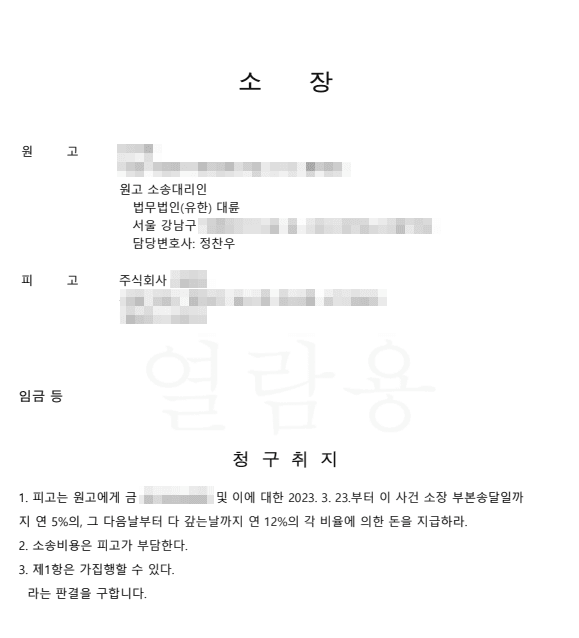
If the matter cannot be resolved through a complaint alone, or if there is a concern that the employer may conceal assets, you should promptly file a civil lawsuit.
If the unpaid amount is 30 million won or less, the matter can proceed as a small claims case, which is relatively simple.
A civil lawsuit is filed by submitting a complaint to the competent district court. (Electronic litigation is available.)
- Purport of the claim : The content stating how much is to be paid and by when
- Cause of the claim : The period of work, the working conditions, and the fact of non-payment
- Attached evidence : The employment contract, pay statements, documents related to joining and leaving employment, bankbook records, messages between the parties concerning payment, recordings, and similar materials
If necessary, it can also be advisable to first freeze the employer's deposits, real estate, or other assets through a provisional attachment.
After the wage or severance pay claim is granted, compulsory execution can be carried out based on that judgment.
Sanctioning the Employer Through a Criminal Complaint
A violation of the Labor Standards Act is, in principle, subject to criminal punishment.
A worker may file a criminal complaint after lodging a petition with a police station or the Ministry of Employment and Labor, and once the complaint is received, it is referred to the competent prosecutors' office.
Nonpayment of wages and retirement allowances, and failure to pay retirement pension contributions, can place strong pressure on the employer through a criminal complaint.
This is because a criminal complaint for a claim for wages or retirement allowances is a crime not punishable against the victim's will, so the matter can be concluded through an amicable settlement with the worker.
If nonpayment of wages or retirement allowances is recognized, the employer is subject to imprisonment for up to 3 years or a fine of up to 30 million won.
4. Claim for Wages and Severance Pay | Issues to Confirm When Filing a Claim
Overtime allowance: If a worker works more than 40 hours per week, an overtime allowance arises.
Overtime work is permitted for up to 12 hours per week, and it must be paid with an additional amount of at least 50% of ordinary wages.
Cases of omitted weekly holiday allowance are also common, so the pay statement should be checked carefully.
② Calculation of shutdown allowance: When work is suspended, materials documenting how the cause arose (internal official documents, instructions from the ordering party, etc.) should be gathered so that it can be proven that the cause is 'not attributable to the worker.'
③ Preservation of evidence: Supporting materials should be secured from as many angles as possible, including the employment contract, attendance records, emails, and recordings, and a coworker's written statement is also valid evidence.
④ Interruption of the statute of limitations: A petition, an application for a payment order, and a lawsuit all interrupt the statute of limitations.
If a single petition is insufficient, the matter may proceed to a civil lawsuit and a criminal complaint.
⑤ Compulsory execution: If you prevail in the civil lawsuit, you should secure the written judgment and then proceed with the compulsory execution procedure.
If the unpaid amount is below a certain amount (such as the simplified substitute payment cap of seven million won), you may make use of the substitute payment system, under which the government pays a portion on the employer's behalf.
5. Claim for Wages and Severance Pay | Differences Between the Worker's and Employer's Positions

A claim for wages or retirement allowances is a right directly connected to a worker's right to subsistence.
If nonpayment has occurred, you should immediately clarify the facts through a petition to the Ministry of Employment and Labor and, depending on the situation, protect your rights by also pursuing an application for a payment order, a civil lawsuit, and a criminal complaint.
The most important thing is evidence. You should thoroughly prepare the employment contract, bank account records, and attendance records so as to be able to prove the fact of work performed and the fact of nonpayment of wages.
If You Are in the Employer's Position?
From the employer's standpoint, rather than attempting to attribute everything to the 'employee's fault,' it is advisable to organize the facts and prepare materials transparently.
An employer may prove, for example, that part of an amount could not be paid for a justifiable reason, or that a matter had already been agreed upon.
An employer may also prevent the matter from escalating into a complaint to the Ministry of Employment and Labor or into criminal punishment through a prompt settlement with the employee.
At this firm, labor and industrial accident attorneys and labor consultants work together to provide consultation and propose resolution methods for wage and severance pay claims.
For matters requiring consultation, this firm offers consultation through its branch offices nationwide.
See More