
CONTENTS
- 1. Industrial Accident Compensation Insurance Act | Items Fully Borne by the Employer

- - Parties Exempt from Mandatory Enrollment in Industrial Accident Insurance
- - Service Providers Covered by Industrial Accident Insurance
- - Disadvantages for Employers Who Fail to Enroll in Industrial Accident Insurance
- 2. Industrial Accident Compensation Insurance Act | Criteria for Work-Related Accidents
- - Work-Related Accidents Caused by an Accident
- - Work-Related Accidents Caused by Illness
- - Criteria for Recognition When a Child with Impaired Health Is Born
- 3. Industrial Accident Compensation Insurance Act | How the Industrial Accident Insurance Premium Is Calculated
- - Special Provisions on Industrial Accident Insurance Premium Rates
- - Rate of Increase or Decrease in the Industrial Accident Insurance Premium Rate Relative to the Loss Ratio
- 4. Industrial Accident Compensation Insurance Act | Other Disadvantages When an Industrial Accident Occurs
- - Public Disclosure of Workplaces with Frequent Accidents and Disadvantages in Public Bidding
- - Civil Liability for Damages
- 5. Industrial Accident Compensation Insurance Act | Risks of Avoiding Industrial Accident Processing
- - Practical Checklist for Managing Industrial Accident Risk
- - A Safeguard That Protects Trust Rather Than Cost

1. Industrial Accident Compensation Insurance Act | Items Fully Borne by the Employer

The Industrial Accident Compensation Insurance Act is a social insurance that protects workers from work-related accidents and provides prompt and fair compensation to injured workers and their surviving family members so that they can maintain a stable livelihood.
Industrial accident insurance must be enrolled in mandatorily by the employer, who bears the full industrial accident insurance premium rather than the individual worker, and it is under the jurisdiction of the Ministry of Employment and Labor and operated and managed by the Korea Workers' Compensation and Welfare Service.
Industrial accident insurance applies regardless of the form of the employment contract, and daily workers, contract workers, overseas dispatched workers, field trainees, and the like are all subject to industrial accident compensation.
As the scope of application has recently been expanding to include platform workers and workers in special types of employment, employers may need to periodically review the parties subject to industrial accident insurance and the structure for calculating the premium.
 Parties Exempt from Mandatory Enrollment in Industrial Accident Insurance
The following businesses are not subject to the Industrial Accident Compensation Insurance Act.
- Businesses eligible for accident compensation under the Public Officials and Soldiers Accident Compensation Act
- Businesses eligible for accident compensation under the Seafarers Act and the Fishers and Fishing Vessels Accident Compensation Insurance Act
- Businesses eligible for accident compensation under the Pension for Private School Teachers and Staff Act
- Household employment activities
- Individual businesses with fewer than five regular workers among agriculture, forestry, fishery, and hunting businesses
Service Providers Covered by Industrial Accident Insurance
- Insurance solicitors
- Construction machinery operators
- Door-to-door study material instructors
- Golf course caddies
- Parcel delivery drivers
- Quick-service couriers
- Loan brokers
- Credit card membership solicitors
- Designated (substitute) drivers
- Door-to-door salespersons
- Door-to-door inspectors of rental products
- Home appliance delivery and installation technicians
- Cargo truck owner-operators at construction sites, such as water trucks and cargo cranes
- All commercial cargo truck owner-operators
- Software technicians
- After-school program instructors
- Tourism interpreter guides
- Children's school bus drivers
Disadvantages for Employers Who Fail to Enroll in Industrial Accident Insurance
Under the Industrial Accident Compensation Insurance Act, industrial accident insurance is in principle mandatory for all workers.
When an employer uses workers, the employer must file a report of establishment of industrial accident insurance with the Korea Workers' Compensation and Welfare Service within 14 days from the date business commences. (Violation results in an administrative fine of up to 3 million won.)
However, even at a workplace that has not enrolled, a worker may file an industrial accident claim directly without the employer's consent, and the Korea Workers' Compensation and Welfare Service investigates the facts in lieu of employer confirmation to decide whether to approve the industrial accident.
Employers must comply with their obligations to file the establishment report and pay premiums within the statutory deadline so that, even if an industrial accident occurs, legal liability and financial burdens can be minimized.
▶Disadvantages for Employers Found Not to Have Enrolled


2. Industrial Accident Compensation Insurance Act | Criteria for Work-Related Accidents
When a worker suffers a work-related accident due to an accident or illness, the worker may, in accordance with the requirements set out in the Industrial Accident Compensation Insurance Act, receive insurance benefits such as medical care benefits, temporary disability benefits, disability benefits, nursing benefits, survivors' benefits, injury-disease compensation annuity, funeral expenses, and vocational rehabilitation benefits.
An accident occurring on a usual commuting route is also recognized as a work-related accident.
Work-Related Accidents Caused by an Accident
- An accident occurring during work or acts under the worker's employment contract
- An accident occurring due to a defect in, or negligent management of, a facility provided by the employer
- An accident occurring during an event organized or directed by the employer, or during preparation for such an event
- Other accidents arising from natural disasters such as typhoons, floods, and earthquakes, and from sudden situations
- A reasonable causal relationship between the work and the accident or disaster
The burden of proving the causal relationship lies with the worker or surviving family member who seeks to receive insurance benefits.
In addition, the causal relationship should generally be judged based on the health and physical condition of the worker concerned, rather than on an average person.
In this case, a disaster caused by the worker's intentional act, self-harm, or criminal act is not recognized.
Suicide by jumping due to stress caused by work, recognized as a work-related accident
A case in which a worker, after stress accumulated from life abroad and an excessive workload, fell into a state of mental derangement and committed suicide by jumping from a window is recognized as having a reasonable causal relationship with the work. (Supreme Court Decision 99Du3331, June 8, 1999)
See More
Work-Related Accidents Caused by Illness
If, due to a work-related cause, the following illness or disability arises or the worker dies, this is likewise judged to be a work-related accident.
[Types Recognized as Work-Related Illnesses]
- Cerebrovascular and cardiac diseases
- Musculoskeletal diseases
- Respiratory diseases
- Neuropsychiatric diseases
- Lymphatic and hematopoietic diseases
- Skin, eye, and ear diseases
- Liver diseases
- Diseases caused by infection and acute poisoning, and the like
- Occupational cancer
Criteria for Recognition When a Child with Impaired Health Is Born
When a worker suffers a work-related accident and gives birth to a child with an injury, illness, or disability, that child is called a 'child with impaired health.'
In this case, medical care benefits, disability benefits, nursing benefits, funeral expenses, and vocational rehabilitation benefits for the child may be received.
The disability grade for a child with impaired health is determined after the age of 18.
3. Industrial Accident Compensation Insurance Act | How the Industrial Accident Insurance Premium Is Calculated
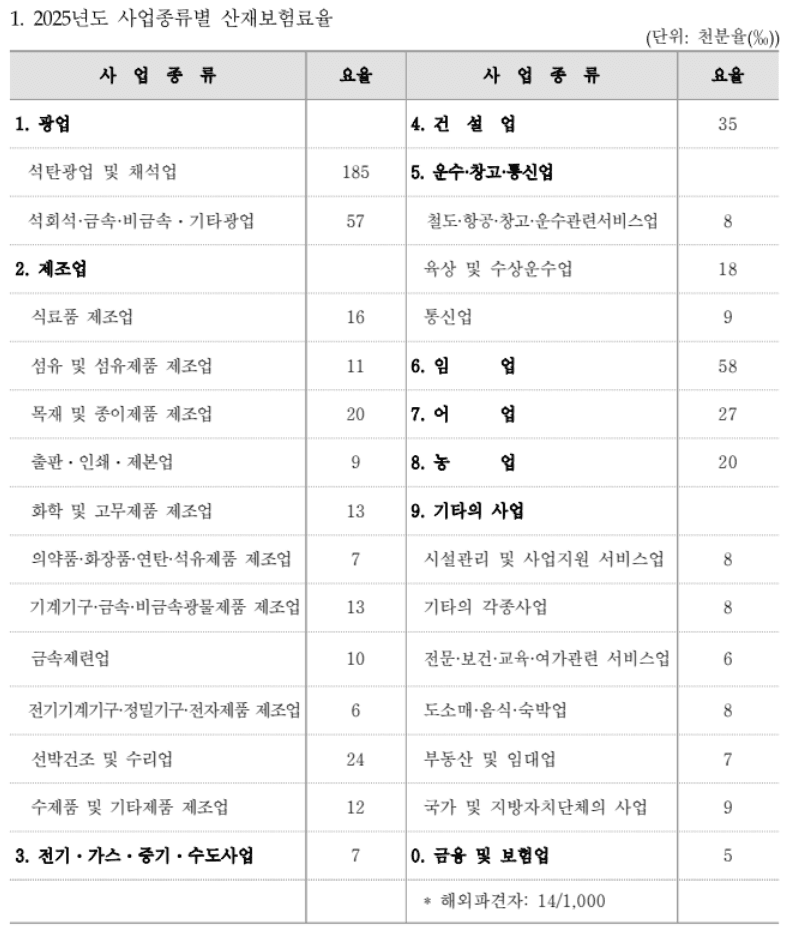
The industrial accident insurance premium that the employer must bear is the sum of the amount obtained by multiplying the total remuneration of the employer's business by the industrial accident insurance premium rate.
Method for Calculating the Industrial Accident Insurance Premium
Each worker's monthly average remuneration × (premium rate by type of business + commuting accident premium rate)
(※ For labor providers, each person's original remuneration amount × industrial accident insurance premium rate)
The commuting accident premium rate is calculated at 0.6/1,000 regardless of the type of business.
Special Provisions on Industrial Accident Insurance Premium Rates
For industrial accident insurance, once three years have passed since the insurance relationship was established, the premium rate is increased or decreased by up to 20% according to the insurance benefit-to-premium ratio. (There is no increase or decrease for a benefit-to-premium ratio of 75% to 85%.)
This applies to businesses such as those with 30 or more regular workers, other than construction and logging businesses.
In addition, certain types of businesses with fewer than 50 workers may receive an additional premium reduction of up to 30% if they obtain recognition from the Ministry of Employment and Labor and establish a risk assessment or an industrial accident prevention plan.
However, if a ground such as the occurrence of an accident arises, the recognition is revoked and the premium is recalculated and additionally collected.
In other words, if industrial accidents occur frequently, the premium rate is increased, and this directly leads to an additional fixed-cost burden beyond labor costs.
However, workplaces with fewer than 30 regular workers, those within three years of the establishment of the insurance relationship, commuting accidents, industrial accidents attributable to a third party, work-related illnesses, and accidents caused by force majeure are not reflected in the individual experience rate.
Rate of Increase or Decrease in the Industrial Accident Insurance Premium Rate Relative to the Loss Ratio
Loss Ratio | Rate of Increase or Decrease in the Industrial Accident Insurance Premium Rate |
Up to 5% | Decrease of 20.0% |
More than 5% and up to 10% | Decrease of 18.4% |
More than 10% and up to 20% | Decrease of 16.1% |
More than 20% and up to 30% | Decrease of 13.8% |
More than 30% and up to 40% | Decrease of 11.5% |
More than 40% and up to 50% | Decrease of 9.2% |
More than 50% and up to 60% | Decrease of 6.9% |
More than 60% and up to 70% | Decrease of 4.6% |
More than 70% and up to 75% | Decrease of 2.3% |
More than 75% and up to 85% | 0 |
More than 85% and up to 90% | Increase of 2.3% |
More than 90% and up to 100% | Increase of 4.6% |
More than 100% and up to 110% | Increase of 6.9% |
More than 110% and up to 120% | Increase of 9.2% |
More than 120% and up to 130% | Increase of 11.5% |
More than 130% and up to 140% | Increase of 13.8% |
More than 140% and up to 150% | Increase of 16.1% |
More than 150% and up to 160% | Increase of 18.4% |
More than 160% | Increase of 20.0% |
[Examples of Increase and Decrease]
-Premiums paid by the company over three years: 10 million won
-Industrial accident compensation paid to workers over the same period: 15 million won (paid by the Korea Workers' Compensation and Welfare Service) -> Loss ratio calculated at 150%
→ General rate increased by 16.1%
-Premiums paid by the company over three years: 10 million won
-Industrial accident compensation paid to workers over the same period: 1 million won (paid by the Korea Workers' Compensation and Welfare Service) -> Loss ratio calculated at 10%
→ General rate decreased by 18.4%
4. Industrial Accident Compensation Insurance Act | Other Disadvantages When an Industrial Accident Occurs
When an industrial accident occurs, the company faces not only an increase in industrial accident insurance premiums but also additional disadvantages.
Under the Occupational Safety and Health Act, when a serious accident occurs, the Ministry of Employment and Labor may issue an order to immediately suspend the relevant work, and work may resume only after improvement measures to prevent recurrence have been completed.
In serious cases, not only the relevant process but the entire workplace or all similar processes may become subject to a work suspension, which can cause harm comparable to a halt in business operations.
If multiple fatalities occur, or if a worker dies in the course of duty because an order was violated even after the Ministry of Employment and Labor issued corrective measures, a request for business suspension or a penalty surcharge imposed in lieu of a work suspension order may be handed down.
In this case, the penalty surcharge is imposed up to 1 billion won.
Public Disclosure of Workplaces with Frequent Accidents and Disadvantages in Public Bidding
The Ministry of Employment and Labor publicly discloses workplaces with conditions such as the occurrence of accidents causing two or more fatalities, a fatality rate per ten thousand workers higher than the industry average, concealment of industrial accidents, or failure to report them.
For disclosed workplaces, in public construction bidding such as the construction industry, their pre-qualification (P.Q) score is lowered, which in effect functions as a restriction on bidding.
Civil Liability for Damages
Under the Industrial Accident Compensation Insurance Act, industrial accident insurance basically replaces the employer's compensation liability.
However, a worker or a surviving family member may additionally file a civil lawsuit if the employer's intent or gross negligence is recognized.
For accidents caused by the failure to install safety devices or by defects in facilities, the liability of the possessor of the structure additionally applies.
Note that when calculating civil damages, industrial accident insurance benefits already received from the Korea Workers' Compensation and Welfare Service are deducted.
5. Industrial Accident Compensation Insurance Act | Risks of Avoiding Industrial Accident Processing

Because of premium increases and concerns about criminal punishment that may result from processing an industrial accident, some companies are tempted to use ‘out-of-pocket settlement (a practice in which, instead of filing an industrial accident claim with the Korea Workers' Compensation and Welfare Service, the employer and the worker directly agree and the worker receives treatment costs and the like)’ instead.
However, this may be viewed as an attempt to conceal an industrial accident.
Instead, this can lead to a much greater risk, such as criminal punishment of imprisonment of up to one year or a fine of up to 10 million won, and an administrative fine of up to 50 million won.
For example, a company having a worker process the matter through health insurance or directly paying treatment costs in cash to discourage an industrial accident claim is regarded as a typical case of industrial accident concealment.
Therefore, when an accident occurs, the company must immediately prepare and retain an industrial accident investigation report and submit it to the competent labor office within one month.
Practical Checklist for Managing Industrial Accident Risk
Companies must thoroughly manage the following in order to prevent industrial accidents from occurring and, when they do occur, to minimize legal disadvantages.
A Safeguard That Protects Trust Rather Than Cost
The Industrial Accident Compensation Insurance Act is directly connected to a company's ESG management.
In connection with the Serious Accidents Punishment Act and the Occupational Safety and Health Act, preventing safety and health risks and, when an accident occurs, handling it through lawful procedures to protect corporate trust and sustainability is critically important.
Company management must recognize that industrial accident risk management goes beyond premium increases and may lead to greater damage to external reputation and disadvantages in business operations.
Our firm's Industrial Safety and Serious Accidents Group helps minimize unnecessary premium burdens through legal interpretation of complex insurance relationships, including the calculation of industrial accident insurance premiums, and through procedural responses.
In addition, when an industrial accident occurs, we will work to quickly ascertain the facts, claim insurance benefits, and respond to disputes.
See More