
CONTENTS
- 1. Lawsuit for Return of Unjust Enrichment | Definition

- - Types of Unjust Enrichment
- 2. Lawsuit for Return of Unjust Enrichment | Requirements for Establishment
- 3. Lawsuit for Return of Unjust Enrichment | Procedure
- 4. Lawsuit for Return of Unjust Enrichment | How to Respond
- - Points to Note and Key Issues
- 5. Lawsuit for Return of Unjust Enrichment | Case Examples
- 6. Lawsuit for Return of Unjust Enrichment | The Need for Professional Assistance

1. Lawsuit for Return of Unjust Enrichment | Definition

A lawsuit for return of unjust enrichment is a legal action requiring the return of a gain where another person has obtained that gain without a legally justifiable reason.
If the other party has acquired another person's property through an unjust method or similar means, you can prove intent through a lawsuit for return of unjust enrichment and recover the amount.
‘Without a legally justifiable reason’ does not necessarily refer only to unlawful acts.
It need not necessarily involve illegality, and a lawsuit may be filed if there is material that can specifically prove the unjust method.
In other words, if the other party has unjustly obtained a gain through a mistake, error, or unlawful act that generally arises in a contract or transaction, you can reverse it through a lawsuit.
 Types of Unjust Enrichment
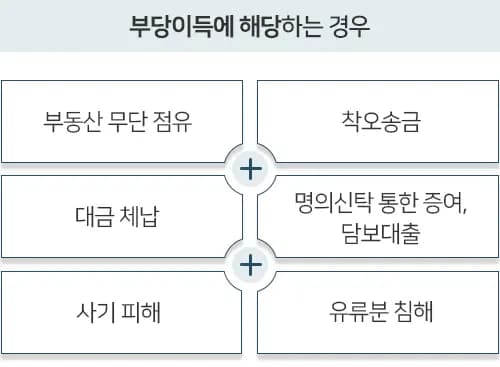
Unjust enrichment is broadly divided into two types.
① Unjust Enrichment by Performance
This refers to a case where the creditor provided a certain performance to the debtor, but the cause for it disappeared due to grounds such as invalidity, rescission, or termination.
For example, a case in which money was paid under an invalid contract falls under this type.
② Unjust Enrichment by Infringement
This is a case where a gain is obtained by infringing another person's right, such as earning profits by infringing intellectual property rights like copyright, trademark rights, or patent rights.
If the act of infringement is found to be illegal, it may also be connected to criminal liability.
2. Lawsuit for Return of Unjust Enrichment | Requirements for Establishment
For a claim for return of unjust enrichment to be recognized, the following four requirements must be satisfied.
▶Occurrence of loss: the claimant must have suffered a loss equal to the gain
▶Causation: there must be a causal relationship between the loss and the gain
▶Absence of a legal cause: there must be no justifiable legal basis for the other party's gain


3. Lawsuit for Return of Unjust Enrichment | Procedure
The procedure for a lawsuit for return of unjust enrichment proceeds in the same way as an ordinary civil lawsuit and consists of the following stages.
1. Drafting and Filing the Complaint
The complaint specifies the fact that unjust enrichment occurred, the grounds for the claim for return, and the specific amount claimed.
Attaching supporting evidence is important.
2. Filing the Answer and Pleading
When the defendant submits an answer containing a rebuttal to the complaint, the court designates a pleading date, and the parties argue against each other.
3. Burden of Proof
The plaintiff must prove the existence of the unjust enrichment and the absence of a legal cause, and the defendant may assert and prove that he or she had a justifiable legal basis.
4. Pronouncement of Judgment
If the court accepts the plaintiff's assertion, it orders the defendant to return the unjust enrichment, and in the opposite case, the claim is dismissed.
5. Compulsory Execution Available After Judgment
If the defendant does not perform voluntarily, the creditor can apply for compulsory execution against real estate, deposits, wages, and the like.
4. Lawsuit for Return of Unjust Enrichment | How to Respond

A lawsuit for return of unjust enrichment is a relatively common type among civil lawsuits, but the legal requirements and proof can be difficult.
If you attempt to respond on your own, you should note the following points.
▶Securing Clear Supporting Evidence
You should have written evidence supporting the occurrence of the gain, such as remittance records, account numbers, text messages, emails, and contracts.
▶Constructing Logic to Rule Out a Justifiable Reason
In preparation for the possibility that the defendant may assert a legal cause, you should include in the complaint or the brief the logic to rebut it.
▶Checking the Extinctive Prescription
Generally, the extinctive prescription of a claim for return of unjust enrichment is ten years (or three years from the date the fact became known).
Whether the prescription period has passed becomes a decisive factor in the court's judgment.
▶Thoroughly Preparing Statements and Opinion Letters
If it is difficult to attend the pleading date or to speak well, preparing and submitting an opinion letter in advance is also an option.
Points to Note and Key Issues
In a lawsuit for return of unjust enrichment, particular care is needed regarding the following main issues.
1. Grounds for Exceptional Non-Return
Under Article 746 of the Civil Act, return cannot be claimed for performance for an illegal cause (performance for the purpose of an unlawful act).
For example, money remitted as gambling funds is, in principle, restricted from a claim for return even if it constitutes unjust enrichment.
2. Whether There Was Bad-Faith Payment of a Nonexistent Debt
Bad-faith payment of a nonexistent debt is a case where payment is made while knowing that no debt exists, and under Article 742 of the Civil Act, return cannot, in principle, be claimed.
However, where the payment was made against the payer's free will, the right to claim return is not lost
3. Whether Criminal Proceedings Such as Fraud or Embezzlement Run in Parallel
Where the circumstances giving rise to the unjust enrichment include criminal acts such as fraud, breach of trust, or embezzlement, a criminal complaint or accusation may be pursued in parallel with the civil lawsuit.
4. Practical Feasibility of Compulsory Execution
Even if you obtain a favorable judgment in the lawsuit, the benefit may disappear if the other party has no property or flees.
It is important to investigate in advance, before the lawsuit, whether the debtor's property can be preserved.
5. Lawsuit for Return of Unjust Enrichment | Case Examples
Let us look at actual case examples of lawsuits for return of unjust enrichment.
| Case 1. A case in which the Supreme Court held that the extinctive prescription arises separately each day This is a case in which the plaintiff, a copyright holder, claimed 40 million won in unjust enrichment from the defendant, a game company, for using background music (the C sound source) in a game (F) without the copyright holder's permission. The Supreme Court found that, by using it without authorization for about eight years from December 18, 2008, to May 2016, the defendant generated new unjust enrichment each day, and it held that the extinctive prescription of the claim for return of unjust enrichment runs separately for each day. Key issues: 1. Starting Point of the Extinctive Prescription -Unjust enrichment arises each day in line with continuous use, and the extinctive prescription also runs separately for each instance 2. Application of the Civil vs. Commercial Extinctive Prescription -Because the matter seeks the return of an amount equivalent to the usage fee for the work rather than the return of a performance, application of the ten-year extinctive prescription under the Civil Act is appropriate -The five-year commercial extinctive prescription under the Commercial Act is not applied by analogy 3. Standard for Calculating Unjust Enrichment -Where a work is used without the copyright holder's permission, the amount equivalent to the reasonable usage fee that should have been paid is treated as unjust enrichment |
| Case 2. A judgment holding that a clause barring any refund 10 minutes after booking is unfair Regarding a clause set by Company Y, an accommodation booking platform, providing that cancellation and refund are possible only within 10 minutes after the booking is completed, the Seoul Central District Court determined that it constitutes an unfair clause excessively disadvantageous to the consumer and is therefore void, and it ordered Company Y to refund the full accommodation fee. The court found that, even if Company Y is a mere mail-order intermediary, it in substance holds the status of a mail-order distributor, and that the Electronic Commerce Act and the Act on the Regulation of Terms and Conditions apply. Key issues: 1. Validity of the Refund-Restriction Clause -The clause providing that ‘cancellation is possible only within 10 minutes after booking’ is excessively disadvantageous to the consumer and is void as an unfair clause under the Act on the Regulation of Terms and Conditions 2. Whether the Mail-Order Intermediary Bears Liability -Contrary to Company Y's assertion that it is a mere intermediary, it was determined to hold, in substance, the status of a mail-order distributor or an equivalent status 3. Whether the Hotel Bears Liability as the Recipient of Payment -Even though the hotel did not receive payment directly from the consumer, it is not free from liability since it received settlement through the platform. |
6. Lawsuit for Return of Unjust Enrichment | The Need for Professional Assistance
A lawsuit for return of unjust enrichment may appear on the surface to be a simple matter of returning money, but in reality it is a complex type of litigation that involves close interpretation of and dispute over the legal requirements.
In particular, in the following cases, receiving the assistance of an attorney who focuses on civil matters may be critical.
▶Where the Circumstances Giving Rise to the Unjust Enrichment Are Complex
For example, where various legal relationships are intertwined, such as copyright, real estate, franchise contracts, interior construction costs, and the return of investment funds, securing a practical benefit through a simple claim for return alone is difficult.
▶Where the Supporting Evidence Is Insufficient or Only Indirect Evidence Exists
Professional collection of materials and logical drafting of briefs are needed in order to prove the calculation of the unjust enrichment amount or the absence of a justifiable legal cause.
▶Where the Other Party Asserts Completion of the Prescription, Justifiable Performance, or Settlement of Payment
Where the defendant asserts the extinctive prescription, a justifiable contractual relationship, or exemption as a mail-order intermediary, a legal rebuttal is needed.
▶Where the Case Runs in Parallel With a Criminal Case or Follow-Up Measures Such as Damages or Compulsory Execution Are Anticipated
Where the case is joined with a criminal case such as fraud, breach of trust, or embezzlement, or leads to compulsory execution after a civil judgment, procedural response becomes even more important.
Our firm's attorneys who focus on civil matters identify the core issues of the case, clarify the points of proof, and then establish a litigation strategy within the range that can realistically be recovered.
We also pursue benefit-focused responses at stages such as conciliation, settlement, and compulsory execution, thereby working to maximize the rights and interests of our clients.
We recommend that you decide on your response method after receiving a comprehensive assessment of matters such as the practical benefit of the lawsuit, the proof strategy, and whether the extinctive prescription applies, together with our firm's attorneys who focus on civil matters.