CONTENTS
- 1. Child Support | Obligation to Bear

- - Borne Regardless of Marital Status
- - Payment Period
- 2. Child Support | Calculation Method
- - Calculation Standards
- - The Court's Determination and Agreement
- 3. Child Support | Calculation Procedure
- - Determining the Standard Child Support Amount
- - Confirming the Total Child Support Amount
- - Calculating Each Parent's Share of Child Support
- - Calculating the Non-Custodial Parent's Payment
- 4. Child Support | Method of Modification
- - Grounds for Modification
- - Standards for Determination
- - Determination on Reduction
- 5. Child Support | How to Resolve Nonpayment
- - Applying for a Direct Payment Order for Child Support
- - Applying for a Security Provision Order and a Lump-Sum Payment Order
- - Applying for a Performance Order
- - Applying for Compulsory Execution
- - Emergency Child Support Assistance Program
- 6. Child Support | Enforcement Support Programs
- - Consultation and Support for Reaching an Agreement
- - Legal Support
- - Claim Collection Support
- - Investigation of the Child Support Debtor
- 7. Child Support | A Family Law Attorney's Assistance System

1. Child Support | Obligation to Bear

Child support is a cost for protecting and raising a minor child, and it is a legal obligation of both biological parents(Article 837-2 of the Civil Act).
Category | Bearing party | Scope of responsibility |
Children during marriage | Both spouses jointly | Adjusted with a focus on the actual caregiver |
Children after divorce | The non-custodial parent | Paid periodically to the custodial parent |
Common-law marriage and children born out of wedlock | Biological parents | Applied equally once the birth is confirmed |
In the case of divorce, the ‘non-custodial parent’ who does not directly raise the child has a legal obligation to pay child support to the custodial parent.
That payment responsibility continues until the child reaches the age of majority or is able to become financially independent.
 Borne Regardless of Marital Status
Whether the parents are married does not affect the obligation to bear child support.
The obligation to pay child support arises equally for children born during marriage, children of divorced parents, children of a common-law relationship, and children born out of wedlock.
In other words, regardless of whether a marriage has been registered, the moment a child is legally recognized as a biological child, the parents bear the obligation to provide child support.
However, when a child is not recognized as a biological child, a separate legal procedure may first be required.


Payment Period
The obligation to pay child support continues until the child reaches adulthood or until the child is able to become economically independent.
However, when special circumstances exist, the payment period may be adjusted.
2. Child Support | Calculation Method

There is no fixed amount of child support set by law; it is determined by considering various factors.
Calculation Standards
The main factors considered when calculating child support are as follows.
∙ The custodial parent's standard of living expenses
∙ The non-custodial parent's economic capacity and income
∙ The child's health condition and any special parenting needs
The Court's Determination and Agreement
In a divorce, child support is, as a rule, determined by agreement between the parties, but when an agreement is difficult to reach, the Family Court decides it.
The court clarifies the amount and method of child support payment, and it may order regular payments.
Below is the 'child support calculation standards table' that the Family Court refers to when determining child support.
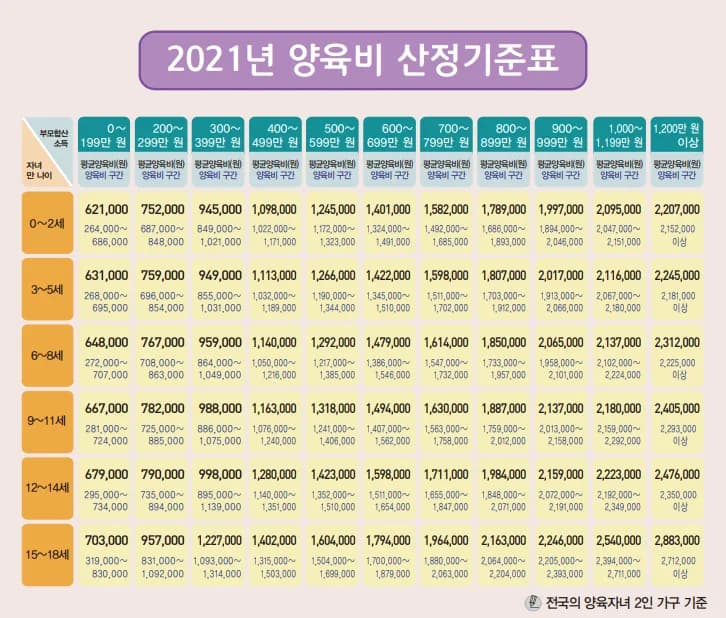
It presents an appropriate child support amount by reflecting the number of children, their age, and the parents' income, and the standards table that the Seoul Family Court put into effect from March 2022 is generally used at present.
The standard child support in the above calculation standards table is based on a four-person household with two children being raised, and it refers to the average child support per child.
This calculation standards table is a guideline prepared by the Seoul Family Court and may serve as a reference.
3. Child Support | Calculation Procedure
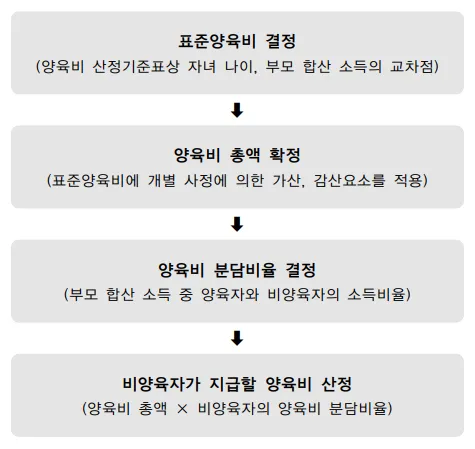
Child support is calculated by considering the child's standard of living and the parents' economic capacity, and it goes through a specific calculation process that reflects the court's standards table and individual circumstances.
In general, the following procedure is followed.
Determining the Standard Child Support Amount
Based on the child support calculation standards table reviewed earlier, the standard child support amount is determined at the point where the child's age and the parents' combined income meet.
This refers to the average monthly child support per child.
Confirming the Total Child Support Amount
The final total amount is confirmed by reflecting individual circumstances, such as the child's illness or disability, special education costs, and supplementary tutoring expenses, in the calculated standard child support.
Calculating Each Parent's Share of Child Support
Once the total child support amount is determined, each parent's share is set by calculating the proportion that each parent's income represents of the total combined income.
Calculating the Non-Custodial Parent's Payment
The amount actually payable is calculated by multiplying the final total child support amount by the non-custodial parent's share.
Total child support amount × the non-custodial parent's share
4. Child Support | Method of Modification

Although child support is an obligation that must be paid continuously once it is determined, when it is recognized as necessary for the child's welfare, the Family Court may modify its terms upon a party's application or on its own authority.
This is a system based on Article 837, Paragraph 5 of the Civil Act.
Parties Who May Request Modification
Grounds for Modification
A modification of child support is mainly reviewed when there is a change in circumstances such as the following.
∙ A change in the custodial parent's economic situation, such as an increase in income or receipt of property by gift
∙ Changes in the child's age or educational situation
∙ Rising prices and the need to bring child support in line with current conditions
Standards for Determination
However, reducing child support based on a mere fluctuation in income alone is difficult.
When a modification application is filed, the Family Court comprehensively considers the following factors and gives top priority to determining whether the modification of child support is 'necessary for the child's welfare.'
Factor Considered | Main Content |
How the previous child support was determined | Whether it was a court decision or an agreement |
Content of existing property agreements | Whether it is linked to consolation money, division of marital property, etc. |
The parents' economic circumstances | Occupation, income, property, health, number of dependents, etc. |
The child's situation | Age, number, health, education cost burden, etc. |
Effect on the child if reduced | Whether there is a negative effect on the child's welfare |
Prices and social conditions | Whether child support reflects current conditions, changes in economic indicators, etc. |
Determination on Reduction
In particular, a claim to reduce child support generally carries a risk of harming the child's welfare, so the court examines the necessity of the reduction, its unavoidability, and the effect on the child more strictly.
The Supreme Court has also stated that, for a reduction to be justified, it must be sufficiently proven that the reduction itself is the best option for the child's welfare.
Supreme Court Decision 2018Seu566, January 31, 2019
5. Child Support | How to Resolve Nonpayment
Child support is an important right directly tied to a child's livelihood and education.
Accordingly, when the agreed child support is not properly paid, the custodial parent may enforce its payment through various legal means.
Applying for a Direct Payment Order for Child Support
If the child support obligor fails to pay child support two or more times without justifiable cause, the child support obligee may, based on the court's order for periodic payments, apply for a ‘direct payment order’ directing that the child support be deducted directly from the obligor's wages and paid.
This order applies directly to the employer who withholds the obligor's income tax, and a violation may result in an administrative fine.
Applying for a Security Provision Order and a Lump-Sum Payment Order
If the child support obligor fails to properly fulfill the payment obligation, the court may order the obligor to provide security in a certain amount.
If the obligor does not comply, the court may issue an order to pay all or part of the child support as a lump sum.
Because confinement may follow noncompliance, this is a very strong measure.
Applying for a Performance Order
Based on a judgment or mediation protocol specifying the payment of child support, you may apply for a ‘performance order’.
If noncompliance continues thereafter, the court may enforce performance through an administrative fine of up to 10 million won or confinement for up to 30 days.
For persistent defaulters, measures such as a travel ban, public disclosure of the name, and even criminal punishment may be possible.
Applying for Compulsory Execution
When the obligor fails to pay even after child support has been finalized through a final court judgment or mediation, you may apply for compulsory execution against the obligor's property, such as real estate or wages.
After obtaining an execution clause, you may apply to the court and secure the child support through methods such as attachment, collection, and auction.
Emergency Child Support Assistance Program
When a child's livelihood is threatened due to nonpayment of child support, an eligible applicant who meets certain requirements may receive ‘temporary emergency child support assistance’ from the Child Support Agency for up to nine months.
This depends on income criteria and whether the applicant is eligible for single-parent family support, and it ends immediately once child support is paid.
Category | Details |
Applying Agency | Child Support Agency |
Support Period | Up to 9 months + extendable by an additional 3 months |
Eligibility Requirements | At or below 50% of the standard median income or eligible for support under the Single-Parent Family Support Act |
Restrictions | Restricted in cases of overlapping support, such as basic livelihood security / ends immediately upon payment by the obligor |
6. Child Support | Enforcement Support Programs

When child support is not paid smoothly, the government provides various enforcement support programs to help.
These programs, offered through the Child Support Agency, provide broad support ranging from encouraging voluntary agreement by the noncustodial parent to compulsory execution.
Below is a summary of four representative enforcement support programs, along with how to apply for them and their key details.
Consultation and Support for Reaching an Agreement
When child support cannot be agreed upon between the noncustodial parent and the custodial parent, this is a support program that links the parties to mediation of an agreement and notarization through the Child Support Agency.
Support Details
▷ If an agreement is reached, preparation of a notarized deed and support for family mediation proceedings available
▷ The terms of performance may be adjusted by agreement without litigation
Summary of How to Apply
Category | Details |
Eligible Applicants | A custodial or noncustodial parent who needs an agreement on the allocation of child support |
Documents to Submit | Application for child support enforcement assistance (Child Support Agency form) |
How to Apply | Online or in-person submission, or phone consultation ☎ 1644-6621 (option 1) |
Process Summary | Application → confirmation of the other party's consent to the agreement → notification of the agreement schedule → conducting the agreement → follow-up support such as notarization |
Legal Support
This is a legal support program that provides representation in child support claim, modification, and enforcement litigation, as well as assistance in securing an enforceable title.
Scope of Support
▷ Assistance with enforcement measures such as performance orders, orders to provide security, and detention
▷ Securing an enforceable title for compulsory execution
To apply for legal support, you may submit an application for child support enforcement assistance along with the documents required for each type of litigation.
Type of Support | Examples of Required Documents |
Paternity Claim Litigation | Basic certificate, family relation certificate, DNA test report or photographs, and other materials proving the relationship |
Child Support Claim Litigation | Income records, family relation certificate, and documents related to an enforceable title such as a written judgment |
Enforcement Litigation | Detention order decision, written decisions such as a direct payment order, and a single-parent family certificate, among others |
Claim Collection Support
This is a program that represents clients in compulsory execution proceedings or carries out collection work through cooperation with credit information companies when confirmed child support is not paid.
Scope of Support
▷ Linkage to compulsory execution through identification of income and assets
Items to Prepare for Application
Category | Details |
Documents to Submit | Power of attorney for child support collection, a copy of the bankbook, debtor records, and the like |
Required Information | The unpaid amount, the period, materials establishing the basis for the child support, and similar information |
Procedure Summary | Application → Review of collection feasibility → Cooperation with a credit information company or pursuit of legal proceedings |
Investigation of the Child Support Debtor
This is a procedure that identifies the income, assets, and financial information of a child support debtor to assess the debtor's ability to pay child support.
Methods of Investigation
▷ If consent is refused, an application for disclosure of property or an inquiry into property may be filed with the court
▷ If necessary, immigration records, insurance information, and other data may be reviewed comprehensively
Principal Agencies Subject to Inquiry
∙ Financial institutions such as banks and insurance companies
7. Child Support | A Family Law Attorney's Assistance System

Our law firm includes many attorneys registered with the Korean Bar Association as certified divorce specialists and certified family law specialists, along with numerous specialist attorneys who have, on average, more than 10 years of experience.
Drawing on extensive legal knowledge and practical experience in child support matters, we can provide comprehensive support ranging from the calculation of child support to enforcement measures and responses to nonpayment.
If you need assistance with child support matters, you may request the help of a family law attorney.