
CONTENTS
- 1. Virtual Assets/Blockchain | Definition

- - What Are Virtual Assets
- - What Is Blockchain
- 2. Virtual Assets/Blockchain | Unfair Trading Practices
- - Prohibition on Use of Material Non-Public Information
- - Prohibition on Trading for the Purpose of Price Manipulation or Inducement
- - Prohibition on Use of Other Wrongful or Deceptive Means
- - Restrictions on Self-Dealing by Virtual Asset Service Providers
- 3. Virtual Assets/Blockchain | Investigation of Unfair Trading Practices
- - Matters That May Be Required During an Investigation
- - External Publication of Investigation Results
- 4. Virtual Assets/Blockchain | Sanctions Against Virtual Asset Service Providers
- 5. Virtual Assets/Blockchain | Points to Note in Asset Management and Asset Disposal
- - Sale of Virtual Assets by Nonprofit Corporations
- - Sale of Virtual Assets by Virtual Asset Exchanges
- 6. Virtual Assets / Blockchain | The Need for Legal Advice
- - Providing a Systematic Response and Tailored Advice

1. Virtual Assets/Blockchain | Definition

Companies involved in virtual assets and blockchain must respond proactively to government regulation and the introduction of new systems in line with rapid market changes.
 What Are Virtual Assets
A virtual asset is an electronic token with economic value that can be traded or transferred electronically.
In other words, it is not mere digital information; virtual assets encompass electronic tokens that have economic value and can be exchanged or transferred by electronic means, together with all rights attaching to them.
However, the Act on the Protection of Virtual Asset Users specifies that the following items are not regarded as virtual assets.
▶ Items That Do Not Constitute Virtual Assets
• Electronic tokens whose places and purposes of use are limited, or information thereon
• Tangible or intangible results obtained through games
• Prepaid electronic payment means and electronic money
• Electronically registered shares, electronic bills, and electronic bills of lading
What Is Blockchain
Blockchain is a distributed technology that stores and processes data by dividing it among multiple users.
All users participating in the network share and keep the same transaction records, through which the structure secures the reliability and transparency of transactions.
Blockchain is a structure in which blocks containing peer-to-peer (P2P) transaction information are linked together like a chain.
2. Virtual Assets/Blockchain | Unfair Trading Practices

Since July 2024, the Act on the Protection of Virtual Asset Users has been in effect, strengthening the establishment of sound order in the virtual asset market and the protection of users.
This Act defines certain acts and transactions occurring in the virtual asset market as ‘unfair trading practices’ and strictly prohibits them.
In particular, criminal punishment has become possible where unfair trading, such as market manipulation, is detected.
In addition, where a user suffers harm as a result of an unfair trading practice, the perpetrator also bears civil liability for damages, so if financial loss occurs, the user has the right to obtain legal relief.
The principal unfair trading practices are as follows.
Prohibition on Use of Material Non-Public Information
Trading virtual assets by using material non-public information, or by causing another person to use it, is strictly prohibited.
Material non-public information here means information that may have a significant effect on a user's investment decisions and that has not yet been officially disclosed to the public.
▶ Persons Subject to the Prohibition
• Major shareholders of the above entities (as defined under the Act on Corporate Governance)
• Persons exercising authority to permit, authorize, or supervise virtual asset service providers and issuers
• Persons who came to know the information in the course of concluding, negotiating, or performing a contract
• Agents, employees, and staff of the above persons
• Persons who received the information from the above persons
Prohibition on Trading for the Purpose of Price Manipulation or Inducement
Acts that lead others to a false impression that virtual asset trading is active are also prohibited.
This includes the act of giving a false impression through information, or of buying and selling, or commissioning or accepting the commission of such trading, so as to vary or fix the price, for the purpose of inducing the trading of virtual assets.
Prohibition on Use of Other Wrongful or Deceptive Means
The following acts are also strictly prohibited as unfair trading practices.
• False statement or representation of material facts, or omission of necessary matters
• Inducement using a false price
• Commissioning or accepting the commission of the above acts
Restrictions on Self-Dealing by Virtual Asset Service Providers
As a rule, a virtual asset service provider may not trade virtual assets issued by itself or by a specially related person.
However, this is permitted where one of the following exceptional grounds applies.
• If a virtual asset issued as a means of payment for goods or services is acquired in return for the provision of goods or services promised to a user
• If acquisition is unavoidable and is carried out in accordance with the procedures and methods prescribed by Presidential Decree
3. Virtual Assets/Blockchain | Investigation of Unfair Trading Practices
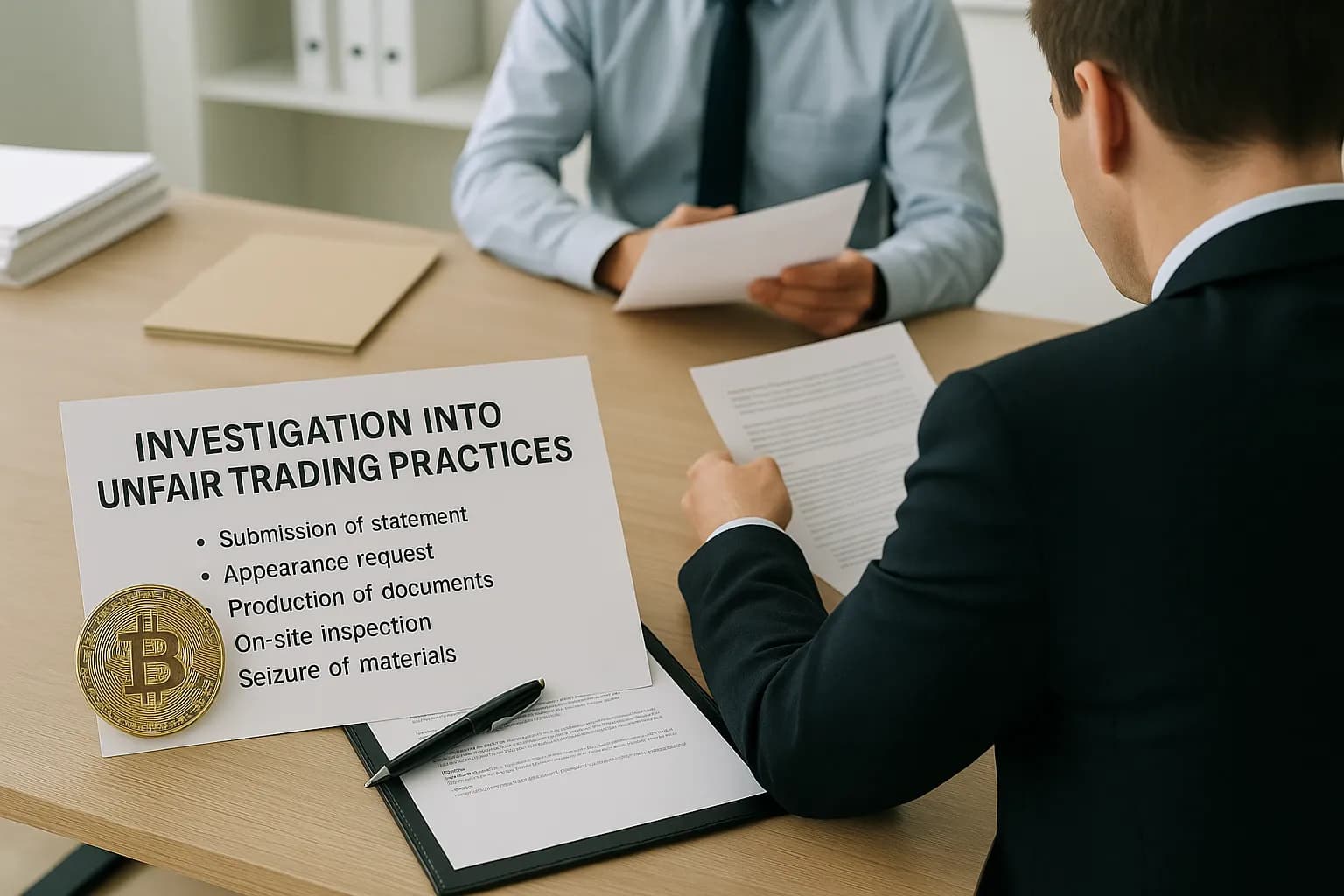
If an unfair trading practice is suspected or there is an allegation of a violation of law in connection with virtual assets, the Financial Services Commission may conduct an investigation directly or direct the Financial Supervisory Service to investigate, in order to protect users and maintain trading order.
The subjects of an investigation include not only the person who committed the violation, but also related parties generally, such as those who hold relevant materials.
Matters That May Be Required During an Investigation
• A request to appear before the Financial Supervisory Service or the Financial Services Commission
• A request to submit books, documents, and other materials
• On-site investigation of an office or place of business and inspection of materials
• Seizure (impoundment) of submitted materials, and the like
If necessary, virtual asset service providers may also be required to submit relevant materials.
External Publication of Investigation Results
If a violation of law is confirmed as a result of an investigation, the Financial Services Commission may publish the case of the violation, the outcome of its handling, information to prevent recurrence, and the like, in accordance with the methods prescribed by Presidential Decree.
4. Virtual Assets/Blockchain | Sanctions Against Virtual Asset Service Providers
If a virtual asset service provider violates statutes or an order of the Financial Services Commission, the Commission may impose the following sanctions.
• A warning or caution
• Suspension of business (in whole or in part)
• Notification to or accusation before an investigative agency
Individual executives and employees are also subject to sanctions.
If an executive or employee of a virtual asset service provider violates statutes, the Financial Services Commission may require the following personnel actions against that executive or employee.
• Employees: Request for removal or suspension
• Others: Warning, caution, or request for reprimand
※ However, where a measure at the level of dismissal or removal is necessary, a hearing procedure must be followed.


5. Virtual Assets/Blockchain | Points to Note in Asset Management and Asset Disposal
The virtual asset and blockchain industry is an area that, beyond simple transactions, requires legal review across the entire organizational structure, including the receipt and disposal of assets by non-profit corporations and the asset management of exchanges.
In particular, as the sale of virtual assets by non-profit corporations and virtual asset exchanges has been permitted since June 2025, measures to prevent unfair trading are being further strengthened and institutionalized.
Amid these changes in the environment, even when seeking to change a business structure or method of operation, the requirements and procedures prescribed by statute must be satisfied rather than relying on a simple internal decision.
Accordingly, advance preparation is needed with reference to the field-specific guidelines below.
Sale of Virtual Assets by Nonprofit Corporations
As donations of virtual assets gradually increase, standards have been established for how nonprofit corporations that receive donations and sponsorships should handle the virtual assets they receive.
These standards set the promotion of a sound donation culture and anti-money laundering (AML) as their main goals, and they are based on the results of discussions by a task force (TF) that included financial authorities, relevant agencies, and industry experts.
▶ Requirements for Corporations Permitted to Sell
In addition, each such corporation is required to establish an internal donation review committee (tentative name) to examine in advance matters such as the appropriateness of the donation and the plan for converting the assets into cash.
▶ Scope of Virtual Assets That May Be Donated
As a rule, such assets are converted into cash immediately upon receipt of the donation, which encourages the minimization of asset volatility and the potential for speculation.
▶ Controls to Prevent Money Laundering
Sale of Virtual Assets by Virtual Asset Exchanges
The guidelines for asset sales by virtual asset exchanges were established with a focus on minimizing market disruption and preventing conflicts of interest between users and exchanges.
▶ Scope and Purpose of Sales
▶ Scope and Limits of Sales
In addition, selling through one's own exchange is prohibited.
▶ Internal Controls and Anti-Money Laundering
6. Virtual Assets / Blockchain | The Need for Legal Advice

The virtual assets and blockchain industry is a field where rapidly changing regulations and complex legal requirements coexist.
When a nonprofit corporation or a virtual asset exchange proceeds with the sale of virtual assets or a change in its business structure, it must strictly comply with the relevant laws and guidelines, so professional legal advice on these matters is necessary.
In addition, unfair trading practices carry not only criminal penalties but also various legal risks, such as civil liability for damages and personnel measures against executives and employees, so particular care is required.
▷ Designing internal control systems and procedures
▷ Responding when unfair trading practices are detected and preparing for investigations by the financial authorities
▷ Designing contract and transaction structures
In this way, preventing risks through systematic legal advice across business operations and asset disposition as a whole, and responding promptly to regulatory changes, is central to successful business operation.
Providing a Systematic Response and Tailored Advice
Drawing on our understanding of the virtual assets and blockchain industry, our firm provides practical legal solutions ranging from regulatory response to asset sales and the design of transaction structures.
Our 🔗finance attorneys, who have extensive experience, take part directly in providing advice, and they also prepare strategic responses spanning the criminal, civil, and administrative areas when a dispute arises.
In addition, through collaboration with experts in each field, such as tax accountants, certified public accountants, and judicial scriveners, we provide support up to asset transfer and subsequent management.
Even within a complex regulatory environment, we will present practical measures that take into account both the direction of the business and legal stability.