
CONTENTS
- 1. Severe Disciplinary Action against Public Officials | Definition

- - Concept of Disciplinary Action
- - Difference Between Disciplinary Action and Removal from Position
- 2. Severe Disciplinary Action against Public Officials | Grounds for Discipline
- - Acts in Violation of Statutes
- - Violation of Official Duties and Neglect of Duty
- - Acts Damaging Dignity or Prestige
- - Other Points to Note
- 3. Severe Disciplinary Action against Public Officials | Types
- 4. Severe Disciplinary Action against Public Officials | Appeal Procedures
- - Filing an Appeal Review
- - Filing Administrative Litigation
- 5. Severe Disciplinary Action against Public Officials | Response Methods
- - Methods for Self-Representation
- 6. Severe Disciplinary Action against Public Officials | Key Issues

1. Severe Disciplinary Action against Public Officials | Definition

Heavy disciplinary action against public officials refers to the more severe disciplinary dispositions among those imposed on public officials.
The authority granted to a public official must be exercised for the people.
The ethical and legal responsibility required of a public official is therefore correspondingly heavy, and a violation of it may result in a strong disciplinary disposition known as a ‘heavy disciplinary action.’
Heavy disciplinary action goes beyond a simple warning or salary reduction, suspending the performance of official duties for a certain period or lowering the rank, and in some cases it is a disposition that completely excludes a person from public office, so its impact is very significant.
 Concept of Disciplinary Action
The disciplinary action referred to in a public official's heavy disciplinary action means an administrative sanction imposed by the State or a local government in its position as the employer, in response to a public official's breach of duty, in order to achieve the purpose of the public service relationship.
Because a disciplinary penalty and a criminal penalty differ in the basis of their authority, purpose, content, and object, it is a characteristic that imposing both a disciplinary penalty and a criminal penalty for the same misconduct does not conflict with the principle against double jeopardy.
Category | Disciplinary penalty | Criminal penalty |
Basis of authority | Authority as employer in the public service relationship | State sovereign power |
Purpose | Maintenance of order in the public service relationship | Protection of general legal interests |
Content | Deprivation of interests relating to status | Restriction of personal liberty and property interests |
Object | Breach of duty under public official law | Violation of antisocial legal interests under criminal law |
Difference Between Disciplinary Action and Removal from Position
Suspension from office is a concept distinct from disciplinary action.
Suspension from office is a system that temporarily strips a person of his or her position so that he or she cannot perform the relevant duties, where the person has been criminally indicted or where certain grounds exist that make it difficult to continue performing official duties.
This is not for a punitive purpose like disciplinary action but is a personnel measure intended to ensure the fairness of the performance of official duties and to give the person concerned an opportunity to concentrate on recovering his or her ability or on responding to the trial.
However, where a person is suspended from office, this not only excludes the person from duties but also entails actual disadvantages such as a restriction on salary step advancement and a salary reduction, so it is legally recognized as an 'unfavorable personnel disposition.'


2. Severe Disciplinary Action against Public Officials | Grounds for Discipline
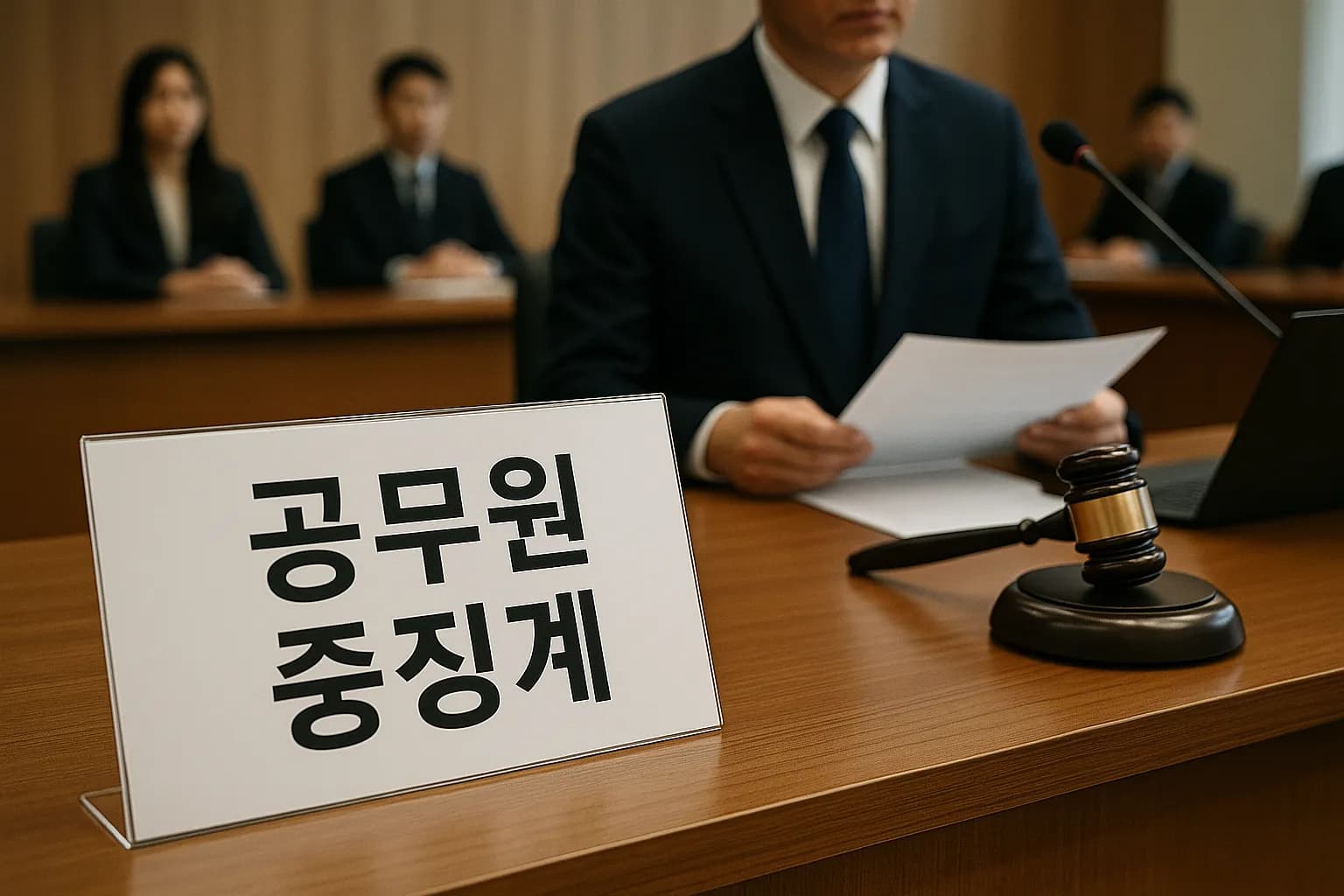
We will look at the grounds for disciplinary action that may result in severe disciplinary action against a public official.
Acts in Violation of Statutes
This refers to cases of violating the provisions of the State Public Officials Act and the administrative orders prescribed by law.
▶Duties of public officials under the State Public Officials Act
-Four prohibitions: the prohibition on leaving the workplace, the prohibition on profit-making work and holding concurrent positions, the prohibition on political campaigning, and the prohibition on collective action
Violation of Official Duties and Neglect of Duty
This refers to a case where a public official fails to perform various statutory and other duties related to their assigned work, or fails to faithfully perform duties that should naturally be performed.
It is established regardless of whether there is intent or negligence on the part of the official, and disciplinary liability may be imposed not only on the actor but also on a supervisor where a specific fact of neglecting the duty of supervision is recognized.
Acts Damaging Dignity or Prestige
Where an external act by a public official directly affects the damaging of the dignity and prestige of public office and carries blameworthiness under general social norms, it falls under a ground for disciplinary action regardless of whether there is criminal liability.
Other Points to Note
Where a person who has received a disposition such as a disciplinary action for a breach of duty again breaches the duty, the person may be disciplined again.
3. Severe Disciplinary Action against Public Officials | Types
The types of severe disciplinary action against public officials are reviewed below.
There are six types of disciplinary action: removal, dismissal, demotion, suspension, salary reduction, and reprimand.
Removal and dismissal are exclusionary disciplinary actions that completely terminate a public official's status, while demotion, suspension, salary reduction, and reprimand are corrective disciplinary actions that restrict part of the official's status-related and salary-related benefits while the official retains his or her status.
∙ Dismissal : A disciplinary action that forcibly retires a public official; a dismissed person cannot be appointed as a public official for 3 years.
∙ Demotion : A disciplinary action that lowers a public official's grade by one rank and bars the official from performing duties for 3 months, with the entire salary reduced during that period.
∙ Suspension : A disciplinary action for a period of 1 month or more and 3 months or less, under which the official retains public official status but cannot perform duties, with the entire salary reduced. The official is also subject to a restriction on salary step advancement for 18 months.
4. Severe Disciplinary Action against Public Officials | Appeal Procedures

The procedures for contesting a decision on severe disciplinary action against a public official are reviewed below.
Filing an Appeal Review
A public official who has received a disciplinary action may, where he or she objects to the disposition, file a request for review of the disposition with the Appeals Review Committee within 30 days from the day on which the written statement of the grounds for the disciplinary action and the like was delivered.
An appeals review must be filed with the competent Appeals Review Committee by submitting an appeals review request stating the following matters, attaching one copy thereof and a copy of the written statement of the grounds for the disposition or the personnel order notice.
2. The name of the affiliated agency or former affiliated agency and the position or former position
3. The respondent (for a disposition or failure to act by the President, the person with the right to request the appointment)
4. The purport of the appeal
5. The grounds for the appeal and the method of proof
Filing Administrative Litigation
If a party objects to the result of an appeals review, the party may file an administrative litigation within 90 days from the date of receiving the written decision.
5. Severe Disciplinary Action against Public Officials | Response Methods
Where severe disciplinary action against a public official is anticipated or has been notified, the following procedural responses are important.
1. Accurately ascertain the facts
Organize whether the act cited as a ground for disciplinary action actually occurred and whether there was intent.
Secure related materials (work logs, emails, internal reports, and the like) and prepare them as defense materials.
2. Prepare a written explanation
Logically explain the unfairness of the grounds for disciplinary action on legal and factual bases.
Citing relevant precedents or similar cases can also be effective.
3. Actively use the opportunity to be heard
Attending the disciplinary committee and explaining one's position orally is very important.
4. Prepare for appeal procedures
Depending on the outcome, one should sufficiently prepare document drafting, evidence gathering, and legal review so as to be able to file an appeals review or administrative litigation.
Methods for Self-Representation
Methods for responding to severe disciplinary action against a public official on one's own are reviewed below.
Because procedural complexity and legal interpretation are required, thorough preparation is necessary.
1. Become familiar with the relevant statutes and precedents on the disciplinary action
Analyze the State Public Officials Act, the disciplinary decree, the code of conduct for public officials, and the like.
2. Try drafting a written explanation on your own
Logically organize the facts, the unfairness of the grounds for disciplinary action, and the intention to improve.
3. Search precedents in similar cases
Refer to judgments in administrative appeals and administrative litigation to find similarities to your own case and cite favorable precedents.
4. Practice filling out the appeals review request form
Based on the form provided on the website of the Appeals Review Committee of the Ministry of Personnel Management, practice writing the content tailored to your own case.
5. Prepare administrative litigation documents
Prepare the complaint, evidentiary materials, statements, and the like in advance, and organize your statements in preparation for the hearing date.
However, where there is a risk that one's career will be interrupted, as with dismissal or removal, or where there may be a serious effect on a future pension or reinstatement, obtaining the assistance of an experienced administrative law attorney is advisable.
6. Severe Disciplinary Action against Public Officials | Key Issues
A heavy disciplinary action against a public official is a serious matter that goes beyond mere individual disadvantage and is connected to one's professional life. Responding on your own requires a sufficient understanding of the relevant statutes, the securing of objective materials, and a systematic explanation strategy.
However, considering the complexity of administrative procedures and the decision-making structure of the disciplinary committee or the appeals commission, receiving expert assistance from the early stages of the response may be far more advantageous in the long term.
This firm provides a one-stop service across the entire process, from analysis of the grounds for disciplinary action to requests for reexamination and litigation, through an administrative law attorney working with attorneys specializing in each field as a task force.
Daeryun operates branch offices in regions throughout the country and provides a 24-hour, 365-day urgent consultation system and non-face-to-face video services. We invite you to make use of Daeryun's legal consultation.