
CONTENTS
- 1. International Taxation | Conclusion of Tax Treaties Between Countries

- - Status of Concluded Agreements and Countries
- 2. International Taxation | Tax Adjustment Within International Transactions
- - Definition of a Special Relationship
- - Substance-Based Taxation of Indirect Transactions
- - Methods for Calculating the Arm's Length Price
- - Transactions Involving Third Parties and Offsetting Transactions
- - Coordination with the Customs Dutiable Value
- 3. International Taxation | Submission of International Transaction Materials
- - Errors When Preparing a Country-by-Country Report
- 4. International Taxation | Inter-Country Tax Cooperation and Assistance
- - Mutual Agreement Procedure and Arbitration
- 5. International Taxation | Overseas Financial Account Reporting System
- 6. International Taxation | Global Minimum Tax
- 7. International Taxation | Administrative Fines under the Adjustment of International Taxes Act
- - Response Measures for Companies Concerned

1. International Taxation | Conclusion of Tax Treaties Between Countries

Within the transactions of multinational enterprises, disputes over taxing rights and questions of tax avoidance arise frequently in the international tax setting.
Countries address these concerns through tax treaties and domestic legislation, and one leading domestic example is the “Adjustment of International Taxes Act.”
This Act governs the adjustment of taxes on international transactions, cooperation in tax administration between countries, the reporting of overseas assets, and the imposition of the global minimum tax.
In international transactions, where there is a separate person to whom taxable income and revenue are attributed, that person is treated as the taxpayer, and the tax treaty applies accordingly.
Notably, the Adjustment of International Taxes Act takes priority over national and local tax rules, and it does not apply the rules on the denial of wrongful calculation found in the Income Tax Act and the Corporate Tax Act.
 Status of Concluded Agreements and Countries
Under the BEPS Multilateral Convention (the multilateral convention to implement tax treaty related measures to prevent base erosion and profit shifting), BEPS countermeasures are reflected automatically in existing tax treaties without separate bilateral negotiations between member countries.
As a member of the OECD and the G20, Korea participates in the BEPS Multilateral Convention and takes part in this international cooperation.
Where a taxpayer concludes that a particular tax assessment violates a tax treaty, the taxpayer may raise an objection in any of the contracting states within three years.
The status of countries with which other agreements have been concluded is as follows.
- Double taxation avoidance agreements concluded : 96 countries
- Tax information exchange agreements concluded : 12 countries
- Multilateral Convention on Mutual Administrative Assistance in Tax Matters : 144 countries


2. International Taxation | Tax Adjustment Within International Transactions

In international taxation, where the price of an international transaction with a foreign related party falls below or rises above the arm's length price (the price a resident, a domestic corporation, or a domestic place of business applies in dealings with a party that is not a foreign related party), the taxpayer may file a return or a request for correction of the tax base and tax amount, adjusted on the basis of the arm's length price.
(1) Filing of a Return and Request for Correction Based on the Arm's Length Price (Article 6)
-For a transaction with a foreign related party, the taxpayer may report the tax base, or file a request for correction, on the basis of the arm's length price
-When filing, the taxpayer must submit documents such as a ‘report on the adjustment of the transaction price’ and ‘supporting documents for the method of computing the arm's length price’
(2) The Head of the Tax Office's Authority to Make Corrections
-The tax authorities may determine or revise the tax amount on the basis of the arm's length price
-Where the same computation method has applied across several tax years, that standard must continue to apply
Definition of a Special Relationship
Substance-Based Taxation of Indirect Transactions
For tax-avoidance structures that rely on third parties or multiple transactions (indirect transactions), the substance governs, the arrangement is treated as a direct transaction, and the application of tax treaties may be restricted.
In such cases, the taxpayer must independently show that the transaction served a legitimate business purpose in order to avoid an adverse result.
Methods for Calculating the Arm's Length Price
Under the Adjustment of International Taxes Act, the arm's length price is determined using a reasonable method selected from the following six methods.
Where a transaction is unreasonable or its substance is difficult to ascertain, it may be treated as a recharacterized transaction.
A company that wishes to apply the same calculation method over a set period may apply to the National Tax Service for advance approval, and a mutual agreement procedure between the two countries must be completed.
The advance approval may be revoked, however, where the conditions are not properly observed or a change in the tax treaty renders the content of the advance approval inappropriate, among other grounds.
If the taxpayer demonstrates a reasonable calculation method, an exemption from the underreporting penalty tax may be available.
Transactions Involving Third Parties and Offsetting Transactions
- Even for an indirect transaction through a related party, the transfer pricing rules apply where the substance is recognized
- A pre-agreed offsetting transaction may be treated as a single transaction and adjusted accordingly
Coordination with the Customs Dutiable Value
- The advance review of the dutiable value for customs and the calculation of the arm's length price for national taxes may be coordinated in advance
- This applies after consultation between the National Tax Service and the Korea Customs Service
- Where a discrepancy arises between the national tax amount and the customs duty because the price of imported goods was adjusted, the taxpayer may request a correction of income tax or corporate tax
See More
3. International Taxation | Submission of International Transaction Materials
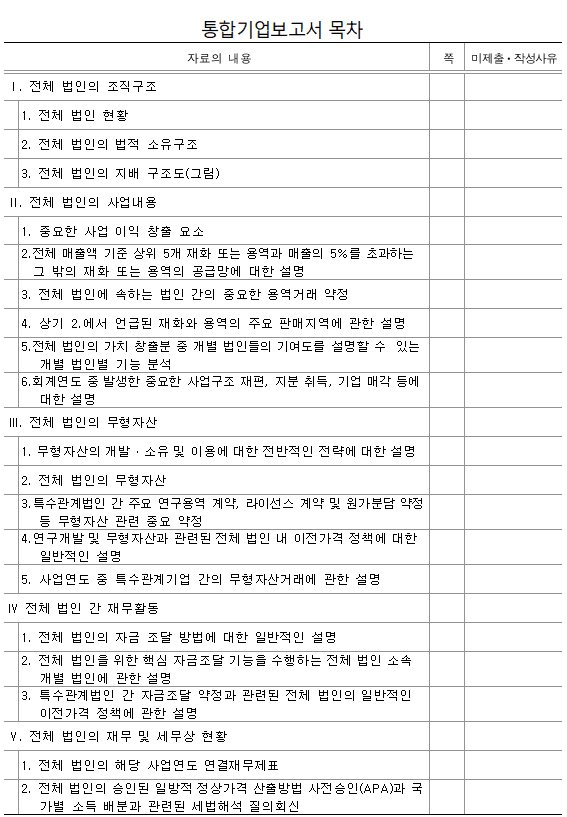
A taxpayer that incurs a tax liability from an international transaction must submit a master file, a local file, and a country-by-country report, among other documents, to the head of the tax office within 12 months after the last day of the month in which the business year ends.
Where the ultimate parent company is a foreign corporation or a nonresident, however, a domestic affiliate of a multinational enterprise group whose consolidated financial statement sales for the preceding year exceed 750 million euros (or the equivalent) must also submit a country-by-country report.
If the taxpayer misses the submission deadline, the tax authorities may impose tax based on the data of comparable companies.
Errors When Preparing a Country-by-Country Report
A country-by-country report sets out key information on the allocation of income and tax paid in each tax jurisdiction where the multinational enterprise group operates, along with the principal economic activities of its affiliated companies.
Care is needed, because the following errors can occur.
- When preparing the list of affiliated companies, the local taxpayer identification number must always be entered
- Allocation details must be converted into the same functional currency (they must always use a single currency unit)
- Allocation details must state the full amount without decimals (abbreviation of the monetary unit is not permitted)
- The tax jurisdiction shown in the allocation details and in the list of affiliated companies must match exactly
4. International Taxation | Inter-Country Tax Cooperation and Assistance
Korea's competent authority may exchange tax information with a contracting partner state for the assessment and collection of taxes, the review of tax appeals, and criminal prosecution.
Mutual Agreement Procedure and Arbitration
Where consultation with a contracting partner state is needed on the application or interpretation of a tax treaty, a taxpayer may apply to the Minister of Economy and Finance, the Commissioner of the National Tax Service, or others to commence a mutual agreement procedure.
The procedure will not commence, however, where a final and binding judgment of a domestic or foreign court already exists, where the application is filed by a person who lacks standing under the tax treaty, or where the taxpayer seeks to use the procedure for tax avoidance.
It bears emphasis that an application for a mutual agreement procedure is no longer possible once three years have passed from the date on which the taxation became known.
If a mutual agreement is reached, it takes precedence over the application of domestic law, and the periods for filing an appeal and for the exclusion of assessment are also extended.
5. International Taxation | Overseas Financial Account Reporting System
This is a system under which, where the combined balance of overseas financial accounts held by a resident or a domestic corporation exceeds 500 million KRW on even a single one of the month-end dates during the relevant year, the account information must be reported to the competent tax office in June of the following year.
Persons obligated to report : Residents or domestic corporations that hold an account opened with a company or a virtual asset service provider and that meet the balance threshold (some, such as foreign-national residents, overseas Koreans, and employees of international organizations, are exempt)
Reporting period : June 1 to June 30
Reporting method : Available through Hometax or the tax office (including name, address, account number, peak balance, and information on related persons)
Failure to fulfill the reporting obligation : For non-reporting or underreporting, an administrative fine of 10% of the amount (capped at 1 billion KRW)
Non-reporting exceeding 5 billion KRW : Disclosure of personal information such as the violator's name, corporate name, age, occupation, and address, along with a notification disposition and possible criminal punishment (imprisonment of up to two years or a fine of 13% to 20% of the non-reported or underreported amount)
6. International Taxation | Global Minimum Tax

To counter tax avoidance through profit shifting and base erosion by multinational enterprise groups, the internationally agreed global minimum tax rules are meant to ensure taxation at or above a minimum tax rate (15%).
Under this system, when the effective tax rate that a particular country actually applies to a multinational enterprise falls below 15%, other countries collect the difference as additional tax.
The rules apply mainly to multinational enterprise groups whose sales exceed 750 million euros in two or more of the four most recent accounting years, including those with a permanent establishment or a subsidiary abroad.
Government entities, international organizations, pension funds, and nonprofit organizations, among others, are excluded.
7. International Taxation | Administrative Fines under the Adjustment of International Taxes Act
Where the obligations under the Adjustment of International Taxes Act go unmet, Korean law imposes administrative sanctions such as administrative fines.
Failure to submit materials such as a statement of international transactions or a global minimum tax information return, or submission of false materials | Administrative fine of up to 100 million KRW |
Failure to comply with a request to correct submitted materials within 30 days | Administrative fine of up to 200 million KRW |
Failure of a domestic corporation obligated to submit materials on hybrid financial instrument transactions to do so, or submission of false materials | Administrative fine of up to 30 million KRW |
Failure to provide financial information | |
Non-reporting or underreporting of overseas financial accounts | Administrative fine of up to 20% of the non-reported or underreported difference |
Failure of a resident making overseas direct investment to meet the obligation to submit materials on an overseas local corporation | Administrative fine of up to 50 million KRW |
Response Measures for Companies Concerned
- Make active use of advance pricing agreements (APAs) for transfer pricing, indirect transactions, and similar matters
- Build an integrated reporting system to manage the risk tied to materials submission
- Design transaction structures around a genuine business purpose
- Watch for the disallowance of excessive interest as a deductible expense and for deemed dividend income
- Manage beneficial owner information and set up a system for responding to financial information requests
- Prepare for BEPS response policies and international tax due diligence
An international taxation attorney can advise on the full range of tax issues that arise when foreign companies enter the Korean market and domestic companies invest abroad.
Through tax advisory work such as analyzing the structural tax risks of multinational enterprises, addressing arm's length and transfer pricing issues, interpreting tax treaties, and handling disputes with the tax authorities, we support the global operations of our corporate clients.
If you need interpretation and strategy that bridge both domestic and foreign tax law and practice, please contact our firm.
We will assemble a task force of international taxation and tax attorneys, certified public accountants and tax accountants, and foreign attorneys advising on U.S. law (United States), among others, to deliver integrated solutions.
See More