
CONTENTS
- 1. Trust Agreement | Definition

- 2. Trust Agreement | Characteristics
- - Contract Between the Settlor and the Trustee
- - The Trustee's Holding of Title
- - Priority of the Settlor's Interests
- 3. Trust Agreement | Composition
- - Money Trust
- - Comprehensive Property Trust
- - Property Trust
- 4. Trust Agreement | Modification
- - Modification of a Trust by Agreement
- - Modification of a Trust by Division and Merger
- 5. Trust Agreement | Termination
- - The Duty of Final Accounting upon Termination of a Trust
- - Approval of the Accounting and Release of the Trustee from Liability
- - Period for Raising Objections to Approval of the Accounting
- - Liquidation Procedure and Continuation of the Trust
- 6. Trust Agreement | Strategy for Preventing Risks in Advance

1. Trust Agreement | Definition
Within a trust agreement, a ‘trust’ means entrusting the management and disposition of property to another person for a defined purpose.
A trust agreement is a contract between a settlor and a trustee.
The person who entrusts the property and establishes the trust
∙ Trustee
The person who receives the property and accepts the trust
2. Trust Agreement | Characteristics

Under a trust agreement, the truster, or settlor, entrusts assets to a trustee for management, and the trustee operates those assets for the settlor's benefit.
This kind of agreement carries several defining features.
 Contract Between the Settlor and the Trustee
A trust arises from a contract between the settlor, who entrusts the assets, and the trustee, who manages them.
The settlor grants the trustee authority to manage and dispose of the property.
The Trustee's Holding of Title
Although the trustee holds the assets as the title holder, actual ownership remains with the settlor.
The trustee operates and manages the assets but may not use them for personal benefit.
Priority of the Settlor's Interests
The trustee manages the assets by placing the settlor's interests first.
The trustee's authority exists solely to serve the settlor's interests.


3. Trust Agreement | Composition

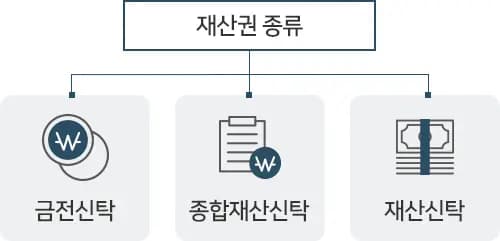
According to the type of property right placed in trust, trusts fall broadly into money trusts, comprehensive property trusts, and property trusts.
The features of each type are set out below.
Money Trust
In a money trust, money is placed in trust, the trustee operates it, and upon termination the principal and the returns are delivered to the beneficiary in the form of money.
This trust may be specified or unspecified, depending on whether operational instructions are given.
Its main purpose is to grow assets through active investment.
Comprehensive Property Trust
A comprehensive property trust takes in two or more kinds of assets, such as money along with securities, monetary claims, and real estate, under a single trust agreement and manages and operates them as one.
In other words, the settlor places several types of assets in trust at once, the trustee manages them together, and the assets are operated and disposed of efficiently.
Because it manages a range of assets together, a comprehensive property trust can produce synergy among them.
Property Trust
In a property trust, assets other than money, such as securities and real estate, are entrusted to a trustee for safekeeping, management, operation, and disposition.
A property trust mainly involves placing securities and real estate in trust, exercising the various rights tied to them on the client's behalf, and assisting with the management and disposition of the assets.
▶ Types of Property Trust
A trust that exercises rights such as the safekeeping of securities and the receipt of dividends on the client's behalf.
② Monetary Claim Trust
A trust in which the right to receive a certain sum of money, a monetary claim, is entrusted to a trustee, and the money arising from the claim is collected.
③ Real Estate Trust
A trust intended for the management and disposition of real estate, divided into Class B real estate management trusts and real estate disposition trusts.
4. Trust Agreement | Modification
The terms of a trust may be changed even after it has been established, as long as certain requirements are met.
Several methods exist, including a change by agreement, a change ordered by a court, and the division or merger of trusts, and a full grasp of the legal requirements for each procedure matters a great deal.
Modification of a Trust by Agreement
A trust may be modified even after its establishment, provided that certain requirements are met.
In particular, where the settlor, the trustee, and the beneficiary agree, the terms of the trust may be changed, and this is one of the most common methods in practice.
▶ Modification of a Trust by Agreement Among the Parties
If the terms of the trust act provide otherwise, however, those terms govern.
▶ Modification of a Trust Through the Court
※ Cases in Which Modification Is Restricted
Converting a ‘purpose trust’ into a trust for the benefit of a beneficiary, or the reverse, is not permitted by law.
Modification of a Trust by Division and Merger
A trustee may modify a trust by consolidating several identical trusts into one, or by dividing an existing trust.
▶ Merger of Trusts
To carry out a merger, however, the statutory requirements must be met, and the consent of the settlor and the beneficiary is required.
▶ Preparation of a Trust Merger Plan
• The purpose of the trust merger
• The terms of the trust act after the merger
• Where the contents of beneficial interests change, the details and the reasons for the change
• Where money or property is delivered to the beneficiary, the details and value of such property
• The effective date of the merger
• The names and addresses of the settlor and trustee of each trust
• The terms of the trust act and the establishment date of each trust
• A list and details of the trust property
• Whether each is a limited liability trust, its name, and similar matters
▶ Approval of the Settlor and Beneficiary
▶ Effect of a Trust Merger
5. Trust Agreement | Termination
A trust agreement may end when the purpose set at the time of establishment is achieved, or for reasons such as a trust merger.
Termination does not simply mean that the agreement is over; a careful settlement of the trust property and matters such as the trustee's release from liability follow, so the legal handling calls for prudence.
The Duty of Final Accounting upon Termination of a Trust
When a trust is terminated, the trustee must promptly perform a final accounting of the trust affairs, then report the result to the beneficiary and the persons entitled to the property and obtain their approval.
Approval of the Accounting and Release of the Trustee from Liability
Once the beneficiary and the persons entitled to the property approve the final accounting, the trustee is released from liability for that trust.
Where the trustee has engaged in intentional misconduct, gross negligence, or a wrongful act, however, the release from liability does not apply.
Period for Raising Objections to Approval of the Accounting
If no objection is raised within one month from the date the trustee requests approval of the accounting, the beneficiary and the persons entitled to the property are deemed to have approved it.
Liquidation Procedure and Continuation of the Trust
Where a trust is terminated through a liquidation procedure under the trust act or by agreement of the parties, the trust continues to exist within the scope of the liquidation purpose until the liquidation is complete.
Liquidation involves steps such as distributing the residual property, repaying debts, and filing taxes, and the trustee or the trust property administrator at the time of termination acts as liquidator.
6. Trust Agreement | Strategy for Preventing Risks in Advance
A trust agreement reaches beyond simple asset management and ties closely into several areas of law, including inheritance, gifts, and taxation.
For this reason, obtaining the counsel of a legal professional across the entire process, from establishment to termination, tends to be closer to a necessity than a choice.
Our firm has resident 🔗finance attorneys who bring hands-on financial experience, and through collaboration with certified public accountants, tax accountants, and others, they can analyze complex trust structures precisely and develop a strategy.
We offer tailored approaches that weigh not only the protection of the client's assets but also long-term risk management.
If you would like to address legal disputes or tax exposure related to a trust agreement in advance, you are welcome to request legal counsel at any time.


Watch related video content
for this case study.

5 things to keep in mind when hiring a lawyer|The lawyer will tell you directly.