
CONTENTS
- 1. The Client Facing Interference With Business Charges

- - The Course of the Case
- 2. Defense Strategy for the Suspect in the Interference With Business Case
- - The Criminal Attorney's Strategy | ① Reviewing the Client's Situation and Initial Response
- - The Criminal Attorney's Strategy | ② Establishing the Facts and Securing Evidence
- - The Criminal Attorney's Strategy | ③ Emphasizing That It Served “the Public Interest”
- - The Criminal Attorney's Strategy | ④ Argument That the Elements of the Charge Were Not Satisfied
- 3. Assistance Result in the Interference With Business Case: Non-Referral
- - Information on Interference With Business and Defamation
- - If You Have Been the Subject of a Criminal Complaint
- - FAQ on Interference With Business

1. The Client Facing Interference With Business Charges
This is the account of a client who came to our firm while facing a police investigation on charges of interference with business and defamation.
 The Course of the Case

When the client enrolled two children in an English kindergarten, the client paid six months' worth of tuition in a lump sum.
During the fourth month, for personal reasons the client decided to withdraw both children and requested a refund for the remaining two months.
However, the refund amount had been calculated incorrectly.
As a parent, the client naturally had questions about this, and after several inquiries the client still did not receive a clear explanation, and ultimately shared the relevant matter on a parents' online community (mom cafe).
However, the post was a review based on objective facts and the client's own experience, written for the purpose of sharing information among parents.
Nevertheless, the academy filed a criminal complaint for defamation and for interference with business through the dissemination of false facts, and the client came to our firm while facing a police investigation.


2. Defense Strategy for the Suspect in the Interference With Business Case

For the client, who had been the subject of a criminal complaint on charges of interference with business and defamation, our firm's attorney specializing in criminal law actively denied the alleged facts, focusing on the following points.
The Criminal Attorney's Strategy | ① Reviewing the Client's Situation and Initial Response
At the initial consultation stage, the criminal attorney closely examined what the client's mom cafe post had actually contained, whether it stated false facts, and whether there had been any intent to defame.
The attorney also analyzed the main thrust of the complaint and confirmed that the issues were whether false facts had been disseminated, whether there was intent, and whether there was a purpose to defame.
The Criminal Attorney's Strategy | ② Establishing the Facts and Securing Evidence
In order to concretely prove what the client had actually experienced during the refund process, the criminal attorney submitted the following materials.
∙ The refund amount breakdown and informational materials
∙ A screen capture of the post's content at the time
These served as important grounds proving that the client's post constituted a review based on objective facts and experience.
The Criminal Attorney's Strategy | ③ Emphasizing That It Served “the Public Interest”
The criminal attorney argued that the mom cafe post was not mere defamation, but had been written for the following purposes.
∙ A public-interest purpose of preventing harm to other parents
This was, in legal terms, a strategy of denying the “purpose to defame” and emphasizing the public-interest nature of providing information.
The Criminal Attorney's Strategy | ④ Argument That the Elements of the Charge Were Not Satisfied
The criminal attorney emphasized that the post did not contain false facts, that it did not specify the name of the complainant's academy, and that it amounted to no more than a personal review and an expression of opinion.
In addition, through a legal explanation that the alleged facts themselves did not satisfy the elements of the charge and the presentation of precedents, the attorney persuasively argued that the suspect's conduct was not subject to punishment.
Supreme Court Decision 2021Do6634, decided September 30, 2021
Where, considering the overall purport of the content, the important parts accord with objective facts and there are merely slight differences in detail or somewhat exaggerated expressions, so that there is no risk of interfering with another person's business, this does not fall within it.
3. Assistance Result in the Interference With Business Case: Non-Referral

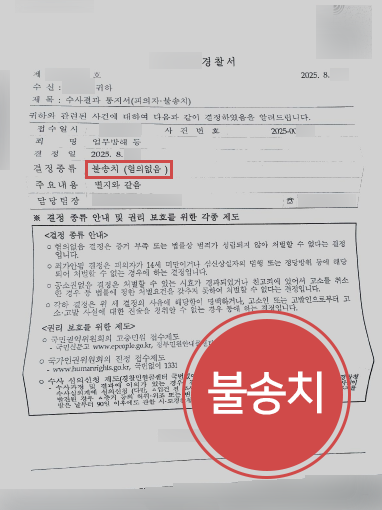
Through the active response of the criminal attorney on the interference with business and defamation charges, the investigative authorities determined that the client's conduct did not meet the requirements for criminal punishment and issued a “Non-Referral (No Suspicion of Crime)” decision.
With the criminal attorney's assistance, the client was able to overcome the unfair complaint, be relieved of legal responsibility, and conclude the case without harm.
Information on Interference With Business and Defamation
Interference with business is established where, for the purpose of interfering with another person's legitimate business, a person disseminates false facts, or impedes the performance of business by deceit or force (Article 314 of the Criminal Act).
In particular, “interference with business through the dissemination of false facts” arising from online posts, reviews, and mom cafe posts is frequently at issue, and recently it has become a common type of dispute among those engaged in service industries, such as academies, hospitals, and small business owners.
The problem is that the boundary between “false facts” and “expression of opinion” is highly ambiguous.
Accordingly, the investigative authorities comprehensively consider the overall context of the post, the social circumstances, and the manner of expression in order to determine the following.
▷ Was there a public-interest purpose?
▷ Was there an actual risk of interference with business?
Level of Punishment for Interference With Business
Statutory Provision | Level of Punishment |
Article 314 of the Criminal Act | Imprisonment for not more than five years, or a fine of not more than 15 million won |
By contrast, defamation under the Network Act (Information and Communications Network Act) may be established where the content, whether it states a fact or a false fact, has the potential to lower a specific person's social reputation.
Elements of Defamation
∙ Disclosing a fact or a false fact
∙ Thereby harming another person's reputation
At this point, the level of punishment varies depending on whether the disclosed fact is false.
Level of Punishment for Defamation
Disclosure of a Fact | Imprisonment for not more than three years, or a fine of not more than 30 million won |
Disclosure of a False Fact | Imprisonment for not more than seven years, suspension of qualifications for not more than ten years, or a fine of not more than 50 million won |
If You Have Been the Subject of a Criminal Complaint
If you have been unfairly made the subject of a criminal complaint as described above, it is most important to set out in concrete terms the background to the case, the circumstances at the time, and the context of the statements.
Legal analysis must be carried out together with securing evidence and establishing a response strategy in order to avoid unfair punishment.
After the consultation, Daeryun Law Firm assigns an attorney specializing in the relevant type of case and, through a systematic response, including organizing the client's statements, securing relevant evidence, submitting a defense counsel's written opinion, and accompanying the client to the police investigation, blocks unfavorable misunderstandings in advance.
In addition, depending on the nature of the case, where necessary the firm collaborates with experts in specialized fields, such as evidence examination and psychological counseling, to reduce the client's burden.
If you are confused after being unfairly made the subject of a criminal complaint, we recommend that you obtain legal assistance by booking 🔗a legal consultation appointment.
Daeryun, the ninth-largest law firm in Korea (based on 2025 National Tax Service value-added tax filings), helps resolve cases through the systematic strategies of legal experts across many fields.
FAQ on Interference With Business
A. Writing a review or expressing an opinion does not, in itself, immediately establish interference with business.Q. Can interference with business be established merely by writing a review?
It is generally established only where there has been a “dissemination of false facts” or “interference by deceit or force.”
Therefore, if a review is based on facts and was made for a public-interest purpose, there is a high likelihood of being cleared of the interference with business charge.
A. These days, it is common for consumers to post reviews through mom cafes, blogs, and social media. Q. Why do online reviews or social media posts lead to complaints for interference with business?
However, when content unfavorable to a particular business spreads, the business often claims “interference with business through the dissemination of false facts” and files a complaint for interference with business, which is why such cases have increased.
In particular, among business operators, filing a complaint for interference with business together with “defamation” has become established as a kind of response measure.
This content is based on actual case studies of Daeryun Law LLC with some adaptations, and the copyright belongs to our firm.
Unauthorized reproduction, duplication, or distribution and other copyright infringements may result in legal action under applicable laws.