
CONTENTS
- 1. Client Involved in a Case of Obscenity via Telecommunication Media

- - Background of the Case
- 2. Response Strategy for the Obscenity via Telecommunication Media Case
- - Proving the Facts through Analysis of Statements and Records
- - Refuting the False Statement with Conversation Records as Evidence
- - Defense through Proof of the Absence of Sexual Purpose
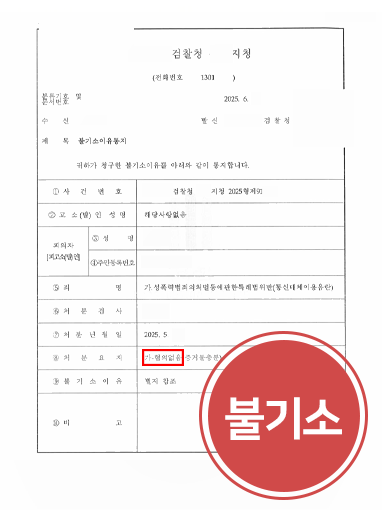
- 3. Result of the Obscenity via Telecommunication Media Case: Non-Prosecution
- - Criminal Defense Attorney FAQ
- 4. Punishment Standards for Obscenity via Telecommunication Media
- - Level of Punishment
- - If You Need Professional Assistance

1. Client Involved in a Case of Obscenity via Telecommunication Media
A minor client was involved in a case of obscenity via telecommunication media, a situation in which a serious criminal punishment was anticipated, but through the systematic assistance of a criminal defense attorney, a disposition of non-prosecution was obtained.
 Background of the Case
At the time of the incident, the client was hanging out with friends and found a photograph of an unknown woman on a friend's mobile phone.
Afterward, while composing a message containing sexual expressions, the message was actually sent during a scuffle with the friends.
The client deleted the message right away, but the woman had already seen it and reported it to the police.
In response, Mr. A, the owner of the mobile phone, shifted responsibility by claiming that the client had personally written and sent the message.
As a high school student, the client feared that criminal punishment would disrupt his studies, and together with his parents, he entrusted the case of obscenity via telecommunication media to a criminal defense attorney.



2. Response Strategy for the Obscenity via Telecommunication Media Case
So that the client, who was under investigation on a charge of obscenity via telecommunication media, could obtain a disposition of non-prosecution, the criminal defense attorney closely examined the central issues of the case.
In this case, it came to light that the owner of the mobile phone had attempted to shift the charge onto the client in order to avoid responsibility.
To prove this, the criminal defense attorney secured and submitted objective evidence, including the consistent statements of the friends, call records, and conversation logs.
The attorney also actively explained that the client, as a high school student, could suffer a significant impact on his studies and future if subjected to criminal punishment, and emphasized the need for leniency.
Proving the Facts through Analysis of Statements and Records
The criminal defense attorney secured the consistent statements of the friends who were present at the scene at the time of the incident, and closely analyzed the call records and message logs before submitting them to the investigative authorities.
According to the statements of the friends who were present, it appeared that Mr. A, the owner of the mobile phone, had personally made the sexual remarks and written the content in question.
On this basis, the criminal defense attorney emphasized that Mr. A was attempting to shift all charges onto the client in order to avoid his own responsibility.
Refuting the False Statement with Conversation Records as Evidence
Mr. A stated that, after the client sent the message in question, he had heard that the client showed it off to a friend who was present.
In response, the criminal defense attorney secured the actual conversation records between the client and Mr. A as evidence and proved that no such remarks had ever been exchanged.
The attorney also emphasized that Mr. A's statement was not based on direct observation but was merely hearsay, presenting the argument that the credibility of the statement was markedly low.
Defense through Proof of the Absence of Sexual Purpose
In a case of obscenity via telecommunication media, the crime is established only when there is a purpose of arousing or satisfying one's own or another person's sexual desire.
However, the client had never met the woman before the alleged conduct and did not even know her gender.
The criminal defense attorney also drew attention to the fact that the message in question was deleted immediately after it was sent, and on this basis emphasized that it was difficult to find that the message had been sent intentionally or with the purpose of arousing or satisfying sexual desire.
3. Result of the Obscenity via Telecommunication Media Case: Non-Prosecution

As a result of proving the absence of intent and of any charge through the criminal defense attorney's thorough analysis of the evidence and the securing of consistent statements, a disposition of non-prosecution was obtained.
As a result, the client was freed from the burden of criminal punishment and able to concentrate on his studies, and he was able to recover his daily life without disadvantage to his future career path.
Criminal Defense Attorney FAQ
A. Obscenity via telecommunication media is assessed not only by the sender's intent but also by whether the recipient may feel sexual shame.Q. Can a person be punished for obscenity via telecommunication media even if the message was sent merely as a joke or out of curiosity?
Therefore, even if it was merely a joke or out of curiosity, if the content of the message is sexually offensive or capable of causing shame, it may be subject to punishment.
A. When a minor is involved in a criminal case, there are instances in which the investigative authorities notify the school of the relevant facts.Q. If a minor is involved in a case of obscenity via telecommunication media, can the school be informed?
In particular, when a protective disposition or criminal punishment is imposed, it may be recorded in the school record, which can result in disadvantage in the course of studies or advancement to higher education.
4. Punishment Standards for Obscenity via Telecommunication Media

Obscenity via telecommunication media is a crime that is established when a person uses a telecommunication medium to send words, writing, images, video, or the like that arouse sexual shame or disgust in the other party.
It is also recognized only when there is a purpose of arousing or satisfying one's own or another person's sexual desire.
Level of Punishment
The level of punishment for obscenity via telecommunication media is determined under the Act on Special Cases concerning the Punishment of Sexual Crimes as follows.
In addition, in the case of a high school student such as the client, the person falls under a juvenile offender (14 years of age or older but under 19 years of age) and may be subject to criminal punishment.
Therefore, when a person comes under investigation, a strategic response that clearly establishes the precise facts and intent from the early stage of the case is necessary.
Article 13 of the Act on Special Cases concerning the Punishment of Sexual Crimes
| Article 13 of the Act on Special Cases concerning the Punishment of Sexual Crimes (Obscenity Using a Telecommunication Medium) | Imprisonment for not more than 2 years or a fine not exceeding 20 million won |
If You Need Professional Assistance
Even when a person is a high school student such as the client, punishment is not exempted merely on the ground of being a minor, and depending on the background and intent of the matter, it may also lead to criminal punishment.
If criminal punishment is imposed, a disadvantage may remain on the school record or restrictions may arise in advancement to higher education and future career, so it is important to receive professional assistance from the early stage of the case.
Daeryun LLC has many criminal defense attorneys with expertise in sex offense cases, including obscenity via telecommunication media, and from the police investigation stage they design the direction of statements in detail and promptly secure evidence that can prove a false accusation or a misunderstanding.
If you have become involved in a criminal case in a situation such as the above, 🔗please reserve a legal consultation to request assistance.
See More

This content is based on actual case studies of Daeryun Law LLC with some adaptations, and the copyright belongs to our firm.
Unauthorized reproduction, duplication, or distribution and other copyright infringements may result in legal action under applicable laws.