
CONTENTS
- 1. Overview of the Quasi-Rape Client's Case

- - The Difference Between Quasi-Rape and Rape
- 2. The Core Issues of the Case of the Client Facing Punishment for Quasi-Rape
- - Non-Referral Disposition
- 3. Quasi-Rape Response Strategy

1. Overview of the Quasi-Rape Client's Case
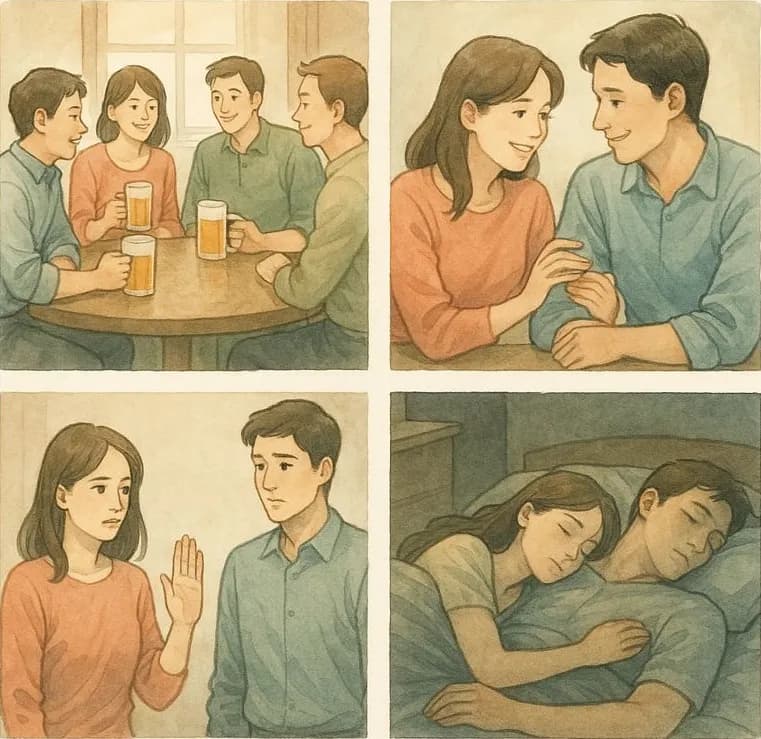
The client, who came to Daeryun stating that the client was facing a quasi-rape charge, had a drinking gathering with acquaintances on the day of the incident, and in the course of it the victim also came to drink together.
During the drinking gathering, the client and the victim talked and a naturally intimate atmosphere formed, and there were also situations in which physical contact was exchanged.
However, in this process, when the victim expressed an intention to refuse, the client immediately stopped and made no further physical contact.
Thereafter, in a situation where the rest of the group was asleep, sexual intercourse took place between the client and the victim, and after the incident the victim filed a complaint for quasi-rape, claiming that at the time of the incident the victim was in a state of mental incapacity or inability to resist due to intoxication, and that the client exploited this to have intercourse.
The client requested the assistance of a sex crime specialist attorney in order to actively contest these charges.
 The Difference Between Quasi-Rape and Rape
Rape (Article 297 of the Criminal Act) and quasi-rape (Article 299 of the Criminal Act) are both equally provided to be punishable by imprisonment for a definite term of not less than 3 years.
However, there is an important difference in the requirements for establishment and in the victim's condition at the time of the incident.
Category | Rape | Quasi-Rape |
Key Criterion | Suppression of free will through violence or intimidation | Exploiting a state of inability to resist |
Point of Determination | The degree and effect of the violence or intimidation | Whether the victim's condition was recognized |
The Victim's Condition at the Time | Capacity to judge exists, but resistance is suppressed | Unable to judge or resist due to alcohol, drugs, sleep, or the like |
Characteristics of the Perpetrator's Conduct | Actively exercises violence or intimidation | Exploits the victim's condition |
See More


2. The Core Issues of the Case of the Client Facing Punishment for Quasi-Rape
1. Whether quasi-rape is established
Quasi-rape is established when intercourse takes place by exploiting a state of mental incapacity or inability to resist, but the sex crime specialist attorney emphasized that, based on CCTV footage secured through the examination of evidence and the digital forensics center, it could be confirmed that at the time of the incident the victim was not heavily intoxicated, walked normally, and moved together with the client.
Accordingly, the attorney asserted, as a core issue, that it was difficult to find that the victim was objectively in a state of mental incapacity or inability to resist.
In addition, the attorney emphasized together that the client had not committed an act of intercourse by genital penetration, and that there was likewise no intent to recognize the victim's condition as one of mental incapacity or inability to resist, or to exploit it.
2. Whether there was consent to the sexual relationship
The attorney emphasized that it was a consensual relationship without coercion, on the basis that the victim responded during the physical contact with the client and that, when the victim expressed an intention to refuse, the client immediately stopped.
3. The credibility of the victim's statements
The attorney highlighted that the victim's statements had parts that changed between the early stage of the case and the subsequent investigation process, and that they did not match the objective circumstances, so that the credibility of the statements was low.
4. Submission of the defense counsel's written opinion
The sex crime specialist attorney submitted a defense counsel's written opinion centered on the 'absence of a state of mental incapacity or inability to resist', the 'absence of intercourse and intent', the 'circumstances of consent', and the 'problem with the credibility of the victim's statements'.
Non-Referral Disposition
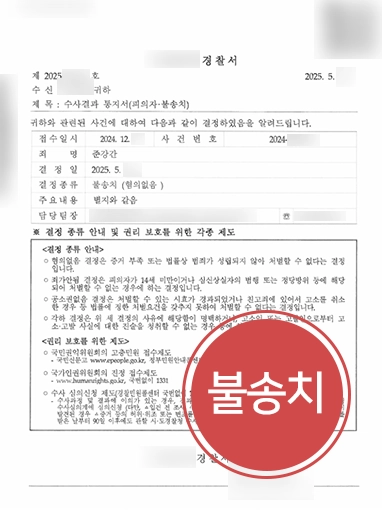
Comprehensively considering the circumstances at the scene at the time, the statements of the persons involved in the case, and other factors, with the assistance of the sex crime specialist attorney the client received a non-referral disposition and was able to escape the crisis of punishment for quasi-rape.
3. Quasi-Rape Response Strategy
If you have been subject to a complaint on a charge of quasi-rape, it is important to prepare a response strategy from the early stage of the case.
Before the first questioning by the investigative authority, it is necessary to organize the circumstances of the case in chronological order and to preserve, without arbitrarily deleting, objective materials such as text messages, call records, payment records, and CCTV footage.
In addition, during the questioning process, it is important to avoid emotional explanations or speculative remarks and to maintain consistent statements centered on the facts.
However, such a response is, at most, only a minimum defense.
In a sex crime case, the victim's statements carry great weight, so there is a clear limit to a layperson's ability to independently judge the legal meaning of evidence and to control the direction of the investigation.
If you retain Daeryun Law Firm, the firm can manage the entire process of the case in one stop, from the initial collection and analysis of evidence through the response to police and prosecution investigations, the submission of the defense counsel's written opinion, and the response at the trial stage, and respond strategically.
If you are worried because you have been implicated in a quasi-rape charge in a similar situation, we recommend that you review your initial response strategy together with a sex crime specialist attorney.
This content is based on actual case studies of Daeryun Law LLC with some adaptations, and the copyright belongs to our firm.
Unauthorized reproduction, duplication, or distribution and other copyright infringements may result in legal action under applicable laws.