
CONTENTS
- 1. Client Charged With Quasi-Indecent Act by Compulsion

- - Background of the Case
- 2. Strategy for Defending the Quasi-Indecent Act by Compulsion Case
- - Reconstruction of the Facts
- - Specific Manner of the Act and Objective Circumstances
- - Insufficient Proof by the Prosecutor
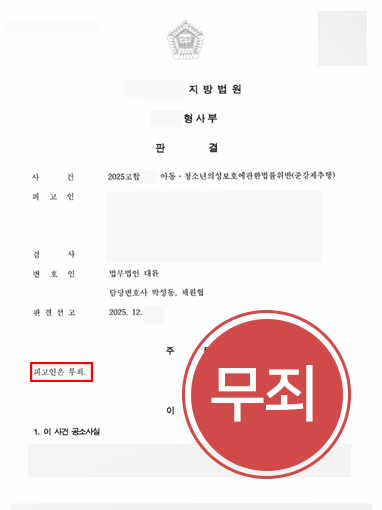
- 3. Result of the Quasi-Indecent Act by Compulsion Case, an "Acquittal"
- 4. Elements of Quasi-Indecent Act by Compulsion
- - Age Standard Under the Act on the Protection of Children and Youth against Sexual Abuse
- - Have You Become Involved in a Case Under the Act on the Protection of Children and Youth against Sexual Abuse?

1. Client Charged With Quasi-Indecent Act by Compulsion
The client, who was under suspicion of quasi-indecent act by compulsion, had been booked by the police on suspicion of committing an indecent act by removing the clothing and underwear of an intoxicated minor.
 Background of the Case
After finishing work, the client had a brief gathering for drinks with the staff members who had been working together at the establishment.
The staff members then contacted Mr. A, a minor who had been working part-time with them, and invited him to join the gathering, and Mr. A accepted and attended the gathering.
During the gathering, Mr. A repeatedly vomited and became heavily intoxicated, and the client, judging that Mr. A was in a state in which he could not move on his own, moved him to a nearby hotel.
Even after arriving at the room, Mr. A continued to vomit, so the client removed the soiled outer clothing, washed it with water, hung it on a hanger, and then returned home.
However, Mr. A claimed that the client had removed his underwear and forcibly committed an indecent act, and reported the matter to the police.
Because Mr. A was a minor, the client faced a situation in which serious criminal liability could become an issue, and the client, asserting that the accusation was unjust, requested the assistance of a lawyer who had handled numerous quasi-indecent act by compulsion cases under the Act on the Protection of Children and Youth against Sexual Abuse.


2. Strategy for Defending the Quasi-Indecent Act by Compulsion Case

The Supreme Court has ruled on indecent acts as follows.
See Supreme Court Decision 97Do2506, January 23, 1998
Accordingly, on the basis of the above legal principle, the lawyer specializing in sexual offenses built a defense centered on the point that the client's conduct in this case did not constitute an indecent act.
Reconstruction of the Facts
The lawyer specializing in sexual offenses obtained the CCTV footage from inside the establishment and the hotel at the time and closely analyzed the circumstances before and after the incident.
As a result, the following facts were confirmed.
· The point that, because of repeated vomiting, his clothing was heavily soiled with vomit
On this basis, the lawyer specializing in sexual offenses logically presented the point that the client, in the course of caring for Mr. A and out of consideration for hygiene and safety, cleaned up the vomit, removed and washed only the soiled outer clothing, and then returned home.
Specific Manner of the Act and Objective Circumstances
In the course of moving Mr. A to the hotel, the client was accompanied by another staff member, and after arriving at the hotel, he identified himself to the staff and completed the room registration procedure.
This series of actions can hardly be regarded as conduct carried out covertly, and it is also clearly far removed from conduct premised on an intent to commit an indecent act.
The lawyer specializing in sexual offenses emphasized that, when the above specific manner of the act and objective circumstances are considered together, it does not accord with common sense to conclude that the client removed Mr. A's clothing with an intent to commit an indecent act.
Insufficient Proof by the Prosecutor
According to Supreme Court precedent, in a sexual offense case where the defendant denies the facts charged, and the direct evidence corresponding to the facts charged is in effect limited to the victim's statement, the credibility of that statement must be judged very strictly. [Supreme Court Decision 2021Do3451, August 19, 2022]
In this case, from the early stage the client admitted that he had removed the outer clothing but consistently denied the act of removing the underwear, and no direct evidence sufficient to acknowledge an intent to commit an indecent act was confirmed either.
Nevertheless, Mr. A's side argued that an indecent act had been committed, relying as its key grounds on the circumstances at the time and on the fact that the client's DNA had been detected on the underwear.
In response, the lawyer specializing in sexual offenses emphasized, on the basis of the following circumstances, that the DNA detection result alone made it difficult to reinforce the credibility of the victim's statement and was also insufficient to prove the fact of an indecent act.
· The point that, in fact, none of the client's DNA was detected on the inner surface of the underwear
3. Result of the Quasi-Indecent Act by Compulsion Case, an "Acquittal"

In the quasi-indecent act by compulsion case, the lawyer specializing in sexual offenses developed a defense based on the relevant legal principles and the objective circumstances, and as a result the court pronounced an acquittal in the client's case.
The client then expressed his gratitude, saying, "I was afraid that everything might collapse in an instant, but thanks to the acquittal I was able to return to an ordinary daily life."
4. Elements of Quasi-Indecent Act by Compulsion
Quasi-indecent act by compulsion is a crime that is established when all of the following elements are satisfied.
· Criminal intent
· An indecent act
In general, quasi-indecent act by compulsion is subject to the same statutory penalty as indecent act by compulsion, and the Criminal Act prescribes the following levels of punishment.
Category | Level of Punishment |
Criminal Act, Article 298 (Indecent Act by Compulsion) | Imprisonment for not more than 10 years or a fine of not more than 15 million won |
Criminal Act, Article 299 (Quasi-Rape and Quasi-Indecent Act by Compulsion) | In the case of quasi-indecent act by compulsion, the provisions of Article 298 apply |
However, where the victim is a child or youth, the Act on the Protection of Children and Youth against Sexual Abuse applies and the level of punishment is further increased.
Category | Level of Punishment |
Act on the Protection of Children and Youth against Sexual Abuse, Article 7, Paragraph 3 | Where an indecent act by compulsion is committed against a child or youth, imprisonment for a definite term of at least 2 years or a fine of not less than 10 million won and not more than 30 million won |
Act on the Protection of Children and Youth against Sexual Abuse, Article 7, Paragraph 4 | Where a quasi-indecent act by compulsion is committed against a child or youth, the provisions of Paragraph 3 apply |
Age Standard Under the Act on the Protection of Children and Youth against Sexual Abuse
The standard for a child or youth to whom the Act on the Protection of Children and Youth against Sexual Abuse applies is a minor under the age of 19 at the time of the incident.
Therefore, even where the victim appears to be an adult in outward appearance, or where the offender believed the offense to be a sexual offense against an adult, if the victim had not yet reached the age of 19 because his or her birthday had not yet passed, the offense is classified as a sexual offense against a child or youth.
In addition, the age standard under the Act on the Protection of Children and Youth against Sexual Abuse is judged on the basis of the victim's age at the time of the offense rather than the victim's current age.
For this reason, one must not respond complacently merely because the victim has become an adult after the incident, and a careful response that takes into account the possibility of the application of the Act on the Protection of Children and Youth against Sexual Abuse from the early stage is necessary.
Have You Become Involved in a Case Under the Act on the Protection of Children and Youth against Sexual Abuse?
Sexual offenses against children and youth carry heavier statutory penalties than ordinary sexual offenses, so the course of a case may differ greatly depending on the initial response.
Daeryun LLC closely reviews the direction of statements even before the investigation stage, systematically organizes the relevant materials, and responds strategically throughout the entire investigation process.
If you have become involved in a sexual offense case such as a quasi-indecent act by compulsion against a child or youth in a situation such as the above, please request assistance through a 🔗Legal Consultation Reservation.
This content is based on actual case studies of Daeryun Law LLC with some adaptations, and the copyright belongs to our firm.
Unauthorized reproduction, duplication, or distribution and other copyright infringements may result in legal action under applicable laws.