
CONTENTS
- 1. Statute of Limitations for Sexual Molestation, the Client's Account

- - Background of the Case
- - The Sexual Offense Attorney's Assistance
- 2. Representation of a Criminal Complaint Within the Statute of Limitations for Sexual Molestation, Proceeding to Indictment for Formal Trial Without Detention
- 3. Statute of Limitations for Sexual Molestation, the Concept and Level of Punishment of Workplace Forcible Indecent Act
- - Level of Punishment
- - Workplace Forcible Indecent Act, What Is the Statute of Limitations for Sexual Molestation?
- 4. If You Need to Respond Within the Statute of Limitations for Sexual Molestation
- - The Sexual Offense Attorney's Response Strategy

1. Statute of Limitations for Sexual Molestation, the Client's Account
The account of the client, who wished to file a complaint for an indecent act by abuse of authority within the statute of limitations for prosecution, is as follows.
 Background of the Case
The client, an office worker employed at a large corporation, suffered sexual molestation at a company dinner by Department Head A (hereinafter the "respondent"), who belonged to a different team.
The respondent repeatedly stroked the client's waist and touched the client's thigh, doing so on one or more occasions, and although the client felt discomfort, the client was unable to express refusal because of the respondent's position as a workplace superior.
The client tried to overlook the respondent's conduct, but situations that made the client uncomfortable continued to arise even after the dinner, such as having to collaborate with the respondent on work or encountering the respondent in the pantry.
Accordingly, the client came to request assistance from a sexual offense attorney in order to proceed with a criminal complaint within the statute of limitations for prosecution.
The Sexual Offense Attorney's Assistance
1) Emphasizing the structure of an offense committed through abuse of authority
The sexual offense attorney organized the circumstances at the time of the company dinner and the relationship in rank, and emphasized that the respondent was the client's superior, arguing that the respondent's conduct constituted an indecent act using authority.
The attorney also secured circumstances showing that the client had informed an acquaintance immediately after the incident and had requested separation of duties, thereby emphasizing the consistency and credibility of the client's testimony.
2) Highlighting the gravity of the psychological harm
The sexual offense attorney submitted a written opinion from a psychiatric specialist along with diagnostic materials, emphasizing that the client's depression, anxiety, and post-traumatic symptoms were ongoing.
In particular, by emphasizing the structure in which the client continued to work in the same space and encounter the respondent, the attorney strongly asserted that the harm was ongoing and that separation was necessary.
3) Asserting a lack of remorse and secondary harm
The sexual offense attorney organized the fact that the respondent had merely repeated formal expressions without a sincere apology, and asserted a lack of remorse.
The attorney also organized the circumstances showing that the respondent had continually created situations of contact by using authority over work to demand in-person reporting and to give direct instructions, thereby emphasizing that secondary harm using the respondent's position was continuing and pleading for the necessity of strict punishment.


2. Representation of a Criminal Complaint Within the Statute of Limitations for Sexual Molestation, Proceeding to Indictment for Formal Trial Without Detention
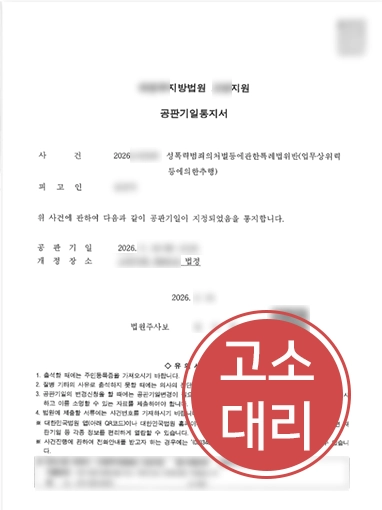
As a result of proceeding with the representation of the complaint for an indecent act by abuse of authority within the statute of limitations for prosecution, the court issued a summary order at the early investigation stage.
However, the sexual offense attorney actively demonstrated the gravity of the matter, the respondent's lack of remorse, and the circumstances of secondary harm using the respondent's position, and argued for the necessity of a formal trial; ultimately, the case was referred to trial proceedings and proceeded to the stage of hearing on the merits.
The sexual offense attorney promptly explained the decision to refer the case to trial and the future trial procedure to the client, providing specific guidance even on the direction of witness examination and sentencing arguments.
In response, the client was relieved that the case would be addressed in a formal trial rather than remaining in summary proceedings, and conveyed thanks to the sexual offense attorney.
3. Statute of Limitations for Sexual Molestation, the Concept and Level of Punishment of Workplace Forcible Indecent Act

If a person commits an indecent act against someone under their protection or supervision by reason of work, employment, or any other relationship, by means of deceit or coercion, that person may be punished on a charge of forcible indecent act, that is, an indecent act by abuse of authority.
Level of Punishment
An indecent act by abuse of authority is punished under the Act on Special Cases concerning the Punishment of Sexual Crimes.
A person who commits an indecent act, by means of deceit or authority, against someone under their protection or supervision by reason of work, employment, or any other relationship may be sentenced to imprisonment for not more than three years or a fine not exceeding 15 million won.
If a person who guards someone in custody commits an indecent act, that person shall be subject to imprisonment for not more than five years or a fine not exceeding 20 million won, and where the act is committed against multiple persons or the same offense is repeated habitually, aggravated punishment may be imposed.
Workplace Forcible Indecent Act, What Is the Statute of Limitations for Sexual Molestation?
1) Where the victim is an adult
For an ordinary forcible indecent act committed against an adult, a statute of limitations of ten years applies, as it does for rape and similar offenses.
(If there is scientific evidence capable of proving the fact of the crime, such as DNA, the statute of limitations is extended by ten years under the Act on Special Cases concerning the Punishment of Sexual Crimes.)
2) Where the victim is a minor
For a sexual offense against a minor, the limitations period begins from the day on which the victim reaches the age of majority (19 years old).
3) Cases where there is no statute of limitations for sexual molestation at all
In the following cases, punishment is possible at any time, no matter how much time has passed.
-Where special rape, rape by a relative, sexual violence against a person with disability, or a sexual offense against a person under the age of 13 leads to murder
-Where a person who commits a sexual offense kills an active-duty service member or a person performing military service
4. If You Need to Respond Within the Statute of Limitations for Sexual Molestation
If you have resolved to file a complaint within the statute of limitations for prosecution, you must prepare not only the organization of the background of the case but also the securing of related materials and an understanding of the investigation procedure.
Because testimony remains as evidence from the moment it is submitted to an investigative agency, it is important to organize the facts in detail in advance.
Text messages, messenger conversations, call records, and circumstances showing that the matter was disclosed to those nearby can also serve as materials supporting the credibility of the case.
Above all, the key is to confirm the statute of limitations for prosecution precisely and to proceed with the procedure before the limitations period expires.
The Sexual Offense Attorney's Response Strategy
The sexual offense attorney closely reviews the statute of limitations for prosecution to accurately determine the applicable charge and whether a complaint may be filed.
The attorney reorganizes the background of the case to fit the legal elements so that the investigative agency clearly recognizes the establishment of the offense.
In addition, by collaborating with the internal Evidence Investigation Center and Digital Forensics Center, the attorney systematically analyzes and preserves digital materials such as text messages, messenger conversations, call records, and deleted data, thereby reinforcing the credibility of the testimony with objective materials.
If you are considering filing a complaint within the statute of limitations for prosecution, please confirm, through the 🔗legal consultation booking, the specific response strategy you can take in your current situation.
This content is based on actual case studies of Daeryun Law LLC with some adaptations, and the copyright belongs to our firm.
Unauthorized reproduction, duplication, or distribution and other copyright infringements may result in legal action under applicable laws.