
CONTENTS
- 1. The Client Who Visited Daeryun Regarding Trademark Infringement

- - The Account of the Client Who Suffered Trademark Infringement
- - Laws Related to Trademark Infringement
- 2. Daeryun's Assistance to Remedy Trademark Infringement
- - The Manufacturing Factory's Filed Trademark Is Substantially Identical to the Client's Trademark
- - The Manufacturing Factory Had the Intent to Infringe the Trademark From the Outset
- - The Client Suffered a Significant Blow Due to the Manufacturing Factory's Trademark Infringement
- 3. The Result of the Trial on the Provisional Injunction Prohibiting Trademark Infringement: 'Granting'
- - For Trademark Infringement, It Is Advantageous to Proceed With Litigation Together With an Attorney Specializing in the Field

1. The Client Who Visited Daeryun Regarding Trademark Infringement
The client, who sought a consultation regarding trademark infringement, was the representative of OO Company, a wholesale and retail business of household goods, and the company sold wet wipes as its main product.
In the course of business, a dispute arose in which the wet wipe manufacturing factory used a trademark identical to the client's, and the client therefore visited Daeryun.
 The Account of the Client Who Suffered Trademark Infringement
The client operated OO Company, a wholesale and retail business of household goods whose main product was wet wipes.
In the course of business, the manufacturing factory with which the client had entered into a manufacturing and distribution contract created a trademark nearly identical to the client's and registered it as a trademark,
and it infringed the client's trademark right by affixing that trademark to wet wipes and selling them.
Anticipating a significant blow to sales as a result, the client wished to promptly prohibit the manufacture and sale of products bearing that trademark through an application for a provisional injunction prohibiting trademark infringement.
Laws Related to Trademark Infringement
A trademark refers to any means used as a mark, such as a product name, logo, or design, to the extent that one product can be distinguished from another product.
Because a trademark right is based on the first-to-file principle, it is structured so that the right is recognized for the person who files first and completes the registration,
and no matter how long one has used a mark, if it has not been registered as a trademark, the right is granted to the person who completed its registration as a trademark.
Therefore, if it is discovered that someone is using a trademark without authorization and without obtaining proper consent from the rightholder, that person may be subject to imprisonment for not more than seven years or a fine of not more than 100 million won.
In addition, even apart from criminal punishment, one may demand monetary compensation through a claim for damages for the harm actually incurred, and one may proceed with an application for a provisional injunction prohibiting trademark infringement in order to prevent further losses.
※ If you would like to learn about the practice areas of Daeryun's Intellectual Property Group related to trademarks, ☞click here☜.
2. Daeryun's Assistance to Remedy Trademark Infringement
Before formally proceeding with litigation over the trademark infringement, Daeryun, seeking to prevent the client's harm by first proceeding with a provisional injunction, made the following arguments in order to obtain a granting of the provisional injunction.
The Manufacturing Factory's Filed Trademark Is Substantially Identical to the Client's Trademark
The mark filed by the manufacturing factory merely changed the font of the trademark created by the client (which contained the trade name as it was).
Accordingly, it was argued that this was not a trademark created by the manufacturing factory by adding its own distinctive features through separate cost, time, and effort, but was clearly a misappropriation of the client's trademark.
|
The Manufacturing Factory Had the Intent to Infringe the Trademark From the Outset
At the time it proposed the goods supply contract to the client, the manufacturing factory was already manufacturing wet wipes and had a distribution contract with another company, yet it nonetheless entered into a wet wipe manufacturing and distribution contract with the client.
Considering the circumstance that, shortly after concluding the contract, it immediately filed a trademark application for a mark substantially identical to the client's trademark, it was argued that there was a high possibility that the factory had proposed the contract with the intent to infringe the trademark from the beginning.
The Client Suffered a Significant Blow Due to the Manufacturing Factory's Trademark Infringement
If the manufacturing factory's trademark infringement were not promptly stopped, the sale of identical or similar products under an identical or similar trademark would ultimately cause confusion as to the source of the sales, and a sharp decline in the client's sales was anticipated.
Accordingly, it was argued that the application for a provisional injunction had to be granted in order to prevent continued harm to the client.
3. The Result of the Trial on the Provisional Injunction Prohibiting Trademark Infringement: 'Granting'
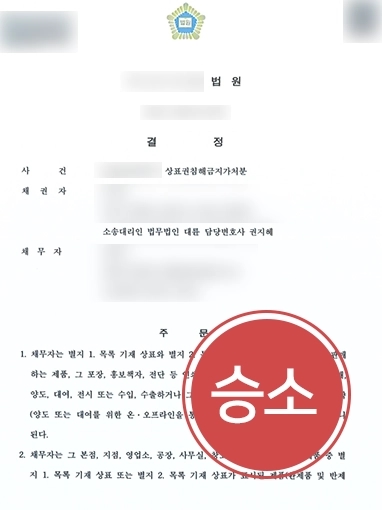
As a result of the client who suffered trademark infringement proceeding with the case together with Daeryun, the court issued a judgment to the manufacturing factory that 'it shall not use the client's trademark on products it manufactures or sells, on packaging, on promotional brochures, and the like' and a judgment that 'the manufacturing factory shall discard, among the products it holds at its head office, business offices, and offices, those products bearing the trademark in question', thereby granting the application for the provisional injunction.
For Trademark Infringement, It Is Advantageous to Proceed With Litigation Together With an Attorney Specializing in the Field
A trademark right, among intellectual property rights, falls under industrial property rights.
Daeryun operates an Intellectual Property Group staffed by attorneys with backgrounds in the courts, the prosecution, the police, the Fair Trade Commission, and patent practice, and it actively assists clients who need help. If you need assistance, please feel free to visit and request a consultation.
This content is based on actual case studies of Daeryun Law LLC with some adaptations, and the copyright belongs to our firm.
Unauthorized reproduction, duplication, or distribution and other copyright infringements may result in legal action under applicable laws.