CONTENTS
- 1. The Client Who Sought a Changwon Damages Attorney

- - The Client's Story as Heard by the Changwon Damages Attorney
- - Relevant Statutes and Precedents Explained by a Changwon Damages Attorney
- 2. The Strategy Established by the Changwon Damages Attorney
- - Changwon Attorney Strategy 1: Arguing That the Lawsuit Should Be “Rejected”
- - Changwon Attorney Strategy 2: Emphasizing the Proper Process of Preparing the Settlement Agreement
- - Changwon Attorney Strategy 3: Addressing A's Unstable Psychological State
- 3. Result of the Changwon Damages Attorney's Assistance: A Judgment of “Rejection of the Suit”
- - Sued Again Even After Reaching a Settlement?

1. The Client Who Sought a Changwon Damages Attorney
The client who visited the Changwon damages attorney was a man in his thirties. An acquaintance who had been involved with him in an assault case some years earlier filed a damages lawsuit against the client for tens of millions of won. The Changwon attorney examined the detailed circumstances.
 The Client's Story as Heard by the Changwon Damages Attorney

The plaintiff in this lawsuit was Mr. A, an acquaintance of the client.
Several years earlier, the two had once gotten into an argument while drinking together.
At that time, the client, overcome with anger, assaulted Mr. A, and after the matter was reported to the police, they were brought before the court.
The two were able to reach an amicable settlement.
Having cleared up their misunderstanding, the two signed a settlement agreement containing the statement that they "would not raise any civil or criminal objections related to this matter in the future."
As Mr. A expressed his wish not to seek punishment, the client received a suspended sentence.
The problem resurfaced when Mr. A suddenly filed a claim for damages against the client.
Mr. A claimed that the settlement agreement at the time had been drawn up under threat from the client, and that he was still suffering mental distress as a result of the violence they had exercised.
The client then sought out a Changwon attorney for assistance.
Relevant Statutes and Precedents Explained by a Changwon Damages Attorney
A juristic act that has lost fairness to a significant degree due to a party's distress, recklessness, or inexperience shall be void.
Where the parties have agreed not to file suit even if a dispute arises regarding a specific right or legal relationship, a suit filed in violation of this agreement has no interest in protection of rights, and the principle of good faith, which requires that the exercise of rights and the performance of duties be carried out faithfully in accordance with good faith, is a general principle of law that governs and regulates not only contract law but all legal relationships, and is naturally required in civil litigation as well. (See Supreme Court Decision 92Da21760, decided May 14, 1993.)
2. The Strategy Established by the Changwon Damages Attorney
The Changwon damages attorney developed a strategy so that the client would not have to pay tens of millions of won in compensation to A.
Changwon Attorney Strategy 1: Arguing That the Lawsuit Should Be “Rejected”
The Changwon attorney determined that the filing of the suit itself was improper.
This is because the two persons had already concluded a 'no-suit agreement' regarding the assault case.
A no-suit agreement means an agreement by the parties to a case that, after amicably resolving their conflict, they will not raise any objection regarding that case in the future.
The two persons had also directly drawn up and signed a settlement document containing such content.
Even though they had agreed not to file civil or criminal suits, the claim of A, who filed a civil suit regarding the same matter, was inevitably difficult to accept.
Changwon Attorney Strategy 2: Emphasizing the Proper Process of Preparing the Settlement Agreement
A claimed that he was frightened by the client's intimidation and signed the settlement agreement out of fear of retaliation.
This claim, however, was also not true.
It was A who first proposed drawing up the settlement agreement at the time.
A called the client and expressed an intention to write a settlement agreement.
Immediately after the two signed the settlement agreement, A even assaulted the client, saying it was "the price for writing the settlement agreement."
The claim that A, who first raised the subject of the settlement agreement and even struck the client, drew up the document under duress out of fear of retaliation was inconsistent.
Changwon Attorney Strategy 3: Addressing A's Unstable Psychological State
Ms. A had been in a psychologically unstable condition from the time she became involved with the client.
Apart from the case involving the client, she had also been booked on several occasions for assaulting other people.
In addition, Ms. A had visited a hospital even before preparing the settlement agreement, and she had also been diagnosed with a mental illness by a doctor.
This means that she was sufficiently aware of her own mental illness at the time the settlement agreement was prepared.
If the mental suffering caused by the assault had truly been severe, she should have mentioned it at the time of signing and requested treatment costs and the like.
3. Result of the Changwon Damages Attorney's Assistance: A Judgment of “Rejection of the Suit”
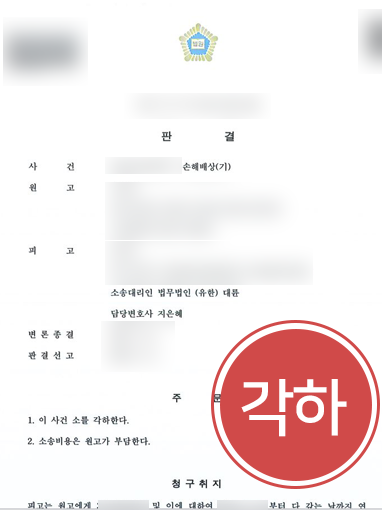
As a result of the Changwon damages attorney's taking responsibility for the lawsuit from beginning to end and assisting the client, the court issued a judgment of rejection.
The court determined that, because the lawsuit itself had been filed in violation of an agreement not to sue, there was no need even to hold a hearing.
Sued Again Even After Reaching a Settlement?
We have introduced the case of a client who, despite having entered into a 'covenant not to sue' agreeing not to raise any further civil or criminal objections in connection with the matter, was unfairly subjected to a civil lawsuit.
In relatively minor matters, as in the case above, the parties often complete a 'covenant not to sue' between themselves and conclude the legal process.
As a rule, where such a promise has been made, objections may not be raised, but if the agreement does not meet the legal requirements, a determination of invalidity may be sought.
The Changwon attorney is part of Daeryun LLC, which includes attorneys with extensive experience in civil litigation.
A team led by an attorney with more than 20 years of experience provides legal services.
If you have any inquiries regarding a covenant not to sue or a damages lawsuit, please consult a Changwon attorney.
This content is based on actual case studies of Daeryun Law LLC with some adaptations, and the copyright belongs to our firm.
Unauthorized reproduction, duplication, or distribution and other copyright infringements may result in legal action under applicable laws.