CONTENTS
- 1. The Client Who Came to a Yongsan Civil Litigation Attorney

- - The Yongsan Civil Attorney's Assessment of the Case
- - The Extinctive Prescription of a Claim as Explained by the Yongsan Civil Attorney
- 2. The Yongsan Civil Litigation Attorney's Assistance
- - Yongsan Civil Specialist Attorney Argues That the Money Was Paid Unilaterally by the Other Party
- - Yongsan Civil Specialist Attorney Argues That It Was Made Clear There Was No Intention to Return the Money
- - Yongsan Civil Litigation Attorney Argues That the Client Told Him Not to Send Money
- 3. Yongsan Civil Litigation Attorney Successfully Defends the Loan Lawsuit
- - The Yongsan Civil Attorney's Summary of the Case

1. The Client Who Came to a Yongsan Civil Litigation Attorney
A man whom the client had been seeing in the past filed a loan lawsuit against the client who came to a Yongsan civil litigation attorney.
In order to prove that the monetary transaction in question was not a loan, the client requested the help of a Yongsan civil specialist attorney at Daeryun Law Firm.
 The Yongsan Civil Attorney's Assessment of the Case
The Yongsan civil attorney conducted the consultation directly and assessed the case.
The client received money from the man on the condition of a relationship.
Although she refused several times, the other party actively tried to provide the money, and the client made clear that she had no intention whatsoever of bearing an obligation to return that money.
Despite this, he continued to transfer money to the client's account, and they later developed into a romantic relationship.
The relationship did not last long, however, and upon breaking up, the other party changed his story, demanded the return of the money he claimed to have lent, and filed a loan recovery lawsuit.
To respond to this, she requested the help of a Yongsan civil specialist attorney.
The Extinctive Prescription of a Claim as Explained by the Yongsan Civil Attorney
The Yongsan civil specialist attorney first conducted a legal review of the extinctive prescription. This is because once the extinctive prescription has passed, the money need not be repaid.
Under the Civil Act, the extinctive prescription of an ordinary claim is ten years.
The extinctive prescription also varies according to the nature of the claim, however; for a claim arising from a commercial act it is five years, for an interest claim set for a period within one year it is three years, and for a claim confirmed by a judgment or similar means it is ten years.
Civil Act Article 162 (Extinctive Prescription of Claims and Property Rights)
(1) A claim is extinguished by prescription if it is not exercised for ten years.
(2) A property right other than a claim or ownership is extinguished by prescription if it is not exercised for twenty years.
2. The Yongsan Civil Litigation Attorney's Assistance
To defend against the loan recovery lawsuit, the Yongsan civil litigation attorney had to establish that the monetary transactions exchanged were not a loan.
A team composed of three people, including specialists in the relevant field, established a tailored defense strategy based on data from the resolution of similar cases.
Yongsan Civil Specialist Attorney Argues That the Money Was Paid Unilaterally by the Other Party
The Yongsan civil specialist attorney argued that, despite the client's refusal, the other party continued to send money unilaterally.
He continued to send money, saying he would give it in return for her meeting him just once a month. The attorney therefore emphasized that this was not a monetary transaction in the nature of a loan.
Yongsan Civil Specialist Attorney Argues That It Was Made Clear There Was No Intention to Return the Money
The Yongsan civil specialist attorney argued that, in response to the other party's active provision of money, the client continued to show an attitude indicating that she had no intention of bearing an obligation to return it.
By submitting the content of conversations exchanged with the other party, the attorney emphasized the content making clear that the monetary transaction with the other party was a gift and argued that it was not a loan.
Yongsan Civil Litigation Attorney Argues That the Client Told Him Not to Send Money
The Yongsan civil litigation attorney noted that, after the client broke up with the other party, she told him not to deposit anything and not to contact her, and she blocked his contact, but despite this,
he continued to come to her, begged for forgiveness, and kept trying to deposit money. By submitting the content of these conversations as evidence, the attorney argued that this was not at all a relationship of lending and borrowing money.
3. Yongsan Civil Litigation Attorney Successfully Defends the Loan Lawsuit
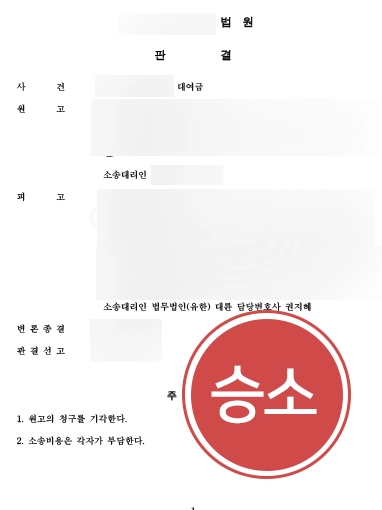
The Yongsan civil litigation attorney successfully defended the loan recovery lawsuit and was able to obtain a judgment dismissing the plaintiff's claim.
The Yongsan Civil Attorney's Summary of the Case
Based on the content of the consultation with the client, the Yongsan civil attorney argued that the money in question was a gift rather than a loan,
and the court accepted the Yongsan civil attorney's argument as it stood, declined to recognize it as a loan, and rendered a judgment dismissing the plaintiff's claim.
As in the client's situation, if a loan recovery lawsuit is filed against you even though you did not borrow money, you should obtain the help of a Yongsan civil attorney and respond from the early stages of the trial.
The period for submitting an answer in a civil lawsuit is about 30 days, and once this period passes, a judgment may be rendered without oral argument, so you should respond to the other party's untrue claims with the help of an attorney with the appropriate expertise.
With the help of a Yongsan civil specialist attorney at Daeryun Law Firm, you may respond quickly from the early stages of the trial.
This content is based on actual case studies of Daeryun Law LLC with some adaptations, and the copyright belongs to our firm.
Unauthorized reproduction, duplication, or distribution and other copyright infringements may result in legal action under applicable laws.