
CONTENTS
- 1. The Client Who Requested a Gunsan Attorney Consultation

- 2. The Collection Claim Suit Through the Gunsan Attorney Consultation
- - Gunsan Attorney Consultation, Arguing the Defendant's Non-Compliance With the Collection Order
- - Gunsan Attorney Consultation, Arguing the Loss Suffered by the Client
- 3. Result of the Gunsan Attorney Consultation, Successful Full Grant of the Collection Claim

1. The Client Who Requested a Gunsan Attorney Consultation

The client who requested a Gunsan attorney consultation had held an advance-payment claim against a non-party, A, for a long time, but A did not repay it, and the client was experiencing great difficulty.
The client learned that A was receiving a salary from the defendant (the employer), filed a collection order suit against the defendant, and obtained an attachment of the claim and a collection order.
However, the defendant did not pay the amount, and the client requested a consultation with the Gunsan attorney in order to proceed with a collection suit.
 The Collection Claim Suit Explained by the Gunsan Attorney
Even after obtaining a final judgment in one's favor through a monetary claim suit, such as a claim for the return of a loan or the price of goods, if the debtor does not voluntarily make repayment, there is no choice but to resolve the matter through compulsory execution.
At this point, collection may be made through the attachment and auction of property such as real estate held in the debtor's name, but it is also possible to attach and collect a claim that the debtor holds against a third-party debtor.
If, despite an attachment and collection order having been obtained, the third-party debtor refuses to pay the amount to the creditor, the creditor may file a ‘collection claim suit’ against the third-party debtor.
This collection claim suit is a civil suit that only the collection holder may file.
According to Supreme Court precedent, in a collection suit the attaching creditor may claim payment directly to itself (direct claim), but when creditors compete, it may also seek a deposit (suit seeking a deposit).
Even in a suit seeking a deposit, this is limited to an attaching creditor who has obtained a collection order, and care should be taken because another attaching creditor who has not obtained a collection order lacks standing as a plaintiff.
2. The Collection Claim Suit Through the Gunsan Attorney Consultation
Through the Gunsan attorney consultation, the client proceeded with the collection claim suit.
Gunsan Attorney Consultation, Arguing the Defendant's Non-Compliance With the Collection Order
The Gunsan attorney argued that, after the collection order in this case, A continued to work at the defendant's company yet did not pay the amount to the client.
The Gunsan attorney closely reviewed the written decision on the attachment and collection of the claim issued by the court and emphasized that the defendant had an obligation to comply with the court's order.
Gunsan Attorney Consultation, Arguing the Loss Suffered by the Client
The Gunsan attorney calculated in detail the loss the client suffered because the defendant did not perform the obligation and argued the amount of damage.
The Gunsan attorney argued for the amount of 90 million won to be paid in this suit, based on the first collection order and the second collection order.
The Gunsan attorney emphasized that the client was suffering greatly from a debt that had gone unresolved for a long time and requested a swift resolution of the case.
3. Result of the Gunsan Attorney Consultation, Successful Full Grant of the Collection Claim
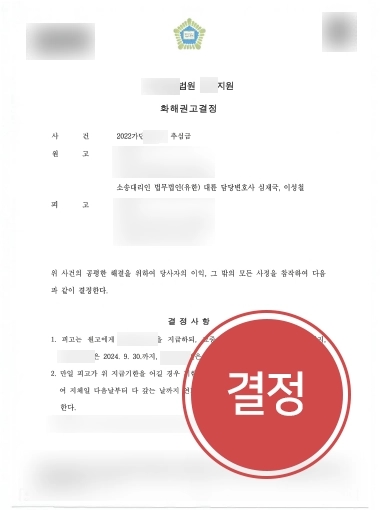
As a result of the Gunsan attorney consultation, the court issued a judgment ordering the defendant to pay 90 million won.
In the case of a collection claim suit, only the collection holder may file it, and the holder must specifically prove the fact that the claim exists, the fact that the order was obtained, and the fact that service of this part was received.
If you are not receiving the collection amount, you must prove the defendant's legal liability for the non-performance and proceed with the legal procedures to recover your rightful rights.
Because unlawful elements in debt collection may be subject to criminal punishment, proceeding through a consultation with an attorney is recommended.
Daeryun Law Firm provides close, seamless representation through a 365-day, 24-hour emergency consultation system.
If you need an attorney consultation in a situation such as the above, please reach out to the Daeryun Law Firm 🔗Gunsan attorney office.
This content is based on actual case studies of Daeryun Law LLC with some adaptations, and the copyright belongs to our firm.
Unauthorized reproduction, duplication, or distribution and other copyright infringements may result in legal action under applicable laws.