CONTENTS
- 1. Suwon Civil Attorney | Case Details

- 2. Suwon Civil Attorney | Case Analysis
- 3. Suwon Civil Attorney | Details of Assistance

1. Suwon Civil Attorney | Case Details

The Suwon civil attorney provided dedicated assistance so that the client could recover the full 200 million won invested.
 The Fitness Trainer's Investment Solicitation
The client came to know the defendant, who was working as a fitness trainer, while receiving personal training at a gym located in Suwon.
The defendant stated that he was preparing to open a gym and asked the client whether the client was interested in investing, expressing confidence about opening the gym and claiming that he already possessed considerable wealth.
The defendant solicited the investment from the client, promising, "Even if the investment fails, I will certainly return the principal."
A Total Investment of 200 Million Won
At the defendant's urging, the client decided to take out a loan, hand the funds to the defendant, and invest in opening the gym.
To this end, the client took out loans on four separate occasions and ultimately paid the defendant a total amount of 200 million won.
In this process, the client prepared an investment contract with the defendant and signed it.
The defendant stated that he would use the investment funds to prepare for opening the gym and would distribute the profits.
Afterward, however, he continually urged the client to take out additional loans, placing ongoing financial pressure on the client.
He even urged the client to take out additional loans and proposed taking out a loan using the client's car as collateral.
In this way, whenever the client was unable to repay the loans, the defendant forced the client into so-called "loan rollover," demanding that the client take out further loans to repay the existing ones.
The Defendant Who Did Not Repay Even After the Due Date
The client requested the return of the principal for the gym in which he had invested, but the defendant refused, arguing that he could not promise to guarantee the principal.
The defendant also argued that, in order to recover the full investment, the client would have to contribute an additional amount, and he did not return the investment funds.
After that, the client tried to contact the defendant several times, but the defendant avoided contact and continued to evade responsibility for repayment.
In the end, the client came to the Suwon civil attorney to request assistance, explaining that he wished to file a civil and criminal lawsuit.
2. Suwon Civil Attorney | Case Analysis
The issues in the case as analyzed by the Suwon civil attorney are as follows.
The Issues in the Case
Attorney, what were the issues in the client's case?
Attorney: The key issue in this case was whether fraud existed due to the defendant's deceptive conduct. The defendant promised the client a guarantee of the principal and created an expectation about opening the gym. In reality, however, there was no plan to open the gym and no intention to return the principal. Because of the defendant's deceptive conduct, the client suffered financial harm, and this became a matter of fraud and damages under the law.
Attorney, was the client able to recover the entire amount?
Attorney: Yes. If the claim for damages arising from the defendant's deceptive conduct was recognized, the client could recover the full investment. By clearly proving that the defendant did not provide the promised guarantee of the principal and had no plan to open the gym, the court was made more likely to order a full return.
Method of Assistance
As a principal strategy, the Suwon attorney gathered evidence capable of proving the fraud charge based on the defendant's deceptive conduct and the investment contract, and clarified the defendant's financial liability so that the client could recover the full amount in the civil lawsuit, proceeding swiftly through the legal process.
In addition, the attorney analyzed the defendant's conduct in evading responsibility as of the repayment due date and, based on this, further strengthened the legal response so that the client could recover the full investment, sparing no effort in providing assistance.


3. Suwon Civil Attorney | Details of Assistance
The Suwon civil attorney made the following arguments in court.
The Defendant's Deceptive Conduct
To prove the defendant's deceptive conduct, the Suwon civil attorney established the defendant's intentional deception by confirming the repeated solicitations of loans, the defendant's statement of a "guarantee of the principal," and the fact that there was, in reality, no plan to open the gym.
Through this, the attorney proved that the defendant had deceived the client to attract the investment funds, clarified the fraud charge, and focused on holding the defendant legally liable.
Refusal of the Request to Return the Investment Funds
Regarding the situation in which the defendant did not return the investment funds and argued that "a guarantee of the principal is difficult," a claim for the return of the principal was filed with the court.
Based on evidence of the defendant's refusal of the client's demand and his delay, the attorney clearly demanded the full return of the investment funds before the court and proved that the defendant had no intention of returning the amount.
Suwon Civil Attorney | Full Recovery of Damages From the Gym Investment
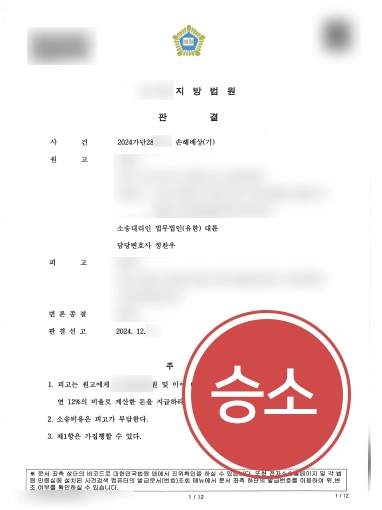
With the Suwon civil attorney's assistance, the client was able to recover the full 200 million won invested in the gym.
The defendant initially promised a guarantee of the principal, but in reality he had no plan to open the gym and no intention to return the principal.
In the end, the Suwon attorney clearly proved that the defendant refused the client's request and evaded the obligation to repay, and obtained from the court an order for the full return of the damages.
If, as in this case, you find yourself in a distressing situation, unable to recover the principal you invested, you may review more of Daeryun's 🔗civil attorney case studies and entrust your case with confidence.
This content is based on actual case studies of Daeryun Law LLC with some adaptations, and the copyright belongs to our firm.
Unauthorized reproduction, duplication, or distribution and other copyright infringements may result in legal action under applicable laws.