
CONTENTS
- 1. The Client Who Requested a Civil Litigation Consultation

- - A Civil Litigation Attorney Understands the Case Through a Careful Consultation
- - An Objection-to-Claim Lawsuit Explained by a Civil Litigation Attorney
- 2. Assistance for the Client Who Requested a Civil Litigation Consultation
- - Civil Litigation Strategy 1. Explaining the Circumstances of the Notarized Deed's Preparation
- - Civil Litigation Strategy 2. Asserting That the Compulsory Execution Had No Effect
- 3. As a Result of the Civil Litigation Consultation, a Decision Disallowing Compulsory Execution Was Successfully Obtained

1. The Client Who Requested a Civil Litigation Consultation

The client who requested a civil litigation consultation sought an objection-to-claim lawsuit to stay compulsory execution.
A civil litigation attorney undertook a careful consultation to understand the client's case.
 A Civil Litigation Attorney Understands the Case Through a Careful Consultation
The client, the representative of a small and medium-sized enterprise, was deceived by defendant A's plausible talk and invested a large sum.
The defendant not only misappropriated the client's investment but also attempted to saddle the client with a false debt.
In this process, the defendant had the client prepare a notarized deed containing false content, and on this basis the client's real estate was forcibly attached.
The client asked the Daeryun attorney whether there was any way to stay the compulsory execution.
The attorney explained that the client should file an 🔗objection-to-claim lawsuit and apply for a stay of compulsory execution.
The client entrusted the case to Daeryun Law Firm, where attorneys respond as one team, collaborating on legal reasoning, case-law research, and the construction of arguments to protect the client's interests.
An Objection-to-Claim Lawsuit Explained by a Civil Litigation Attorney
An objection-to-claim lawsuit is a lawsuit in which the debtor asserts that the content and substance of the title of execution do not match, in order to exclude its enforceability.
As with the client in the above case, it is a legal procedure to prevent unjust compulsory execution.
The purpose of an objection-to-claim lawsuit is for the court to judge the legitimacy of the original claim and correct an erroneous decision. This lawsuit is mainly filed when compulsory execution is found to be unjust.
For example, this may apply where the claim has not arisen, where the claim set out in the title of execution has been extinguished, or where the right is being abused.
Typical grounds on which an objection-to-claim lawsuit may be filed
| -Grounds for extinction of a right: where the claim indicated in the title of execution existed and then was extinguished, such as through rescission for mistake, fraud, or duress, or termination of a contract -Grounds for suspension of a right: cases such as a grace period for the due date of performance, a condition precedent, or a restriction suspending the effect of the claim -Change in the claim: cases such as assignment of the claim or an assumption of debt discharging the original debtor |


2. Assistance for the Client Who Requested a Civil Litigation Consultation
We undertook to assist the client who requested a civil litigation consultation.
The civil litigation attorney prepared an objection-to-claim lawsuit to stay compulsory execution, focusing on the circumstances under which this notarized deed came to be prepared.
Civil Litigation Strategy 1. Explaining the Circumstances of the Notarized Deed's Preparation
The defendant asked the client to prepare a notarized deed regarding an agreement to pay 400 million won, a portion of the equity, if the investment business succeeded.
The client was entirely unaware that this investment was a fraudulent act.
The defendant then suddenly changed his position and demanded that the client prepare a document stating that the defendant had loaned 400 million won to the client.
The client was worried about preparing a loan certificate for a loan that had never been borrowed, but, thinking that failing to prepare it might mean being unable to recover even the investment itself, the client came to prepare a notarized deed with that content.
Civil Litigation Strategy 2. Asserting That the Compulsory Execution Had No Effect
The civil litigation attorney asserted that compulsory execution could not be carried out.
This is because this notarized deed was prepared based on false content, with no actual loan in existence.
The civil litigation attorney emphasized that this notarized deed was based on false content and that compulsory execution founded on it could not be permitted, and requested a judgment disallowing the compulsory execution.
3. As a Result of the Civil Litigation Consultation, a Decision Disallowing Compulsory Execution Was Successfully Obtained
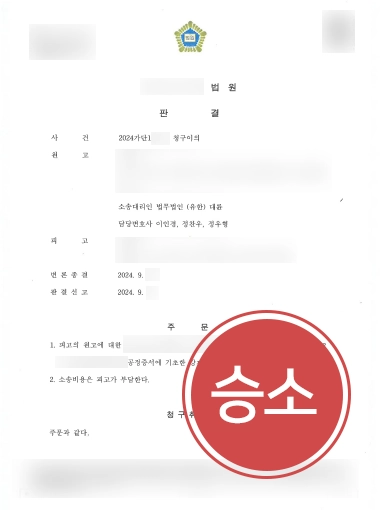
The client who requested the civil litigation consultation was able to obtain a decision disallowing compulsory execution.
This was the result of the court recognizing that the notarized deed had been based on a false loan, as the civil litigation attorney had argued.
An objection-to-claim lawsuit is a procedure for raising an objection to a judgment rendered by a court, and it is a complex legal process that seeks to change or modify an existing judgment.
This process requires legal expertise and experience, so it can be difficult for an individual to carry out alone.
In such situations, the help of an attorney with a sufficient understanding of the legal procedure is important.
This is because an attorney can efficiently gather the evidence needed to steer the case favorably and can carry out oral arguments in court in a professional manner.
At Daeryun Law Firm, attorneys devote themselves to every legal procedure to protect the client's interests.
This content is based on actual case studies of Daeryun Law LLC with some adaptations, and the copyright belongs to our firm.
Unauthorized reproduction, duplication, or distribution and other copyright infringements may result in legal action under applicable laws.