
CONTENTS
- 1. The Client Who Decided to File a Lawsuit Claiming Return of a Loan

- - The Circumstances Leading to the Decision to File a Loan Claim Lawsuit
- 2. Lawsuit Claiming Return of a Loan: What Is the Case-Related Information?
- - Loan Claim: What Are the Relevant Statutes?
- - Loan Claim: What If You Have Not Been Repaid?
- 3. Areas of Assistance for the Lawsuit Claiming Return of a Loan
- - Civil Attorney's Argument ① No Evidence of a Gift
- - Civil Attorney's Argument ② No Evidence of Investment Funds
- - Civil Attorney's Argument ③ No Evidence for the Defendant's Claims
- 4. Result of the Assistance in the Lawsuit Claiming Return of a Loan: “Full Return”
- - In Order to Recover an Unpaid Loan

1. The Client Who Decided to File a Lawsuit Claiming Return of a Loan

The client who decided to pursue a claim for return of a loan decided to file a lawsuit to recover the loan made by his late father, and through the assistance of an attorney who had handled numerous loan return lawsuits, the client succeeded in recovering the full amount.
 The Circumstances Leading to the Decision to File a Loan Claim Lawsuit
The father of the client who filed the lawsuit for return of a loan recently passed away from a chronic illness.
While preparing to inherit the father's estate, the client learned that the father had transferred a large sum of money to a friend.
Upon checking this, it was confirmed to be a loan, and the client demanded repayment.
However, the father's friend denied this, claiming that the money was not a loan.
Accordingly, the client, who resolved to file a 🔗lawsuit for return of a loan, came to a civil attorney to request assistance.
2. Lawsuit Claiming Return of a Loan: What Is the Case-Related Information?

As in the account of the client who decided to file a claim for return of a loan, if the other party borrowed money but does not repay it, the claim may be pursued through various responses.
The relevant statutes and response measures for loans are as follows.
Loan Claim: What Are the Relevant Statutes?
A loan for consumption becomes effective when one party agrees to transfer ownership of money or other substitutes to the other party, and the other party agrees to return goods of the same kind, quality, and quantity.
Loan Claim: What If You Have Not Been Repaid?
If you have not been repaid a loan, you can claim return of the loan through the following methods.
You prepare and send content-certified mail containing a demand that the debtor return the borrowed money.
This can apply psychological pressure on the debtor and can also be used as material for a later lawsuit.
You apply for provisional attachment of the debtor's property in preparation for the debtor hiding or disposing of the property.
Applying for provisional attachment can preserve a future execution.
If the debtor acknowledges the debt, you can easily claim the loan through demand proceedings.
In demand proceedings, the creditor can apply to the court for a payment order, and the matter can be resolved promptly without appearing in court.
If the debtor denies the debt, you can file a civil lawsuit regarding the return of the loan.
Even if the debtor raises an objection to the creditor's application for a payment order, the matter may proceed as a civil lawsuit.


3. Areas of Assistance for the Lawsuit Claiming Return of a Loan
In order to assist the client who had decided to file a lawsuit for the return of a loan, the civil attorney closely reviewed the client's case.
In addition, the attorney collected relevant evidence and analyzed precedents and statutes, establishing a strategy to assist the client.
Civil Attorney's Argument ① No Evidence of a Gift
The civil attorney asserted that the money in question could not be claimed as a gift.
As a result of confirming the deceased's financial transaction information, it could be confirmed that the deceased's assets were not large.
On this basis, the attorney was able to argue that the likelihood that the money had been gifted was low.
Civil Attorney's Argument ② No Evidence of Investment Funds
The civil attorney argued that the money in question could not even be claimed as investment funds.
According to the client's statement, it was learned that at the time the money was transferred, the deceased's health had deteriorated and he was hospitalized.
On this basis, it was possible to establish that the deceased, who was in poor health, would have had no occasion to invest a large sum of money.
Civil Attorney's Argument ③ No Evidence for the Defendant's Claims
The civil attorney argued that the defendant's assertion lacked a clear basis.
The defendant asserts that the money in question was not a loan, but failed to present any basis related to this.
Therefore, it could be emphasized that if this cannot be proven, the money must be returned as unjust enrichment.
4. Result of the Assistance in the Lawsuit Claiming Return of a Loan: “Full Return”
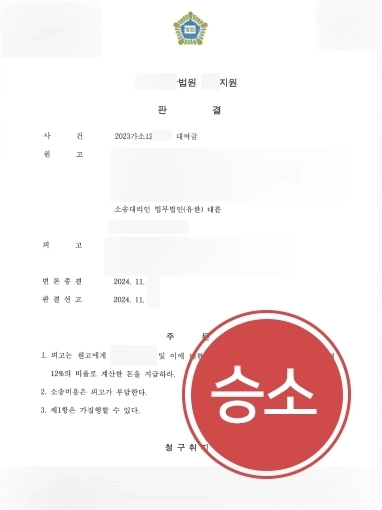
As a result of the civil attorney's assistance to the client, who had filed a lawsuit to claim the return of a loan, the court rendered a judgment ordering the defendant to repay the full amount.
The client conveyed deep thanks, stating that with the civil attorney's assistance the client was able to recover the loan through the lawsuit to claim the return of the loan.
In Order to Recover an Unpaid Loan
This was the case of a client who had nearly been unable to recover his deceased father's loaned money but was able to recover the full amount of the loan through a claim for return of a loan.
As this shows, you can recover the money only if there is evidence and a legal basis to prove that it was a loan.
Therefore, rather than preparing on your own, it is advantageous to respond to the case after receiving legal advice from a specialized attorney.
At Daeryun Law Firm, attorneys who have handled numerous loan lawsuits form a TF to closely review the case and support the client.
If you have decided to pursue a claim for return of a loan as in the client's case, please request support from a civil attorney through 🔗legal consultation booking.


Watch related video content
for this case study.

Can I be sued for fraud if I don't receive the money I lent for 'for the first time in my life'?
This content is based on actual case studies of Daeryun Law LLC with some adaptations, and the copyright belongs to our firm.
Unauthorized reproduction, duplication, or distribution and other copyright infringements may result in legal action under applicable laws.