
CONTENTS
- 1. The Client Who Violated Copyright

- - The Client's Requests
- 2. Copyright Violation: What Is Copyright
- - Examples of Copyright Infringement
- - Level of Punishment for Violating the Copyright Act
- 3. Responding to the Copyright Violation Charge
- - Handling the Settlement on Behalf of the Client
- 4. Result of the Copyright Violation Case
- - The Need for a Specialized Lawyer

1. The Client Who Violated Copyright

This is the account of a client who sought assistance while facing the risk of punishment on a charge of copyright violation.
The client stated that a few weeks earlier, the client had received a call from a police investigator asking whether the client used torrents.
Because the client had occasionally downloaded and watched movies via torrent, the client answered yes, and the investigator then asked whether the client had ever downloaded movie A via torrent.
The client answered that the client did not remember well and did not think the client had ever downloaded movie A.
The investigator then said that a forensic examination could be conducted later, and stated that a police investigation was necessary on a charge of copyright violation.
The client thereby learned that the client had been the subject of a complaint on a charge of copyright violation, and came to this firm.
 The Client's Requests
The client says that after a phone call with the investigator, it occurred to him that he might have downloaded and watched movie A through a torrent.
Saying that he was currently in charge of an important project at his company, he hoped to wrap up the case as quickly as possible.
The client requested help in concluding the case at the 🔗police questioning stage.
2. Copyright Violation: What Is Copyright
Copyright infringement refers to a crime of violating the Copyright Act and infringing another person's copyright.
Here, 🔗copyright is the exclusive right that a creator holds in the work he or she has created.
In simple terms, it is the right that allows an author who has created a creative expression such as a literary work, art, music, photograph, video, software, or design to control others from reproducing, distributing, performing, exhibiting, or publicly transmitting the work.
Examples of Copyright Infringement
Examples of copyright infringement acts that may give rise to suspicion of a copyright violation are as follows.
2. Editing and posting part of a YouTube video without permission
3. Copying an entire paper and posting it on one's own blog
Level of Punishment for Violating the Copyright Act
As with the client, a person who infringes another person's work through methods such as reproduction, distribution, or rental is punished under the Copyright Act.
① A person who falls under any of the following may be punished by imprisonment with labor for not more than 5 years or a fine of not more than 50 million won, or both may be imposed concurrently.
1. A person who infringes an author's economic right or other property right protected under this Act (excluding the right under Article 93) by means of reproduction, performance, public transmission, exhibition, distribution, rental, or the production of a derivative work


3. Responding to the Copyright Violation Charge
The specialized attorney set out to review the Copyright Act in order to prevent the client's punishment.
As a result, the attorney ascertained that, in the case of simple copyright infringement that is not for the purpose of profit or habitual, it constitutes a crime requiring a complaint to prosecute.
Article 255 of the Criminal Procedure Act (Withdrawal of Public Prosecution) ①Public prosecution may be withdrawn before the pronouncement of the judgment of the first instance.
A crime requiring a complaint to prosecute is a crime for which public prosecution can be instituted only if there is a complaint from a person entitled to file a complaint, such as the victim.
Therefore, if the person entitled to file a complaint withdraws the complaint before the judgment of the first instance is rendered, the client could be cleared of the charge.
Accordingly, the specialized attorney decided to set out to reach a settlement on the client's behalf and to try to obtain a non-referral decision of no right to prosecute.
Handling the Settlement on Behalf of the Client
The specialized attorney contacted the legal representative of the film company on behalf of the client, and then led to a settlement by conveying the following positions.
▶Explaining that the client's conduct had been non-commercial
▶Expressing the client's attitude of reflection and intention to promise to prevent recurrence
▶Proposing an appropriate settlement sum to induce withdrawal of the complaint
This made it possible to reach a settlement with the film company, and a settlement agreement and a withdrawal of complaint were obtained.
4. Result of the Copyright Violation Case

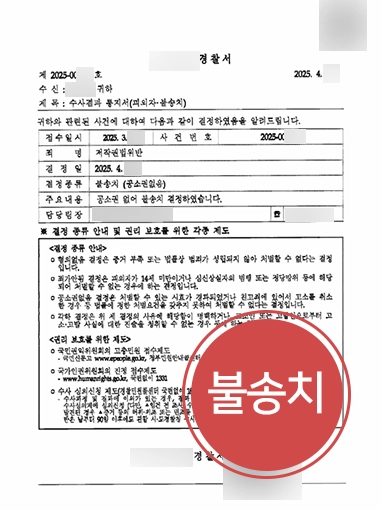
The police rendered a decision of non-referral for no right to prosecute in the client's case.
The client was in a situation in which he could have been sentenced even to an actual custodial sentence for committing copyright infringement.
However, after the attorney ascertained the facts and reviewed the legal principles, a settlement with the film company was reached, and so the case was able to be concluded at the police investigation stage.
The Need for a Specialized Lawyer
In the case of a copyright violation, severe punishment is imposed in that it infringes the rights of the author.
The firm has its criminal law specialist attorneys and copyright specialist attorneys collaborate on copyright violation cases to prepare a strategy tailored to the client through legal review and analysis of precedents.
In addition, civil law specialist attorneys handle settlements on the client's behalf and prepare for civil disputes that may arise later.
If you need legal assistance regarding a copyright violation, please try making a 🔗legal consultation appointment.
This content is based on actual case studies of Daeryun Law LLC with some adaptations, and the copyright belongs to our firm.
Unauthorized reproduction, duplication, or distribution and other copyright infringements may result in legal action under applicable laws.