
CONTENTS
- 1. The Client Who Sought Assistance to Obtain Non-Referral for Obscenity via Telecommunication Media

- - Circumstances of the Obscenity via Telecommunication Media Case
- 2. Identifying the Issues to Obtain a Non-Referral Decision for Obscenity via Telecommunication Media
- - Establishing a Case Strategy to Obtain Non-Referral
- 3. Response Strategy to Obtain Non-Referral for Obscenity via Telecommunication Media
- - The Obscenity via Telecommunication Media Attorney's Argument 1 | The Absence of Sexual Intent
- - The Obscenity via Telecommunication Media Attorney's Argument 2 | That It Was Merely an Expression of Opinion
- 4. Non-Referral Decision for Obscenity via Telecommunication Media
- - If You Wish to Obtain a Non-Referral Decision in an Obscenity via Telecommunication Media Case?

1. The Client Who Sought Assistance to Obtain Non-Referral for Obscenity via Telecommunication Media
The client who wished to receive a non-referral decision for obscenity via telecommunication media had been charged with the crime of obscenity via telecommunication media, but was able to obtain a non-referral decision through the prompt assistance of a sex crime attorney.
 Circumstances of the Obscenity via Telecommunication Media Case
The client had been continuing to exercise at home, referring to YouTube videos for the sake of health.
In the course of this, the client came across an exercise method somewhat more difficult than ordinary movements on a YouTube channel, and wrote a comment containing a personal reaction to the exercise posture in that video.
However, the person who posted the video took issue with this and filed a complaint against the client on the charge of obscenity via telecommunication media.
The client appealed that there had been no particular intent and that it was merely a reaction to the exercise movement itself, but once the criminal procedure began in earnest, the client came to feel a great psychological burden.
As concern grew over a situation that could lead to a record of a sex crime, the client came to Daeryun's sex crime attorney to request assistance in order to obtain a non-referral decision.


2. Identifying the Issues to Obtain a Non-Referral Decision for Obscenity via Telecommunication Media
The client, who had hoped that the case would conclude with a non-referral of the obscenity via telecommunication media charge, felt a heavy burden at having become the subject of an investigation despite having had no sexual intent.
‘Tongmaeeum’ is an abbreviation for the ‘crime of obscenity via telecommunication media,’ one of the sex crimes provided for in Article 13 of the Act on Special Cases concerning the Punishment of Sexual Crimes.
This refers to the act of sending another person words, sounds, writings, pictures, images, or the like that cause sexual shame or aversion through telecommunication media such as text messages, messengers, SNS, and email.
Level of punishment for obscenity via telecommunication media
Sexual Crimes Punishment Act Article 13 (Obscene Act Using Telecommunication Media) | Imprisonment for not more than 2 years or a fine of not more than 20 million won |
Establishing a Case Strategy to Obtain Non-Referral
Non-referral means that, after the police investigate a criminal case, they conclude the case on their own without sending it to the prosecution, for reasons such as the absence of a suspicion of crime or the lack of conditions for prosecution.
In response, the sexual offense attorney built a strategy so that the client could receive a non-referral decision in this obscenity via telecommunication media case.
First, by closely analyzing relevant precedents and similar cases and concentrating on securing materials, the attorney logically supported the point that the client's conduct did not fall within the elements of the relevant crime.
In addition, by comprehensively organizing matters such as the circumstances of writing the comment and the content of the expression, the attorney prepared a strategy emphasizing that there had been no sexual intent or willfulness.
3. Response Strategy to Obtain Non-Referral for Obscenity via Telecommunication Media

To obtain a decision of non-referral in the obscenity via telecommunication media case, the sexual offense attorney closely analyzed the circumstances of the case and the relevant case law.
On this basis, the attorney systematically proved that the client's comment was not intentional and had no obscene intent, advancing the following arguments.
The Obscenity via Telecommunication Media Attorney's Argument 1 | The Absence of Sexual Intent
The client happened to watch the YouTube video on a recommendation from an acquaintance, and after writing the comment in question, the client never visited the channel again.
Moreover, at the time of leaving the comment, the client left it as a simple reaction without any particular intent, entirely unaware that the expression could cause the other party displeasure.
Accordingly, the obscenity via telecommunication media attorney cited the following precedent to emphasize that the client's act had no purpose whatsoever of arousing or satisfying sexual desire.
Supreme Court Judgment 2016Do21389
The Obscenity via Telecommunication Media Attorney's Argument 2 | That It Was Merely an Expression of Opinion
The obscenity via telecommunication media attorney emphasized that the video posted by the other party was exercise content, and explained that the comment left by the client was likewise nothing more than a personal expression of opinion about the exercise movements.
In particular, the attorney emphasized that the client had merely used an expression frequently used by those engaged in exercise-related work, and that it is very difficult to recognize intent for the crime of obscenity via telecommunication media on this ground.
4. Non-Referral Decision for Obscenity via Telecommunication Media

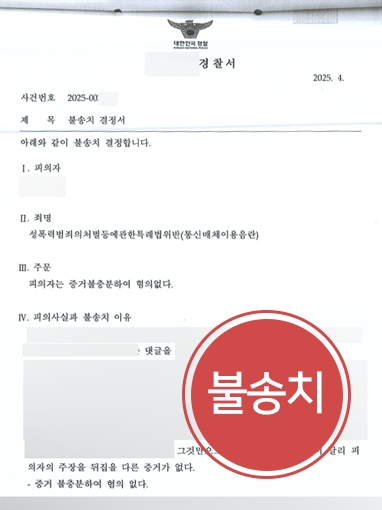
The police, who accepted the arguments made by the sex crime attorney to obtain a non-referral decision for obscenity via telecommunication media, issued the client a 'non-referral' decision.
With the prompt conclusion of the case, the client was able to be freed from unnecessary legal burden and psychological stress.
If You Wish to Obtain a Non-Referral Decision in an Obscenity via Telecommunication Media Case?
If you become involved in a sexual offense case such as obscenity via telecommunication media, responding systematically in the early stages of the case to resolve it effectively is crucial.
Daeryun Law Firm has many specialist attorneys who have handled numerous sexual offense cases.
In obscenity via telecommunication media cases as well, the firm closely reviews the case as a whole and prepares a response suited to the client's situation.
In addition, an in-house evidence examination and digital forensics center collaborate to systematically collect and analyze relevant evidence from mobile phones, messengers, storage media, and the like through lawful procedures, thereby securing the accurate basis needed to resolve the case.
If you are facing a police investigation in an obscenity via telecommunication media case, please feel free at any time to request assistance through Daeryun Law Firm's 🔗legal consultation booking.
See More

This content is based on actual case studies of Daeryun Law LLC with some adaptations, and the copyright belongs to our firm.
Unauthorized reproduction, duplication, or distribution and other copyright infringements may result in legal action under applicable laws.