
CONTENTS
- 1. The Client Who Came to the Advisory Attorney

- - What Is a Settlement Amount Claim?
- 2. Advisory Attorney Develops a Strategy to Rebut the Settlement Amount Claim
- - Denying the Very Existence of a Settlement Agreement
- - Denying That an Association (Partnership) Relationship Was Established
- - Denying Reimbursement Liability for the Loan
- 3. Result of the Advisory Attorney's Assistance, Dismissal of All Settlement Amount Claims
- - Why an Advisory Attorney Is Needed

1. The Client Who Came to the Advisory Attorney

This is the story of a corporate client who visited an advisory attorney.
The client, who operated a distribution business, had concluded a collaboration with internal staff in the past and was planning a transition to a new business.
In connection with this, however, one of the former internal collaboration staff filed a lawsuit against the company claiming a settlement amount.
The plaintiff asserted that he had been in a partnership-like relationship with the company and was entitled to receive a certain amount under a settlement agreement mutually agreed upon at the time of his departure and the end of the collaboration, and filed a civil lawsuit seeking payment of a settlement amount of 50 million won.
Bewildered by the sudden filing of the lawsuit, the client retained Daeryun Law Firm as an advisory attorney and set out to respond, in order to accurately understand the legal relationships in this case and respond promptly.
 What Is a Settlement Amount Claim?
A lawsuit claiming a settlement amount is a lawsuit filed mainly when a joint business or partnership relationship is terminated.
It is a type of civil lawsuit in which a legal dispute arises over how to divide the jointly invested assets and debts, how to distribute profits and losses, and how the obligations under the contract or agreement were concluded.
This case is a settlement amount lawsuit related to a partnership.
The content of the contract, in particular a special agreement on the return of the investment upon withdrawal, becomes an important issue.


2. Advisory Attorney Develops a Strategy to Rebut the Settlement Amount Claim
The advisory attorney closely examined the summary of the plaintiff's claims and the facts, and set about establishing a strategy for dismissal of the claim.
-The plaintiff is a member (partner) who has jointly operated the business with the defendant company
-At the time of resignation and the end of the collaboration, the parties entered into a settlement agreement
-Under this agreement, the company benefited in matters such as the business name, the smart store account, and loan repayment, so the company must pay the corresponding settlement amount
The plaintiff also made an alternative claim, arguing that even if the principal claim is not accepted, the bank loan the plaintiff executed under his business name was funds for the joint business, so the plaintiff should receive a certain amount of reimbursement from the company.
Denying the Very Existence of a Settlement Agreement
The advisory attorney proved that the agreement content the plaintiff claimed was merely part of the content of the text messages, and that no agreement had been reached on the substantive terms of the contract (the settlement amount, the method of payment, the time of performance, and the like).
The attorney also presented, with materials, that at the very time this discussion was ongoing, the plaintiff had unilaterally cut off contact and, several months later, sent a content-certified mail suddenly asserting a past agreement.
For a contract to be formed, there must be a "meeting of the minds" between the parties, that is, a mutual agreement.
It is not necessary for all of the contract content to perfectly coincide, but for the core or important content of the contract there must be a specific agreement, or there must be an agreement on the criteria or method by which this can later be clearly determined.
The Supreme Court's position is that if there is no clear agreement on such core matters, then absent special circumstances the contract should be regarded as not having been formed.
Denying That an Association (Partnership) Relationship Was Established
The advisory attorney argued that there was no basis for the client to bear an obligation of reimbursement to the plaintiff.
The advisory attorney emphasized that there was no agreement or accord setting out a clear business purpose, specific methods of business operation, or an allocation of roles between the parties, and that neither party had made any contribution toward a joint venture, and emphasized that there was no basis for finding that a partnership had been established between the plaintiff and the client.
Denying Reimbursement Liability for the Loan
The plaintiff argues, on the premise that a partnership had been established, that the loan the plaintiff received from the bank was a capital contribution to the partnership.
The advisory attorney proved, through an analysis of the card usage records, that the loan claimed by the plaintiff was a bank loan executed under the plaintiff's individual name, and that the use of those funds was mostly the plaintiff's personal consumption or private spending.
The attorney legally explained, under the Civil Act, that even if some of those funds had been used for business preparation, they amounted only to funds the plaintiff contributed to operate his own business, so there was no reason for the company to recognize them as a partnership debt.
3. Result of the Advisory Attorney's Assistance, Dismissal of All Settlement Amount Claims
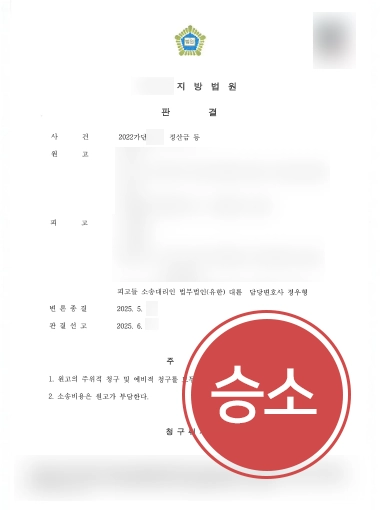
As a result of the advisory attorney's assistance, the court rendered a judgment dismissing all of the plaintiff's settlement amount claims.
The existence of a settlement agreement was the key point, but the court found that it could not recognize the formation of a settlement agreement, given that the specific terms of the contract had not been determined and the parties to the agreement had not been identified.
As for a partnership relationship, the court found that the requirements under the Civil Act, such as an agreement to jointly operate a business, the details of contributions, and an agreement on the distribution of profits and losses, were not met, and that the fund-raising and expenditures the plaintiff carried out alone constituted an individual business activity rather than the operation of a partnership.
Why an Advisory Attorney Is Needed
A lawsuit claiming a settlement amount may appear to be a simple monetary dispute, but in reality it is a high-difficulty civil case involving the following complex legal issues.
-Whether a partnership (joint business) relationship was formed
-Determining the existence and validity of the settlement agreement
-Distinguishing the legal nature of the capital contribution and the debt
-Analyzing the actual use of funds and the structure of responsibility allocation
-Establishing the adequacy of the evidentiary materials and the response strategy
At Daeryun Law Firm, specialized attorneys who have handled many settlement amount cases provide one-stop legal services, from thorough consultation to evidence collection, a tailored response strategy, and recurrence-prevention consulting.
▶Supporting dispute-prevention documents in advance, such as content-certified mail and draft agreements
▶Advisory services to diagnose the company's operating structure and block risks in advance
This content is based on actual case studies of Daeryun Law LLC with some adaptations, and the copyright belongs to our firm.
Unauthorized reproduction, duplication, or distribution and other copyright infringements may result in legal action under applicable laws.