
CONTENTS
- 1. How the Client Came to the Cheongju Sexual Offense Attorney

- - The Client Who Requested the Cheongju Sexual Offense Attorney's Assistance
- - Statutes Related to the Case Explained by the Cheongju Sexual Offense Attorney
- 2. The Cheongju Sexual Offense Attorney's Assistance
- - Cheongju Sexual Offense Attorney Argued That the Client Did Not Know the Victim Was a Minor
- - Cheongju Sexual Offense Attorney Argued That the Victim's Statements Had Low Credibility
- 3. Result of the Cheongju Sexual Offense Attorney's Assistance: ‘Acquittal’
- - The Cheongju Sexual Offense Attorney's Casebook

1. How the Client Came to the Cheongju Sexual Offense Attorney
The client who came to the Cheongju sexual offense attorney urgently came to Daeryun's sexual offense attorney after being contacted by the police regarding a charge of rape of a minor.
 The Client Who Requested the Cheongju Sexual Offense Attorney's Assistance
This is the account of the client who requested the Cheongju sexual offense attorney's assistance.
The client had drinks together with an acquaintance of a younger friend with whom the client was usually close.
Among them, the female victim, who was so intoxicated that she could not control her body, said she had nowhere to go and asked the client to take her to a motel.
The client then entered the motel, and the victim reportedly kissed the client, who was sitting in a chair.
Feeling guilty over the victim's active physical advances, the client, who had a family, left the motel.
Afterward, the client received a call from the police stating that an investigation was underway on a charge of rape of a minor.
However, the client maintained that there had been some physical contact but that no rape had occurred, and that the client had not known the person was a minor, expressing a sense of injustice.
The client then came to the Cheongju sexual offense attorney at Daeryun Law Firm and requested a defense against punishment.
Statutes Related to the Case Explained by the Cheongju Sexual Offense Attorney
Punishment for Statutory Rape and Statutory Indecent Act by Compulsion Against a Minor
Criminal Act Article 305 (Sexual Intercourse With or Indecent Act Against a Minor)
(1) A person who has sexual intercourse with or commits an indecent act against a person under 13 years of age shall be subject to the same penalties as provided in Article 297, Article 297-2, Article 298, Article 301, or Article 301-2.
(2) A person who is 19 years of age or older and who has sexual intercourse with or commits an indecent act against a person who is 13 years of age or older but under 16 years of age shall be subject to the same penalties as provided in Article 297, Article 297-2, Article 298, Article 301, or Article 301-2.
Criminal Act Article 298 (Indecent Act by Compulsion)
A person who commits an indecent act against another through violence or intimidation shall be punished by imprisonment for not more than 10 years or by a fine not exceeding 15 million won.
Criminal Act Article 297 (Rape)
A person who rapes another through violence or intimidation shall be punished by imprisonment for a definite term of at least 3 years.
Article 301 (Rape, etc. Causing Injury)
Where a person who commits a crime under Article 297, Article 297-2, or Articles 298 through 300 injures another or causes another to suffer injury, the person shall be punished by life imprisonment or by imprisonment for at least 5 years.
Article 301-2 (Rape, etc. Causing Death)
Where a person who commits a crime under Article 297, Article 297-2, or Articles 298 through 300 kills another, the person shall be punished by death or life imprisonment. Where the person causes another to die, the person shall be punished by life imprisonment or by imprisonment for at least 10 years.
2. The Cheongju Sexual Offense Attorney's Assistance
Through detailed consultations with the client, the Cheongju sexual offense attorney examined the case closely. The attorney emphasized that the client had not known the victim was a minor and that the victim's statements lacked credibility.
Cheongju Sexual Offense Attorney Argued That the Client Did Not Know the Victim Was a Minor
When entering the motel, the motel staff checked identification and then guided the victim and the suspect to a room, so the client was in a situation where no suspicion could be raised.
In addition, because the defendant's close younger friend was an adult, the client assumed the acquaintance was also an adult, and the attorney argued that it was difficult to tell whether the person was a minor because she was wearing makeup and dressed in a mature manner.
Cheongju Sexual Offense Attorney Argued That the Victim's Statements Had Low Credibility
The victim initially stated as if she did not remember the circumstances at the time of the incident at all, and then reversed her statement during the police investigation.
The attorney argued that, because the victim's statements were inconsistent and difficult to reasonably accept, their credibility and probative value were low.
3. Result of the Cheongju Sexual Offense Attorney's Assistance: ‘Acquittal’
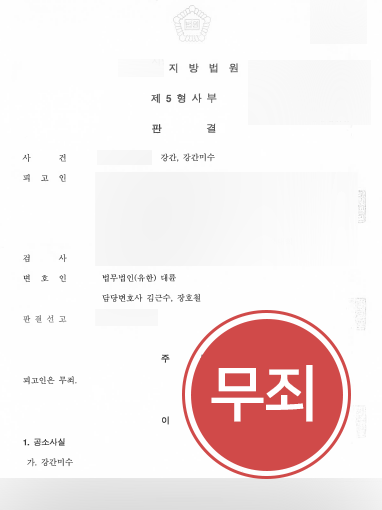
Accepting the Cheongju sexual offense attorney's arguments, the court rendered a judgment of acquittal on the client's charge of rape of a minor.
The Cheongju Sexual Offense Attorney's Casebook
This was a case in which the client, who had been charged with the rape of a minor, received a judgment of acquittal with the assistance of the Cheongju sexual offense attorney.
Because rape of a minor is a serious crime that may result in an actual custodial sentence, it is advisable to defend against punishment with the help of an experienced attorney.
At Daeryun Law Firm, an attorney who has handled numerous sexual offense cases personally assists with the client's case from the initial response through to resolution.
If you need legal help in a situation like the case above, you may request assistance from a Cheongju sexual offense attorney at Daeryun Law Firm.
This content is based on actual case studies of Daeryun Law LLC with some adaptations, and the copyright belongs to our firm.
Unauthorized reproduction, duplication, or distribution and other copyright infringements may result in legal action under applicable laws.