
CONTENTS
- 1. The Client Facing Suspicion of Violation of the Copyright Act

- - The Client's Alleged Offense and the Structure of Torrent Programs
- - Issues in the Case
- - Level of Punishment for Violation of the Copyright Act
- 2. Assistance Provided in Defending Against the Suspicion of Violation of the Copyright Act
- - Assistance of the Copyright Attorney ① | Preparing for Anticipated Questions and Preparing Statements
- - Assistance of the Copyright Attorney ② | Accompaniment to the Police Investigation
- - Assistance of the Copyright Attorney ③ | Key Statements in the Protocol of Examination
- 3. Result of the Violation of the Copyright Act Case: Concluded with a Non-Referral Decision
- - If You Are Facing Suspicion of Violation of the Copyright Act for Using a Torrent Program

1. The Client Facing Suspicion of Violation of the Copyright Act
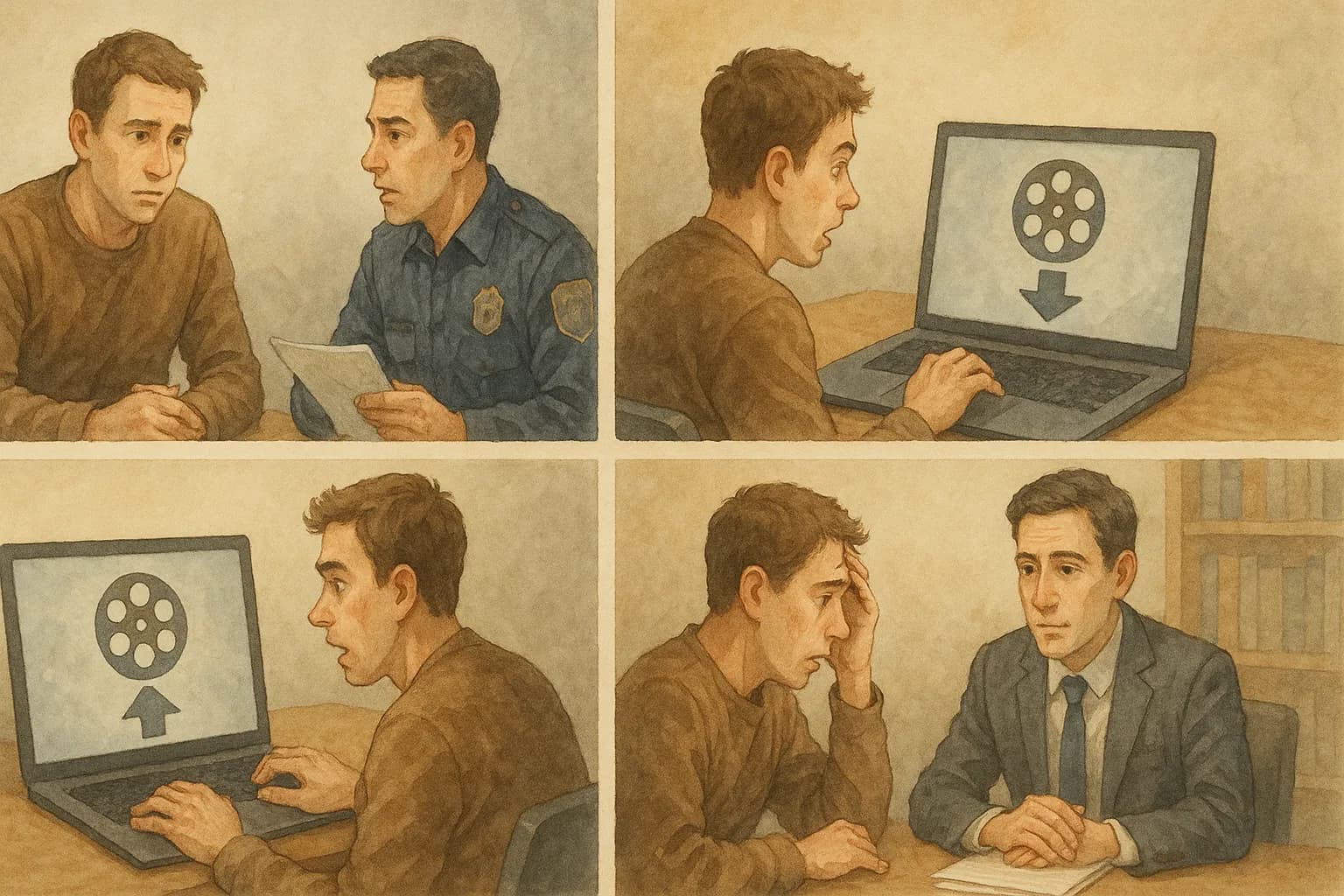
Facing a police investigation on suspicion of violation of the Copyright Act, the client was the subject of a criminal complaint on the ground that he had downloaded a film through a torrent program and then distributed it without authorization.
While the client had in fact downloaded the film for free using a torrent program, he was entirely unaware of the torrent program's automatic upload and distribution functions.
However, the complainant alleged that the act constituted an intentional violation of Article 136 of the Copyright Act and requested severe punishment. The client therefore sought out a copyright attorney in order to resolve the unfair situation.
 The Client's Alleged Offense and the Structure of Torrent Programs
The client came under suspicion of violation of the Copyright Act on the ground that he had downloaded a film using a torrent program, a P2P-based file-sharing program.
A torrent program is structured so that, at the same time a file is downloaded, parts of that file are automatically transmitted and distributed to other users.
In other words, even if the user does not intend it, an 'upload' is immediately combined with the act of downloading, and this can lead to copyright infringement such as 'distribution' or 'public transmission'.


Issues in the Case
The problem is that, even where a person downloads for personal use without being aware of this structure, as in the client's case, a criminal complaint may be filed solely on the ground that an 'act of distribution' has, as a result, occurred.
On this basis, the complainant alleged an 'infringement of rights by reproduction and distribution' under Article 136 of the Copyright Act.
Accordingly, the following matters could be regarded as the central issues of the case.
▶ Whether the automatic upload function gives rise to legal liability even though the purpose was a simple download
▶ Whether 'intent' and 'awareness' under the Copyright Act constitute requirements for the establishment of punishment
Ultimately, the technical structure of the torrent program, the client's subjective awareness, and the intent behind the conduct became the essential issues in this case.
Level of Punishment for Violation of the Copyright Act
If the client's conduct were found to be a violation of the Copyright Act, he faced the following punishment.
Statutory Provision | Level of Punishment |
Article 136, Paragraph 1 of the Copyright Act | Imprisonment for up to 5 years or a fine of up to 50 million won |
2. Assistance Provided in Defending Against the Suspicion of Violation of the Copyright Act

The client, who faced suspicion of violation of the Copyright Act, had simply downloaded a film without being aware of the structure of the torrent program itself.
In response, the copyright attorney established a meticulous strategy ahead of the police investigation.
Assistance of the Copyright Attorney ① | Preparing for Anticipated Questions and Preparing Statements
The copyright attorney prepared the questions anticipated from the investigative authorities and reasonable answer scenarios in response and provided them to the client.
In particular, with respect to the automatic upload structure of the torrent program, the attorney prepared the client in advance to consistently explain that he had not been aware of it.
Assistance of the Copyright Attorney ② | Accompaniment to the Police Investigation
The copyright attorney personally accompanied the client to the police investigation and carefully ensured that the client's statements were not distorted or recorded unfavorably.
In particular, during the investigation, the client repeatedly explained that he had been entirely unaware of the 'distribution and upload' functions through the torrent program and had recognized it only as a free movie-download site.
Assistance of the Copyright Attorney ③ | Key Statements in the Protocol of Examination
During the investigation, the client strongly denied any intent behind the conduct through the following statements.
▷ That he had thought of it merely as a free movie-download site and had only recently learned that it was in fact a torrent program
▷ That he had obtained no benefit other than watching the film and had not even been aware that uploading and distribution occurred automatically
▷ That, after the incident, he had already deleted the torrent program and would never use it again
These statements served as important grounds for establishing the absence of intent and the client's lack of awareness of any illegality, and the copyright attorney provided assistance to ensure that they were faithfully reflected in the protocol of examination.
3. Result of the Violation of the Copyright Act Case: Concluded with a Non-Referral Decision
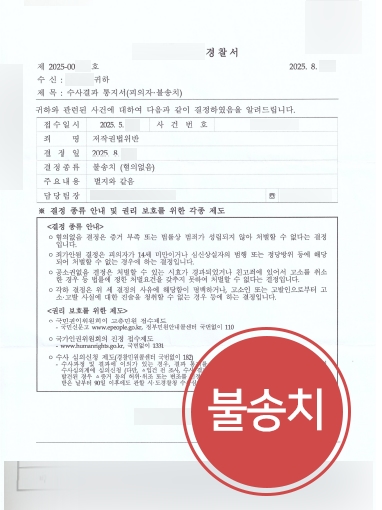
With respect to the violation of the Copyright Act case, the investigative authority determined that the client's conduct could not readily be regarded as intentional uploading and distribution.
Thanks to the copyright attorney's assistance, it was found that the client had simply downloaded the film for personal use without being aware of the structure of the torrent program itself, and that he had no intent to provide the copyrighted work to an unspecified number of people.
In particular, it proved decisive that the protocol of examination recorded the consistent statement that he "had not known the very concept of uploading and distribution and had learned only this time that it was a torrent program."
In the end, the police issued a non-referral decision regarding the suspicion of violation of Article 136 of the Copyright Act, and the client was able to escape the risk of criminal punishment and return to his daily life.
If You Are Facing Suspicion of Violation of the Copyright Act for Using a Torrent Program
Because of the structure of torrent programs, a charge of 'distribution' may be applied based solely on the fact of a simple download.
Cases of violation of the Copyright Act using torrent programs are steadily increasing, and there are also many instances in which criminal complaints are misused for the purpose of obtaining a settlement payment.
Accordingly, where a person does not properly understand a technical structure such as that of a torrent program, there is a risk of being treated as a criminal despite the absence of intent.
In such situations, it is very important to accurately grasp the intent behind the investigative authorities' questions and to maintain consistent statements.
Through its dedicated consultation attorney system, Daeryun Law Firm quickly grasps the matter and the issues, and through the assignment of a dedicated attorney, it provides assistance to protect the client's rights, ranging from guidance on anticipated questions and model answer scenarios to accompaniment at police investigations and the organization of legal issues.
If you are facing a related charge, please feel free at any time to entrust your case through 🔗Legal Consultation Reservation.
This content is based on actual case studies of Daeryun Law LLC with some adaptations, and the copyright belongs to our firm.
Unauthorized reproduction, duplication, or distribution and other copyright infringements may result in legal action under applicable laws.