Page title background (PC version)Page title background (mobile version)

Press Coverage

Numerous media outlets recognize the expertise of Daeryun Law LLC.
Explore interviews, legal commentary, and columns by Daeryun lawyers.

2 places including Laurider
2025-11-18
“65세 정년 연장·포괄임금제 금지, 선제적 대응책 마련해야”
“Extension of retirement age to 65 and ban on inclusive wage system, preemptive response measures must be prepared”
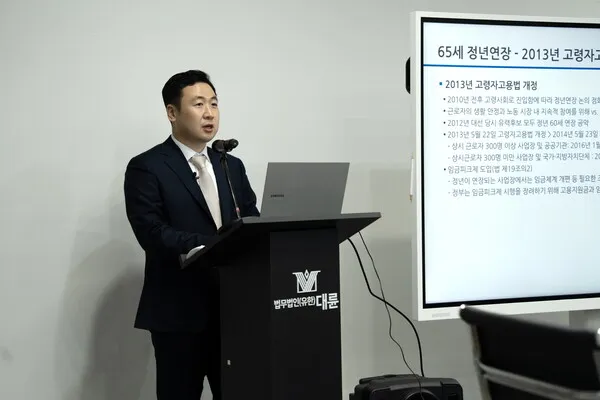
Daeryun Law Firm holds an HR seminar for foreign-invested companies. Lawyer Intae Bang introduces major issues and response tasks, focusing on banning retirement age extension and comprehensive wage system. Daeryun “We will further strengthen human resources and labor advice for companies.” Daeryun Law Firm announced on the 17th that it held a working-level discussion on trends in labor law revision at the ‘HR ROUND TABLE’ seminar held for human resources managers of foreign companies together with the Korea Foreign Enterprise Human Resources Managers Association (KOFA HR). KOFA HR This seminar, hosted by Daeryun Law Firm and held at Daeryun Law Firm's Yeouido main office on the 12th, was attended by many executives and workers in charge of human resources from global companies. The seminar speaker was lawyer Bang In-tae of Daeryun (41st class of the Judicial Research and Training Institute). Attorney Bang is a labor lawyer registered with the Korean Bar Association and is a practical expert who has provided advice and litigation on the overall personnel and labor issues, including employment contracts, wage systems, working hours, collective bargaining, and dismissal and disciplinary action, for various companies at home and abroad. In the lecture, Attorney Bang In-tae explained major issues and corporate response tasks, focusing on the 'extension of retirement age to 65' and 'ban on comprehensive wage system', which are currently being legislated. In the first session, Attorney Bang first The background on the discussion on extending the retirement age, such as labor shortage due to aging and low birth rate, and the income gap caused by raising the national pension starting age, was analyzed, and related bills currently proposed in the National Assembly were analyzed, and expected scenarios when future bills were passed were introduced. Next, as a way to prepare for the extension of the retirement age, we discussed measures to reform the system, including an evaluation system centered on competency and performance, personnel management, and career path redesign. In the second session, the main contents of the Labor Standards Act amendment regarding the ban on the comprehensive wage system were explained, and the impact on companies if comprehensive wage contracts were banned was discussed. Next, in preparation for the ban on comprehensive wage contracts, it was emphasized that companies need to make preemptive preparations by suggesting specific measures such as inspecting the working hour management system, improving work efficiency, and reorganizing wage regulations. In the Q&A session that followed the lecture, personnel practitioners at foreign companies asked questions about the operation of retirement systems and standards for judging working hours, etc., which they encountered in the field, and attorney Bang In-tae provided tailored advice based on actual cases. Attorney Kim Kuk-il, managing director of Daeryun Law Firm, said, "This seminar “We plan to further strengthen human resources and labor advice for domestic and foreign companies,” he said. “As the pace of legal change is accelerating, we plan to continue to provide opportunities for corporate human resources managers to share realistic solutions.” Meanwhile, Daeryun Law Firm is operating a corporate legal group that specializes in labor contract review, employment structure reform, collective agreements, and labor dispute response for global companies and foreign companies aiming to enter the domestic market, and is collaborating with professional organizations in the field. We are actively continuing our close-knit advisory project. Law Leader Reporter Son Dong-wook twson@lawleader.co.kr Law Leader - “Extending the retirement age to 65 and banning the comprehensive wage system, preemptive countermeasures must be prepared” (link) Money S - "Extension of retirement age to 65 and ban on inclusive wages are coming"... Daeryun presents ‘HR solution’ (link)
2 places including My Daily
2025-11-18
SJKP, 美 시라큐스 대학교 로스쿨과 글로벌 법률 교류 MOU 체결
SJKP signs global legal exchange MOU with Syracuse University Law School
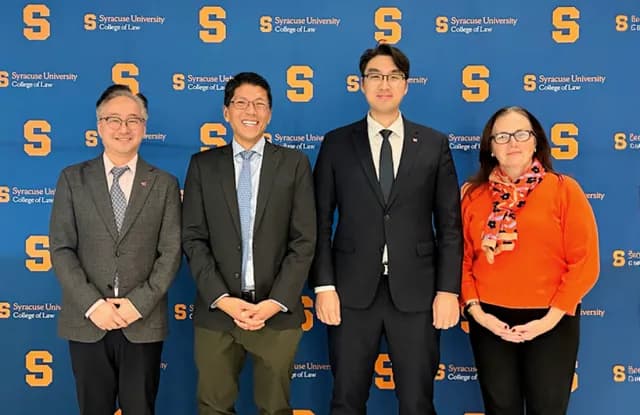
Cooperation in various fields such as international trade and customs... Promotion of global talent exchange program - SJKP “We will increase competitiveness in the Korean legal market by collaborating with institutions around the world” SJKP, the U.S. branch of Daeryun Law Firm, announced on the 18th that it has signed an MOU (business agreement) with Syracuse University College of Law in the U.S. and will begin global legal education and research cooperation. This business agreement ceremony was held with key faculty members including Dean Terence J. Lau and Vice Dean Shannon Gardner and SJKP. It was held at Syracuse University in New York, USA, with CEO Park Dong-il and American lawyer Son Dong-hu in attendance. Syracuse University is a prestigious private university in the eastern United States and is also widely known as the school from which former US President Joe Biden graduated. It has accumulated excellent educational capabilities based on its long history and tradition, and is highly regarded as an educational system that encompasses practice and academics. Through this MOU, SJKP plans to establish a foundation for practical cooperation in various fields such as global legal education, international practical seminars, and talent training. Specifically, it will broadly discuss ▲academic exchanges such as legal education ▲joint seminars focusing on comparison of cultures and systems ▲international talent training programs, etc., and promote continuous exchange of experts and joint research. We reached a consensus. In particular, in this MOU, the promotion of joint seminars specialized in the field of international trade and customs and global practice-oriented research were selected as key areas of cooperation. Based on the expertise of Dean Lau, a former Ford Motor Company legal advisor, SJKP and Syracuse Law School plan to regularly conduct joint research on global trade issues and tariff regulations. In addition, SJKP, together with Daeryun, will engage in talent exchange with Syracuse Law School. Daeryun plans to invite about 20 students from Syracuse Law School to the Daeryun Korean law firm office in May of next year and conduct a field-oriented practical exchange program with Daeryun's professional lawyers. Terence J. Lau, Dean of Syracuse University Law School, said, "The MOU with SJKP will be an important milestone in expanding Syracuse Law School's educational philosophy of practice-oriented global legal education." He added, "Based on the expertise of both institutions, we will jointly offer various global programs." “I look forward to operating it,” said Park Dong-il, CEO of Daeryun Law Firm. “Daeryun is a law firm that has been leading practice-oriented legal services in Korea, and through direct cooperation with prestigious American law schools, we have been able to contribute to fostering more practical international legal talent.” He added, “We will continue to work in solidarity with educational institutions and experts from around the world to increase the global competitiveness of the Korean legal market.” Meanwhile, SJKP, the American branch of Daeryun Law Firm, is located in Manhattan, New York. The office is located on the 76th floor of the World Trade Center, and currently provides services in major legal areas throughout the United States, including civil, criminal, domestic affairs, corporate legal affairs, investments, and international contracts. Reporter Cheon Ju-young (young1997@mydaily.co.kr)[View full article] My Daily - SJKP signs global legal exchange MOU with Syracuse University Law School (Click here) Seoul Shinmun - Daeryun Law Firm's American subsidiary SJKP collaborates with Syracuse University on global legal education and research (link)
Money Today
2025-11-18
'아이돌 응원봉' 분쟁 확산…내 IP 보호하는 전략은?
'Idol Lightstick' Dispute Spreads... What is my strategy for protecting my IP?
Recently, the controversy over the similarity of the lightstick designs of idol groups 'The Boyz' and 'QWER' is spreading beyond the fandom and into the industry as a whole. As it has been pointed out that the core design of the lightstick released by QWER is similar to the 'loudspeaker' shape that The Boyz has previously used, the conflict is expected to continue as each agency announces legal action. The essence of this situation lies in the boundary between ideas and expressions, which are the core principles of intellectual property law. Article 3 of the Framework Act on Intellectual Property defines intellectual property as something whose property value can be realized through intangible things such as knowledge, information, technology, and expressions of ideas or emotions created or discovered through human creative activities or experiences. In particular, with regard to the appearance of a product, the Design Protection Act and the Unfair Competition Prevention Act specify and protect the subject of protection. In other words, the concept of a 'loudspeaker-shaped cheering stick' itself is an idea and cannot claim exclusive rights. Although it is difficult, the specific shapes, colors, and proportions that realize it are clearly the area of intellectual property rights. It has been pointed out that the two controversial lightsticks are similar in the area of ​​these ideas, but the difference is also clear in that The Boyz's is heart-shaped and QWER's is circular, which is expected to become a major issue in future legal disputes. In this case, it is inevitable that it will ultimately be judged by two legal standards: the Design Protection Act and the Unfair Competition Prevention Act. The Design Protection Act serves as a preemptive shield that protects the exclusive rights of previously registered designs. If one party registered the design right first, the court determines infringement by considering whether the overall aesthetics of the two designs are similar in the impression they give to consumers. On the other hand, even if there is no design registration, the Unfair Competition Prevention Act can serve as an ex post facto relief device. The core of this law is to prevent acts that disrupt market order and obtain unfair profits by imitating the results of others' significant investments or efforts without permission. The court comprehensively considers whether a specific design is already widely known in the market and whether latecomers have imitated it and confused consumers. So what should companies and creators prepare to prevent IP disputes that frequently occur in rapidly growing industries and daily life? First, an IP portfolio must be created. Many companies and creators are often unaware of what intangible assets they have. For example, in the case of tech companies, it is necessary to look at not only patents but also ideas from the design process, such as research notes and blueprints. Design assets such as the product's appearance and packaging, web and app UI, and content assets such as promotional videos and work manuals are also essential. Even in the case of creators, creative works such as completed scripts and works, as well as individual characters and storyboards, must be recognized as a ‘bundle of rights.’ Second, ‘registration first, disclosure later’ must be made an iron rule of business. Before revealing an idea to the world, the most reliable and economical way to protect it is to secure legal rights by first applying for design rights or trademark rights. Responding after a dispute breaks out will only result in the double whammy of enormous litigation costs and a decline in brand image. Third, the possibility of legal disputes during the collaboration process must be blocked through contracts. IP disputes frequently occur not only in relationships with external competitors, but also with internal collaborators (employees, outsourced services, partners) who work together to complete ideas. Therefore, internal risks must be thoroughly managed from the beginning of the business by establishing clear legal measures such as ① signing a non-disclosure agreement (NDA) before discussing ideas, ② establishing employee invention regulations that clearly state that employees' ideas are company assets, and ③ stipulating IP ownership provisions for outsourced services in the contract. Ultimately, the way to avoid disputes lies in 'routine' management. Building an IP portfolio, the principle of first registration and then disclosure, and tight contract management provide a much more effective shield than responding after the fact. Unnecessary legal disputes can be prevented by preventing legal risks in advance by changing the attitude of recognizing IP protection devices as core competitiveness rather than complex regulations. Small and Medium Business Team[View full article] 'Idol Lightstick' Dispute Spreads... What is my strategy for protecting my IP? (Shortcut)
KBC Gwangju Broadcasting
2025-11-17
30대 술 마시고 운전했는데 '무죄'...왜? 법원 "운전 고의 없어”
I was in my 30s after drinking and driving, but I was found not guilty... why? Court: “Driving was not intentional”
Driving while drunk and crashing into a parked car... “I just touched him in his sleep,” the rebuttal court said, “The defendant was asleep until the police arrived... If he had been intentional, he would have left the place” A man who was handed over to trial on charges of drinking and driving a vehicle was found not guilty. The Ansan Branch of Suwon District Court found Mr. A, in his 30s, not guilty on charges of violating the Road Traffic Act (drinking driving) on the 29th of last month. Mr. A had a blood alcohol content of He was accused of driving a vehicle while intoxicated at 0.147%. In the process, it was confirmed that Mr. A crashed into a vehicle parked behind his vehicle. Mr. A denied the charge. After drinking, he fell asleep in the car. It was hot, so he turned on the air conditioner, and in his sleep, he touched the gear and put it in reverse. The court said, "At the time of the incident, the car was parked only at the rear of the defendant's vehicle," and "If he had intended to drive, he would have driven forward. “There was no special reason to back up,” he said, and declared him not guilty. He added, “The defendant was still sleeping in the car after colliding with the car behind him, until the police arrived on the scene,” and added, “If there had been intent, he would have left the location.” Attorney Kim Young-min of Daeryun Law Firm, who represented Mr. A, explained, "The Supreme Court ruled that if a car moves without the will or involvement of the person inside the car, it does not constitute driving. It is common to get out of the car to check the state of damage when a traffic accident occurs, but Mr. A emphasized that he was asleep without the intention of driving." #Drunk driving #Not guilty #Not intentional #Accident Park Seok-ho (haitai2000@ikbc.co.kr)[View full article] I was in my 30s after drinking and driving, but I was found not guilty... why? Court: “Driving was not intentional” (Shortcut)
Seoul Newspaper
2025-11-17
“사소한 불일치는 위증 아냐”…배임 재판 출석했다 위증 피소된 50대 ‘불기소’
“Minor discrepancies are not perjury”... A man in his 50s who attended a trial for breach of trust and was accused of perjury was ‘not indicted’
A man who was accused of perjury by the company after testifying as a witness in a company's trial for breach of duty was acquitted. Although the testimony based on memory had some differences from objective facts, the prosecution judged that the overall purpose could not be considered false. According to the legal community on the 17th, the Changwon District Prosecutors' Office decided not to indict Mr. A, who was transferred on charges of perjury last September. In August of last year, Mr. A was sued for giving false testimony while attending the trial of Mr. B, the former CEO of the company he worked for, on charges of breach of trust. The issue in the trial at the time was whether Mr. B executed the funds without receiving approval from the chairman, the actual owner of the company. Mr. A, who worked as the head of the management department at the company, testified in court, saying, "All funds, even if small amounts, were subject to the final approval of the chairman. Additional salaries paid to executives were also according to the chairman's instructions." The company then sued Mr. A for perjury, claiming that all of Mr. A's testimony was false. The company claimed that vouchers that had not been approved by the chairman were confirmed, and in particular, vouchers related to foreign currency execution were not approved by the chairman at all. The company also claimed that the payment of additional salaries to executives was done at the direction of Mr. B, and that Mr. A testified falsely even though he wrote a fact-confirmation statement regarding this. However, Mr. A denied the charges, saying, “The fact that some slips did not have the chairman’s approval was simply an omission in the lump-sum approval process, and I did not intentionally lie.” Mr. A also claimed, "In the case of executing foreign currency, there was no approval process from the beginning, and everything was reported verbally to the chairman. The confirmation of facts was also written according to the instructions of a company official." The prosecution ruled that although there were some inconsistencies with the facts in Mr. A's testimony based on memory, the overall purpose was not different from objective facts and there was no intention to perjure, and they were dismissed. It is a result of a combination of factors such as the possibility that the slip with the missing payment occurred by mistake as claimed by Mr. A, and that it is against common sense to give a large amount of additional salary to an executive without the instructions of the chairman, who has the final approval authority. Attorney Jong-Hoon Han of Daeryun Law Firm, who represented Mr. A, said, “The crime of perjury cannot be established simply because the testimony differs from objective facts, and the witness must recognize that he or she has made a false statement against his or her memory. The client must be aware that he or she is responsible for the company’s payment system and self-execution process. “Because I consistently stated what I remembered, I was able to get an acquittal by legally explaining that the entire testimony could not be viewed as false just because of some exceptional facts,” he said. Reporter Jeong Cheol-wook[View full article] “Minor discrepancies are not perjury”... A man in his 50s who attended a trial for breach of trust and was accused of perjury was ‘not indicted’ (link)
Gangwon Ilbo
2025-11-16
[월요칼럼]‘고수익 아르바이트 함정’…보이스피싱 범죄 공범이 되는 순간
[Monday Column] ‘Highly profitable part-time job trap’… The moment you become an accomplice to voice phishing crime
Recently, voice phishing crimes have become increasingly sophisticated. In the past, there were many relatively simple forms such as ‘loan fraud calls’ or ‘threat calls impersonating prosecutors’, but now it is evolving into a method of using ordinary citizens as ‘tools of crime’. In particular, cases of recruiting people to participate in voice phishing crimes under the names of ‘high-paying part-time job’ or ‘part-time errand job’ on famous job search sites or SNS used by everyone are rapidly increasing. In fact, a client who visited the author not long ago believed an advertisement called “a simple online side job” on a famous social media site. I applied for a part-time job to help the household, and the company requested the client's resident registration card photo, contact information, bank account, etc. for recruitment and work. The client performed this, saying it was a simple task of sending the number '1' at a set time. A few days later, more than 10 million won was deposited into the client's account and then automatically withdrawn. The company's finance team explained that the deposit was for a business test. However, this was a typical voice phishing money laundering process, and in the end, the client realized that he had been involved in the crime without his knowledge, told his family about this, and turned himself in to the police. Clients involved in such crimes often say, “I thought it was simply a case of delivering company money.” However, such acts can be classified as transfer of cannon accounts, withdrawals, or transfers, and can be punished for violating the Telecommunications Fraud Damage Refund Act (Telecommunications Financial Fraud), the Electronic Financial Transactions Act, or the Act on Concealment of Crime Proceeds. This criminal structure is carefully designed, and recently, phishing attempts have been attempted by sending text messages containing URLs to job seekers who approached them after seeing online advertisements such as ‘300,000 won per day high-profit part-time job, working from home’ or by luring them through 1:1 mobile messengers. The number of methods is increasing. Afterwards, they request a copy of your ID card or account information and then use it to commit crimes. In addition, as a typical technique, cash is delivered in the name of ‘transportation of company funds’, ‘salary payment work’, and ‘quick service payment delivery’. Victims either provide personal and account information for money laundering without their knowledge, or become a collection agent or consignment agent, and are ultimately subject to criminal punishment. One of my clients started a part-time job through a close friend's introduction to earn living expenses, and although he was only paid about 1 million won in actual part-time work expenses, he was arrested and tried in custody on charges of acting as a collection agent within a large voice phishing organization. You can come across part-time job recruitment posts on the Internet. You must check whether the company is trustworthy, check the company address, business registration, official contact information, etc., and be immediately suspicious if it asks for personal ID, account information, OTP number, etc. No matter how close you are to an acquaintance, you should not be quick to be suspicious even if they suggest a part-time job with high profits and ask for your account and ID card without telling you the exact details of the job. In particular, it is important to keep in mind that saying, “You just need to hand over the money” or “Please do the banking for me” are representative voice phishing methods. Recently, voice phishing crime has evolved into an organized crime that recruits members based overseas, such as Cambodia and China. It is also advertised as a high-profit part-time job on famous job search sites and SNS, so people who are new to society, students, and job seekers who need quick money are committing crimes without knowing exactly what they are doing. Is involved. Voice phishing is not just a scam, it is a serious crime that destroys trust in the entire society. In order to avoid becoming a victim or participant in crime, you must above all be wary of the sweet temptation of “easy and quick money.”[View full article] [Monday Column] ‘Highly profitable part-time job trap’… The moment you become an accomplice to voice phishing crime (Shortcut)
lowrider
2025-11-13
[솔루션] 'LH·명문학군·탈세' 노리고···위장전입 처벌과 대처법은
[Solution] Aiming at ‘LH, prestigious schools, tax evasion’... What are the punishments and countermeasures for false transfers?
In the past, fake transfers were considered just a means of getting children assigned to a specific school district. However, recently, it has turned into a serious crime aimed at economic gain, such as real estate fraud or tax evasion. In fact, the number of cases of fake transfers related to transfers discovered by the Seoul Metropolitan Office of Education last year was 102, an increase of about 70% in five years, and related crimes are on the rise, with fake transfers accounting for more than 70% of real estate illegal subscription methods. Attorney Kang Dae-hee of the Daeryun Law Firm emphasized, “Fake transfers are a clear violation of positive law, and it is difficult to avoid criminal punishment if you think complacently and react hastily.” Below are related questions and answers.Q1. How is ‘false transfer’ legally defined, and what is the punishment? What is the legal difference between simple address mismatch and ‘false moving-in’, which is subject to criminal punishment? A: False moving-in refers to the act of filing a false move-in report as if you moved for an unlawful purpose, even though you have not moved your residence according to the Resident Registration Act. According to Article 37 of the Resident Registration Act, it is a serious crime punishable by ‘imprisonment of up to 3 years or a fine of up to 30 million won.’ The key criterion that distinguishes between failing to change address due to a simple mistake and false residence, which is subject to criminal punishment, is ‘the presence or absence of an unlawful purpose.’ A crime is established when a clear intention to obtain benefits not permitted by law, such as a child's school assignment, real estate subscription, or tax evasion, is proven.Q2. Through what channels and methods do the government or investigative agencies mainly detect fake transfers? A: In the past, they often relied on internal reporting or civil complaints, but recently, the detection system has become quite sophisticated. The Ministry of Land, Infrastructure and Transport and local governments constantly monitor abnormal transactions through the Real Estate Transaction Management System (RTMS), and in particular, in areas where subscriptions are overheated, all winners are investigated to determine whether they actually reside there. In addition, it is detected by analyzing the actual living base using big data such as health insurance premium payment history, credit card usage records, and communication records. Q3. I know that there are many cases of fake transfers for the purpose of assigning children to ‘prestigious school districts’, real estate subscriptions, or tax avoidance. Recently, for what purpose have fake transfers become a major problem? A: False transfers for the purpose of school districts still exist, but recently, fake transfers related to real estate speculation are overwhelmingly common. The purpose is mostly to increase the subscription points for apartments in the metropolitan area or overheated speculative districts, or to obtain special supply qualifications given to residents of specific areas. In addition, false transfers for the purpose of tax avoidance, in which a false address is transferred to a house that is not actually occupied in order to receive exemption from capital gains tax for one house per household, are also treated as a serious problem.Q4. There are cases where the line between living in a different place due to employment, etc. and clearly illegal moving in under false pretenses is unclear. What is the most important standard to legally distinguish between the two? A: According to the Supreme Court precedent, when the address on the resident registration and the actual residence are different, the standard for distinguishing between legal and illegal is where the ‘substantial basis for living’ is. For example, if a couple spends a weekend as a couple due to work or temporarily stays in another area due to their children's studies, there is a high possibility that the base of living is at the original address where the family is. However, regardless of the location that is the center of family, social, and economic activities, if the address is moved solely for the purpose of obtaining specific benefits, this clearly constitutes a disguised transfer. In the end, the ‘purpose and intention’ of address transfer becomes the most important criterion for judging legitimacy.Q5. If you are suspected of false registration and are under investigation, what is the first thing the suspect should do? Can the level of punishment be lowered if the crime is voluntarily reported or the period of residence is short? A: First of all, you should avoid making hasty statements and organize the facts with the help of a legal expert. Attempting to unconditionally deny the charges or destroy evidence may result in unfavorable results. Voluntarily reporting a crime serves as a very important sentencing reduction factor during the investigation and trial process. In addition, if you can prove with objective data that the period of false registration is relatively short and that the actual benefits obtained through it are not significant, you can increase the possibility of receiving leniency such as a fine or probation. Reporter Son Dong-wook, Lawleader, twson@lawleader.co.kr [Solution] Aiming at ‘LH, prestigious schools, tax evasion’... Punishment and countermeasures for false transfers (Go here)
Financial News
2025-11-11
"사건 뒤에는 늘 한 사람의 인생이 있다" 법무법인 대륜의 아침 엿보기
“Behind an incident, there is always a person’s life” A glimpse into the morning of Daeryun Law Firm
Daeryun Law Firm’s main office located in Park One, Yeouido, Seoul. Just past 8 a.m., the conference room door opens and lawyers from Daeryun branch offices located throughout Seoul take their seats one by one. Each person holds a case record in their hands. Attorneys Woo Jin-gyu, Chae Won-hyeop, and Park Jeong-gu attended the meeting that day. The person leading them is Chief Attorney Ahn Kwon-seop. He has led the prosecution practice in the special, violent, and general criminal fields for 25 years. After joining Daeryun, he is directly leading the cases received from all over the country. The case on the table that day was a group sex crime case that occurred in a local area. In Daeryun, where offices across the country are connected through a single network, ‘local incidents’ do not remain ‘local affairs’. In this case as well, four lawyers with extensive experience in sexual crime cases gathered together. “In this case, the key evidence was secured early, so we need to set a clear direction in the first investigation,” Attorney Ahn said, and Attorney Woo nodded and agreed, saying, “The client is also psychologically sensitive as a suspect. I think the explanation process needs to be designed more carefully.” Attorney Ahn, who is in charge of the practice, is famous for carefully examining case records within the company. Even on days when there is no trial scheduled, there is always a thick pile of record files at his desk. Attorney Ahn said at the meeting that day, "There is always a person's life behind a case. Understanding and empathy for people are ahead of the law. What is as important as winning a case is trust. Because the trust with the client built in that way becomes a lifelong asset." The most important thing for Attorney Ahn is communication with the client. He believes that since clients involved in lawsuits are inevitably anxious every day, it is important for the lawyer in charge to clearly explain the flow of the case first. He said, "I think it is basic to explain first before the client asks. If communication is cut off, no matter how faithfully the writing is written, trust will be lost." He said that he feels most rewarded when clients keep in touch with him even after the case is over. He emphasized several times that trust is built through the process, not the result. Even after the meeting is over, the lines at the national office are always busy. Case records are shared in real time through an integrated management system, and regional lawyers frequently access online meetings. Daeryun's case handling process is the force that makes 36 offices across the country operate as one organization. Attorney Ahn's philosophy that "trust is built in the process, not the result" ultimately encapsulates the direction Daeryun pursues in one word. Reporter Kwon Byeong-seok (bsk730@fnnews.com)[View full article] “Behind an incident, there is always a person’s life” A glimpse into the morning of Daeryun Law Firm (Shortcut)
Money S
2025-11-11
법무법인 대륜, AI·플랫폼 도입… '리걸테크' 가속화
Daeryun Law Firm introduces AI platform... Acceleration of ‘legal tech’
Daeryun Law Firm is expanding the application of Legal Tech in the legal market by introducing technology-based systems such as artificial intelligence (AI) and mobile platforms throughout the entire legal service process. It appears to be focusing on using technology to increase customer convenience and standardize service quality between branches across the country. Daeryun announced on the 11th that it is operating a technology-based system throughout the entire process from initial legal consultation to case closure. During the consultation process, 24-hour basic legal consultation services are provided through 'AI Daeryun', an AI-based consultation system. This enables immediate consultation even at night or on weekends, and is later used as basic data for actual consultation with lawyers, contributing to shortening the first response time and maintaining consultation quality. In the case implementation stage, the mobile-based service platform 'MY Daeryun' is introduced and utilized. Through the app, clients can immediately communicate with their attorney and process case progress status, scheduled schedule, and submission of necessary materials in real time. Daeryun announced that customer satisfaction has significantly increased since the introduction of 'MY Daeryun'. Daeryun operates its own integrated case management system to unify the processing standards for all cases received at 36 state/branch offices nationwide. All incident information is automatically linked to the central server, and progress stages and responses are recorded according to the internal standardization system. It was built with the purpose of providing legal services of the same quality without regional variation. This technological infrastructure is expected to serve as a core competitiveness in Daeryun's global strategy. Daeryun has currently opened SJKP Law Firm at the World Trade Center in Manhattan, New York, USA, and is structuring the AI ​​and mobile-based systems being used domestically so that they can be used overseas as well. Daeryun CEO Kim Kook-il said, "Legal Tech is a means of helping lawyers focus more on their clients," and added, "We will continue to innovate in the domestic and international legal markets through technology-centered legal services." Reporter Hwang Jeong-won (jwhwang@mt.co.kr)[View full article] Daeryun Law Firm introduces AI platform... Acceleration of ‘Legal Tech’ (Shortcut)
international newspaper
2025-11-11
[기고] 부산 해양수도 특별법, 국가 균형발전의 새 항로를 열다
[Contribution] Busan Maritime Capital Special Act opens a new path for balanced national development
On the 7th, the ‘Special Act on Support for Busan Maritime Capital Relocation Institutions’ (hereinafter referred to as the Special Act) was passed by the National Assembly’s Agriculture, Food, Rural Affairs, Oceans and Fisheries Committee. It has great symbolic and practical significance in that it has created a hybrid model that can simultaneously realize balanced national development and the simultaneous growth of the maritime industry. This bill aims to promote balanced development of the country by decentralizing the administrative and industrial structures concentrated in the metropolitan area, and at the same time establish a new growth axis for the Republic of Korea by strengthening the competitiveness of the maritime industry centered on Busan. In particular, this special law is the result of cooperation that transcends the ruling and opposition parties and incorporates the contents submitted by Kim Tae-seon (Ulsan-dong) of the Democratic Party, Kwak Gyu-taek (Seodong-gu, Busan), and Cho Seung-hwan (Busan Jung-yeongdo) of the People Power Party. This is a symbolic scene that declares that beyond political factions and interests of specific regions, there was a bipartisan consensus on the call of the times for Busan to be Korea's new growth axis and the center of the maritime capital. Busan Port, the former center, is the world's second-largest transshipment port and seventh-largest container port as of 2024, and is the undisputed logistics hub of Northeast Asia, handling 24.4 million TEU of containers and 13.5 million TEU of transshipment cargo annually. As such, the core of this special law is to lay the foundation for the systematic growth of the 'Buul-Gyeong Marine Economic Zone', which is the heart of Korea's maritime industry and where the offshore plant market worth 230 trillion won is concentrated, centered on the site that is taking a leap forward as a smart port with the opening of the country's first fully automated dock in April 2024. To this end, the special law broadly stipulates support measures such as support for the relocation costs of the Ministry of Oceans and Fisheries, stable housing for government officials, education for children, and improvement of living conditions. In addition, by establishing a new marine specialized district system, it was possible to create a marine industry complex cluster that combines administration and industry, thereby laying the institutional foundation for Busan to establish itself as the ‘Maritime Capital of the Republic of Korea’ in name and reality. If the National Assembly quickly completes the Legislation and Judiciary Committee and plenary proceedings, the Ministry of Oceans and Fisheries will complete its relocation to Busan within 2025, and Korea will set an important turning point toward becoming a true maritime power. In order for this important decision to lead to the practical result of dominating the $3 trillion global maritime market by 2030, it is necessary to quickly complete the legislative process for the special bill as well as follow-up legislative processing. This is because in order to be called a true maritime capital, it must be filled with actual administrative authority by transferring shipbuilding and offshore plant policy functions, rather than simply moving the signboards of ministries. The capabilities of all entities must be brought together, including active participation from industry and academia to successfully establish ‘Marine Capital Busan’ on a new legal basis, strategic support from the financial sector to attract domestic and foreign investment, and professional assistance from the local legal community to legally support all of these processes. The process of completing all these tasks is the path to establishing Busan as Korea's undisputed maritime capital and a successful model for balanced national development, and it is the path to laying a solid foundation for Korea's new prosperity. Park Dong-il, representative attorney at Daeryun Law Firm[View full article] [Contribution] Busan Maritime Capital Special Act opens a new path for balanced national development (Shortcut)
Have more questions?
Quick Menu

KakaoTalk