Page title background (PC version)Page title background (mobile version)

Press Coverage

Numerous media outlets recognize the expertise of Daeryun Law LLC.
Explore interviews, legal commentary, and columns by Daeryun lawyers.

Medipana
2025-07-23
[기고] 비대면 의약품 주문 및 택배 배송에 대한 법적 쟁점
[Contribution] Legal issues regarding non-face-to-face drug ordering and courier delivery
Recently, there has been a lot of interest in warehouse-type pharmacies. The existing pharmaceutical industry is opposing warehouse-type pharmacies that promote distribution efficiency and cost savings, fearing misuse of medicines and ecosystem collapse. If these warehouse-type pharmacies attempt non-face-to-face sales, the impact is expected to be even greater. At this point, the Supreme Court ruling on non-face-to-face sales of pharmaceuticals was issued on the 12th of last month (Supreme Court ruling 2023Do9880). The ruling is a case dealing with a violation of the Pharmaceutical Affairs Act in the act of receiving reorders over the phone for diet herbal medicine sold after face-to-face interview and delivering it by courier. The appeals court in this case said that the above act did not violate Article 50, Paragraph 1 of the Pharmaceutical Affairs Act for the following reasons, saying, "The main part of the series of activities that make up the sale of medicines, such as ordering, manufacturing, delivery, and medication guidance, can be viewed in the same way as if they took place within a pharmacy." (Seoul Eastern District Court ruling 2021No1678). ① After conducting a face-to-face interview and selling the herbal medicine for the first time, he said over the phone that he wanted to take more of the herbal medicine, and the herbal medicine was resold through courier. ② The contents, composition, and price of the herbal medicine sold the first time and the herbal medicine sold again were all the same. ③ The buyer of the herbal medicine did not complain of any abnormal symptoms through the phone call, so the seller had to make an additional purchase. However, the Supreme Court ruled that Article 50, Paragraph 1 of the Pharmaceutical Affairs Act stipulates that 'pharmacy operators and drug dealers shall not sell drugs in places other than their pharmacies or stores,' and the reason for strictly restricting the places where drugs are sold is 'not only to prevent misuse and abuse of drugs through faithful medication guidance, etc., but also to block the possibility of deterioration and contamination of drugs during the storage and distribution process, and to make clear who is responsible in the event of a drug accident.' The decision was made to the effect that 'the series of actions of checking the physical changes after taking herbal medicine while facing the orderer, then receiving the order of herbal medicine suitable for the orderer's physical condition, dispensing it, and faithfully providing medication instructions were not properly carried out, and the seller did not directly deliver the herbal medicine to the orderer without any intermediate process. Therefore, all or major parts of the series of activities that constitute the sale of medicines, such as ordering, delivery, and medication guidance, cannot be considered to have been carried out within the pharmacy.' The above Supreme Court ruling is the warehouse pharmacy's next business. It shows that 'online ordering and courier delivery', which are considered models, are highly likely to be judged as a violation of Article 50, Paragraph 1 (Restrictions on Sales Places) of the Pharmaceutical Affairs Act at this point. However, non-face-to-face medical treatment and drug prescription systems are being activated in developed countries such as the United States, Japan, and the United Kingdom, and in Korea as well, in June 2022, it will be possible to purchase over-the-counter drugs through a remote control system after receiving consultation and medication guidance through a video call with a pharmacist through a monitor installed in front of a pharmacy. Considering that special regulatory provisions for verification purposes have been designated for vending machines, it seems likely that related regulations and precedents will change in Korea as well.[View full article] [Contribution] Legal issues regarding non-face-to-face drug ordering and courier delivery (link)
Gyeonggi Ilbo
2025-07-22
"유명 건설사 시공” 허위 분양 광고에 속았다…법원 “계약금 전액 지급해야”
I was deceived by a false sales advertisement for “construction by a famous construction company”… Court: “Full deposit must be paid”
When I asked for ‘contract termination,’ both the housing association and the developer evaded responsibility. “A contract was concluded in error due to false advertising… The down payment must be returned.” Subscribers who complained of damages, claiming that they had signed up for a private rental apartment after seeing a false and exaggerated advertisement claiming that they had signed a construction contract with a famous construction company brand, won in trial. According to the legal community on the 22nd, the Suwon District Court ruled on the 26th of last month that two members of a local housing association filed against the union and the developer in the Suwon District Court as the plaintiffs. The court ruled in favor. “The union and the developer worked together to recruit contractors through false advertisements, so this can be seen as a case of deception or mistake. Therefore, the contract can be canceled or invalidated,” he said. “Even if the contracting party is the association, it can be confirmed that the developer also acts as a party to the contract text, etc.” The sale deposit is paid in full or in part as a penalty when the contract is terminated, and in principle, cannot be refunded. However, the court ruled that the contract must be returned because the contract was entered into by mistake due to false and exaggerated advertising. Previously, in October of last year, two subscribers signed a preliminary tenant contract with Union A on the condition of paying a rental deposit of about 200 million won and a down payment of 55 million won. At the time, the union encouraged subscribers to sign up by explaining that a famous construction company brand was in charge of construction. For the down payment, an advance deposit method was proposed instead of the existing two-month deposit method. If you deposit in advance, part of the down payment is returned. However, the construction company advertised by the union later posted a warning notice on its website saying, “There has been no agreement or contract for construction related to the new rental housing project.” Subscribers who saw this submitted applications for contract termination, but the union postponed contract termination without disclosing the exact reason. Even though the developer was designated as the recipient of the down payment, he also avoided responsibility by claiming that he was “not an actual party to the contract.” In relation to this, attorney Kim Tae-hwan of Daeryun Law Firm, who represented the plaintiff, pointed out, “The defendants delayed the return of the down payment on the grounds that they were not parties to the contract, making it difficult to clearly hold them legally responsible and dispersing the contracting parties.” He continued, “The defendants recruited subscribers with advantageous sales conditions, but in reality, the construction company was not determined and the land for the site was distributed.” “The defendants had to return the entire down payment and litigation costs as they were responsible for restoring the contract to its original state due to withdrawal of subscription,” he explained. Reporter Kim Mi-ji (unknown@kyeonggi.com)[View full article] I was deceived by a false sales advertisement for “construction by a famous construction company”… Court: “Full contract deposit must be paid” (Shortcut)
3 places including Legal Times
2025-07-22
배터리산업협회, '미국 OBBB 법률 및 비자 대응 전략 설명회' 개최
Battery Industry Association holds ‘U.S. OBBB Law and Visa Response Strategy Briefing’
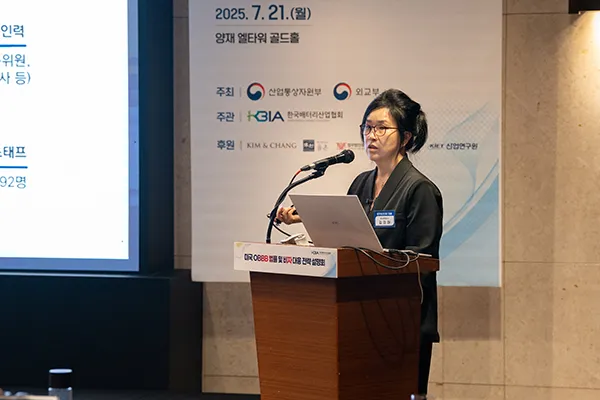
A presentation by lawyers from law firms such as Daeryun, Kim & Chang, and Yulchon As the U.S. administration led by President Trump implemented strong immigration policies such as restricting the entry of foreigners and cracking down on illegal immigrants, the domestic industry was also put on alert. Amid the strengthening of U.S. visa screening, an information session was held on July 21 at El Tower in Yangjae, Seoul to explore corporate response measures following the enactment of the so-called 'One Big Beautiful Bill Act (OBBBA)', which reflects President Trump's major national agendas such as tax cuts and strengthened crackdown on illegal immigration. At the 'U.S. OBBBA legal and visa response strategy briefing session' held by the Korea Battery Industry Association, lawyers from several law firms, including Kim & Chang Law Firm, Yulchon Law Firm, Daeryun Law Firm, and American law firm Covington & Burling, appeared as presenters and shared know-how on visa interviews and tax credit compliance. U.S. attorney Mia Kim introduces B1/B2 visa interview know-how. U.S. attorney Mia Kim of Daeryun Law Firm noted, "Recently, cases of visa approval delays or rejections in cases where there is a replaceable workforce in the U.S. or a history of repeated entry through ESTA and long-term stays are increasing," and introduced interview know-how for B1/B2 visas, which Korean companies frequently apply for but face difficulties among the major types of U.S. visas. The B1 non-immigrant visa is for short-term business purposes in the United States, and the B2 is for tourism, medical treatment, etc. Both visas are short-term visits and the length of stay is limited to 6 months. Attorney Kim explained, “You must prepare a specific and consistent business trip or research plan focusing on content directly connected to your professional field, such as career experience, business trip plan, research plan, and job relevance,” and “If the business trip is for the purpose, the specific schedule and work details must be revealed.” Foreign lawyer Koo Ja-min of Covington & Burling, foreign lawyer Hong Wook-seon of Yulchon Law Firm, and accountant Jeong Hyun explained the main contents of OBBB Law's tax reform in the battery sector. In addition, he said that eligibility requirements and compliance standards will be specified through the Ministry of Finance's enforcement regulations in accordance with the OBBB Act, and shared a tax credit compliance checklist, including eligibility review, construction start requirements, tax credit calculation and transfer, compliance obligations and sanctions related to Prohibited Foreign Entity (PFE), and contract and legal risk management. Foreign lawyers So-yeon Park, Yeon-woo Lee, and Eui-hyun Kim of Kim & Chang Law Firm presented the newly introduced definition of PFE, material assistance requirements, and corporate compliance matters for PFE to regulate supply chains in specific countries. If a PFE from a covered nation, such as China, North Korea, Russia, or Iran, invests, manufactures, and produces in the United States, it cannot receive tax credits such as the Advanced Manufacturing and Production Tax Credit (AMPC), Clean Power Investment Tax Credit (ITC), and Production Tax Credit (PTC). Legal Times Reporter Eunjae Lee (eunjae@legaltimes.co.kr)[View full article] Legal Times - Battery Industry Association holds ‘U.S. OBBB Law and Visa Response Strategy Briefing’ (Go here) Korea Economy - US visa screening has become stricter... “A strategic approach is needed to reduce entry risk” (link) Naeoe Economy TV - "U.S. Visa, now a strategy is needed"... Companies are on high alert due to strengthened screening (Click here)
Money Today
2025-07-22
[기고] 속도 붙은 '李SG' 공시 의무화…기업 위험 요인은?
[Contribution] ‘Lee SG’ speeds up mandatory disclosure… What are the corporate risk factors?
With the recent introduction of the Corporate Sustainability Reporting Directive (CSRD) by the European Union (EU), mandatory ESG disclosure has become a global, irreversible trend. In this trend, President Lee Jae-myung, during his candidacy, argued that the mandatory ESG disclosure period should be brought forward from 2026 to 2025. The goal is to 'improve corporate transparency in line with global standards and resolve Korea's chronic discount'. This is expected to have positive effects in the long term, such as attracting global investment, improving corporate trust, and expanding sustainable management infrastructure. However, there are growing concerns that early implementation in situations where institutional and practical preparations are insufficient may result in serious burdens and risks for companies. In particular, in the case of small and medium-sized companies, the resources and capabilities required to establish an ESG disclosure system are not sufficient, so there is a high possibility of trial and error and side effects. So, what specific risk factors can early mandatory ESG disclosure pose to companies? First of all, various legal disputes may arise due to incomplete disclosure. Producing highly reliable ESG data requires significant time and cost, including improving existing systems and receiving verification from external professional organizations. However, if disclosure is rushed without sufficient internal system maintenance or external verification amid pressure for early implementation, the accuracy and reliability of the data will inevitably decline. Such unverified information or exaggerated performance can become a catalyst for shareholder lawsuits targeting management directly in accordance with Article 125 of the Capital Markets Act (liability for compensation due to false statements, etc.). In particular, 'greenwashing', which is packaging non-environmentally friendly activities as if they are eco-friendly, is not limited to a simple reputation issue and is highly likely to lead to actual sanctions, such as fines from the Fair Trade Commission for violating the Labeling and Advertising Act. Such unverified disclosures can spark legal disputes for companies. Second, excessive response burden occurs due to ambiguity in evaluation standards and inconsistency in standards for each institution. Currently, domestic and international ESG evaluations are carried out in different ways by various organizations without internationally unified standards. For example, global rating agencies MSCI, S&P Global, and Korea ESG Standards (KCGS) apply different evaluation indicators and industry-specific weights. In fact, according to a report analyzing 55 of the top 100 domestic companies in 2021, the ESG ratings of each institution differed by an average of 1.4 levels. In other words, a company that is rated ‘excellent’ by one agency may be judged ‘poor’ by another agency. Such inconsistencies and ambiguities are rapidly increasing the company’s response costs. ESG reports, audit data, improvement plans, etc. must be duplicated to suit the needs of each organization, and consulting costs and manpower burden also increase. This is a huge risk, especially for small and medium-sized businesses with limited financial and human resources. Third, 'disconnection risk' may occur throughout the supply chain. ESG disclosure is difficult to complete solely through the efforts of individual companies. Various indicators such as carbon emissions, human rights, safety, and ethics require securing and managing data throughout the entire supply chain. In particular, carbon emissions data requires information from partner companies. However, many partners lack understanding and preparation for ESG, and their manpower and capacity to build systems are limited. As a result, partner companies that have difficulty responding to ESG face the risk of being excluded from the supply chain of large companies. This could soon lead to the 'risk of supply chain disruption'. The discussion surrounding the timing of mandatory ESG disclosure is a process for our society to move in a better direction. Whether in 2025 or 2027, this huge wave of change is bound to come. The important thing is not ‘when to start’ but to gather wisdom on ‘how to prepare well.’ ESG will become a stepping stone for our companies and capital markets to take a leap forward only when we minimize the side effects caused by hasty implementation and fully realize the purpose of the system through thorough preparation. We need to navigate this important transition wisely. Small and Medium Business Team[View full article] [Contribution] ‘Lee SG’ speeds up mandatory disclosure… What are the corporate risk factors? (Shortcut)
blotter
2025-07-22
[상법개정안 여파] 사외이사에서 독립이사로…'거수기' 꼬리표 떼기 '글쎄'
[Aftermath of the Commercial Act Amendment] From outside director to independent director… ‘Well,’ to take off the ‘Geosugi’ label.
We examine the impact of the Commercial Act amendments on corporate management. There is an assessment that the independence and responsibility of the board of directors will be strengthened as the amendment to the Commercial Act includes the conversion of outside directors to independent directors and expansion of their size. In fact, the purpose is to lay the foundation for outside directors, who have been criticized as being the management's top movers, to raise their voice for checks and surveillance through the amendment. However, in the legal community, there are concerns that confusion may arise in the field because it is difficult to find a suitable person with independence and expertise or a company-specific strategy is not prepared, and it is pointed out that specific measures must be prepared to secure actual independence beyond name changes. The commercial law amendment bill recently passed at the cabinet meeting removes the existing outside directors. It includes changes to the name of independent directors and expansion of the mandatory appointment ratio from one-fourth to one-third of the total number of directors. An independent director is defined as 'a director who, as an outside director, performs functions independent of internal directors, executive officers, and business execution directives.' Accordingly, it is expected that independent directors will be required to have a higher degree of independence than existing outside directors. Changes in the existing management environment, which was greatly influenced by management, are also expected. Attorney Seok-Hyeon Yoo of the law firm Mission said, "It will be possible to increase the check on the company's management." Seung-Gyu Byeon, a lawyer at the law firm Seum, said, "In particular, in line with the main content of the Commercial Act Amendment Bill, which requires directors to directly bear a duty of loyalty to shareholders, when independent directors make decisions for major shareholders, the possibility of making decisions that take into account the interests of all shareholders will increase, considering the possibility of being sued by minority shareholders even if it goes against the interests of major shareholders." I looked ahead. It is necessary to secure candidates for independent directors and prepare customized strategies for each company. However, it may be difficult to achieve the practical effects of the amendment simply by changing the name to independent directors and expanding the size. First, there is the problem of finding appropriate independent director candidates. Kim Ji-ho, an attorney at Lin Law Firm (Limited), said, “If several companies increase the number of independent directors at once to meet the one-third appointment ratio requirement, it may become difficult to find suitable people who meet the qualifications for the relevant industry, and as the responsibilities of directors are strengthened, there is a possibility that candidates may avoid independent director positions.” To prevent this situation, a system for discovering and managing independent director candidates must be systematized. Attorney Yoo explained, “We need to prepare in advance for the appointment of new independent directors to prevent a situation where there is a shortage of candidates right before implementation.” Dong-Han Lim, a lawyer at Dongin Law Firm, emphasized, "Efforts must be made to increase the reliability of the selection of independent directors through an objective and professional director recommendation process and to establish an efficient decision-making system." Jong-Soo Shin, a lawyer at Daeryun Law Firm, said, "The selection process and qualification requirements must be strengthened to ensure the actual independence of independent directors." He added, "In line with the trend of strengthening requirements for independent directors, the candidate recommendation committee system must be practically operated and the independence verification process must be objective." “I do it,” he said. In particular, he advised receiving candidate recommendations through multiple channels. Attorney Kim said, “There is a need to actively consider recommendations from external experts and shareholders,” and added, “In the case of independent directors recommended and appointed through various channels, it is expected that they will contribute to securing independence.” In addition, a careful approach is needed depending on the circumstances of each company. Attorney Shin said, "The impact of the amendment to the Commercial Act will vary depending on each company, whether it is a listed or large-scale listed company, the distribution of shareholders' shareholding, the composition of the existing board of directors and outside directors, and transactions with affiliated companies with different shareholdings of controlling shareholders." He added, "The amendments must be reviewed in detail and responded to according to the company's situation." Attorney Byun also said, "As the effect of changing the name of an outside director of a listed company to an independent director is not explicitly and specifically set, what effect does this amendment to the Commercial Act have on actual corporate management? “We need to look at the accumulation of practice and precedents and the revision of the Enforcement Decree of the Commercial Act to see whether it will have an impact,” he said. If such supplementation is made, it is expected to ultimately have a positive impact on the capital market. Attorney Lim pointed out, "The change to the independent director system will send a positive signal to global investors about the improvement of the governance structure of Korean companies and will have a positive impact on resolving the chronic problem of Korea discounts." Attorney Kim said, "By increasing trust in companies externally and introducing the concept of independent directors, which is emphasized in the corporate governance structure of developed countries, it can contribute to strengthening the international competitiveness of Korean companies and increasing the share of foreign institutional investors in Korea." Reporter Park Seon-woo (closely@bloter.net)[View full article] [Aftermath of the Commercial Act Amendment] From outside director to independent director… Removing the ‘Geosugi’ label ‘Well’ (Shortcut)
Seoul Newspaper
2025-07-21
만취해 화장실 갔다가 ‘엿보기’ 혐의 50대…증거불충분 불기소
A 50-year-old accused of ‘peeping’ after going to the bathroom while drunk… Not indicted due to insufficient evidence
A man in his 50s who was sent on charges of entering a unisex restroom and peeping into the women's compartment was acquitted. According to the legal community on the 21st, the Chuncheon District Prosecutor's Office decided not to indict Mr. A, who was sent on charges of violating the Special Act on the Punishment of Sexual Crimes (Invading Public Places for Sexual Purposes) on the 26th of last month due to insufficient evidence. In December of last year, Mr. A peeped at Mr. was charged with Mr. A was arrested as a red-light criminal and handed over to the prosecution with a recommendation for indictment. Mr. A denied the charges. He claimed that he was drunk at the time and that he only used the public restroom because he was not feeling well. Regarding the circumstances of looking into the women's compartment, he said, "While I was dozing in the bathroom, I heard the door to the next compartment open, and as I was about to go out, my legs went numb and I collapsed," and claimed, "At that time, I just happened to bump into Mr. B, and there was no sexual purpose." The prosecution acknowledged that Mr. A tried to look in front of the women's compartment, but it was difficult to conclude that this act alone was intended to satisfy his sexual desires from the time he entered the bathroom. As a result of checking the CCTV, it was confirmed that Mr. A stayed in the bathroom for about 40 minutes, which was judged to be consistent with Mr. A's claim that he fell asleep in the bathroom. The prosecution believed that there was no clear evidence to admit the charges, considering that other customers at the bar also used the restroom. Attorney Jae-young Yoo of Daeryun Law Firm, who represented Mr. A, said, “For a charge related to trespassing into a public place for sexual purposes to be established, the requirements must be met, such as satisfaction of sexual desire, a place for multiple use, and failure to comply with a request to vacate. Person A can receive a non-indictment by actively proving that he entered the restroom before Person B and that the reason for entering was to solve physiological problems such as vomiting. “There was,” he said. Reporter Jeong Cheol-wook[View full article] A 50-year-old accused of ‘peeping’ after going to the bathroom while drunk… Not indicted due to insufficient evidence (link)
KBC Gwangju Broadcasting
2025-07-21
돈 안 갚고 차용증까지 위조한 50대..法, 징역 1년6개월
A man in his 50s who did not repay money and even forged an IOU... Law, sentenced to 1 year and 6 months in prison
A man in his 50s who committed litigation fraud by submitting a forged IOU to the court was sentenced to prison. According to the legal community on the 21st, the 2nd criminal division of the Wonju Branch of the Chuncheon District Court sentenced Mr. A, who was sent to trial on charges of attempted fraud and forgery of private documents, to 1 year and 6 months in prison on the 25th of last month. Mr. A borrowed 305 million won in the name of business funds from Mr. B, a former co-worker, in 2017 and then used it. Mr. A submitted a forged IOU to the court and claimed that the debt did not exist, but it was not accepted. Accordingly, Mr. B filed a complaint, claiming that Mr. A had forged supporting documents and used them fraudulently. At the trial, Mr. A argued that "the indictment was filed after the statute of limitations had expired" on charges such as forgery of private documents and that "an acquittal should be pronounced." However, the court did not consider the circumstances of the crime and The court sentenced Mr. A to prison, saying that the nature of the crime was not good considering the method. The court stated the reason for sentencing, saying, "The defendant falsified the loan certificate to avoid a large debt in a civil lawsuit and submitted it as evidence, thereby hindering the proper exercise of judicial power. Among fraud crimes, litigation fraud is an aggravating factor in sentencing." Attorney B's legal representative, Daeryun Gil Se-cheol, said, "Mr. A gave money to Mr. B. “Not only did they not repay, but they submitted false information in a civil lawsuit that had been going on for about four years, wasting unnecessary time and money.” Shin Min-ji (sourminjee@ikbc.co.kr)[View full article] A man in his 50s who did not repay money and even forged an IOU... sentenced to 1 year and 6 months in prison by law (link)
Pharmacy Newspaper
2025-07-20
[기고] 제약회사·의료기기 업체 리베이트 수사사례 모음과 시사점
[Contribution] Collection of rebate investigation cases for pharmaceutical and medical device companies and implications
Attorney Daeryun Lee Il-hyung "steadily strengthened..Internal whistleblowing is the most common,Clues vary.-Multi-agency cooperation becomes routine"'HIRA prescription data analysis, Expected to use various investigative techniques, including use of tax investigation data" Regarding the rebate issue, CSO Introduction of reporting system, A series of rebate incidents occurred, And the new government's 'Pharmaceutical Industry Rebates' Special crackdown notice(2025year 7~10month)Tensions are increasing in the pharmaceutical and medical device industry as these overlap.. In this regard, the author 2025year 6The overall rebate regulation was covered in a monthly article in the Pharmaceutical Newspaper.. This time for practitioners 2015Summary of major cases related to rebates from 2008 to the recent past., Let’s take a look at the implications.. 1. 2015year Jhospital incident - Rebate using direct wholesale JThe hospital incident involved the hospital chairman, etc. 46The name is so-called ‘Direct wholesale’While operating 2011since 2015Pharmaceutical companies by year 18Rebate from anywhere 10This is a case where billions of won were received.. These are ‘Direct wholesale’and operates a pharmaceutical company and 'unit price contract'I received a rebate by signing a contract and pocketing the difference in drug price discount.. Meanwhile, in this case, clues to the investigation(Background on how the investigation began)go ‘the former’(Hospital direct wholesaler)It is unique in that it was reported by a pharmaceutical company employee who could not endure the abuse of power.. Another unusual thing is that the criminal and administrative measures were different.. The prosecution ‘The rebate is a small amount or the salesperson's personal deviant behavior’The pharmaceutical company was not indicted, including deferred prosecution, on the grounds that it appeared to be. However, this was also a controversial case as the Ministry of Food and Drug Safety announced that it would make its own judgment and take administrative action against some pharmaceutical companies.. 2. 2016year Nfour incident - Variant rebate using academic journals Nlive 2011since 2016Until 2018, we used medical journals and academic journals to hold round-table meetings in the name of advertising expenses and provide medicines to doctors. 25He was indicted on charges of providing bribes worth hundreds of millions of won.. The investigation into this case began with the revelation of an employee of a medical magazine., The investigation began in earnest with the Seoul Western District Prosecutors' Office conducting a search and seizure operation.. The prosecution ‘Roundtable discussions and academic journal production’In the end 'Variant Rebate' He claimed that, At the trial, controversy continued over whether there was organized collusion and recognition of illegality.. What is noteworthy about this case is that relatively heavy sentences were sentenced to working-level officials and professional academic journals., NThe company executives were declared not guilty and exempted.. Prosecutors claimed it was an organized kickback case at the company level, but, The court is a working group(PM) It was judged that there was insufficient evidence that executives or department heads were specifically reported to or were involved in the act.. In addition, some kickback activities were exempted as the statute of limitations had expired., He acknowledged that there was a possibility that the defendants were not aware of the illegality.. In particular, in the field of rare diseases and anticancer drugs, the need for academic events to improve disease awareness was also taken into consideration.. 3. 2018year ‘5dog pharmaceutical company’ case - Multi-agency joint investigation 2018year 9In January, the Board of Audit and Inspection conducted its own audit of the results of the integrated corporate and individual investigation by the Seoul Regional Tax Office., 5Total number of pharmaceutical companies 374After confirming the suspicion of providing monetary and in-kind kickbacks worth hundreds of millions of won to doctors and pharmacists., Ministry of Food and Drug Safety(Ministry of Food and Drug Safety)The need for investigation was notified to. Accordingly, the Central Investigation Team under the Ministry of Food and Drug Safety(Joongjodan)this 2018year 12month DThe investigation began in earnest with a search and seizure of the company's headquarters.. This incident ‘National Tax Service tax investigation → Board of Audit and Inspection Auditor → Ministry of Food and Drug Safety investigation → Sent to prosecution’It is characteristic in that it is a case of rebate detection linked to multiple institutions leading to. In addition, the Board of Audit and Inspection analyzes tax audit results to detect kickback suspicions and, It is noteworthy that the investigation was initiated after notification to the relevant agencies.. 4. 2024year Kpharmaceutical, 2025year DRecent pharmaceutical incidents 2024years and 2025There was also a rebate-related incident in 2012.. However, in both cases, the company denies the charges., As the facts have not been confirmed, I do not think it is appropriate to make specific comments.. Therefore, we would like to replace the above incidents with other press releases.. 5. 2024year medical device company GCompany case medical device company Glive 2016since 2022Drug-eluting stents for coronary arteries by(DES) Nationwide to expand sales 54gun in dog hospital 37Clinical research expenses worth billions of won, Academic activity fees, He was caught by the Fair Trade Commission on charges of providing advertising expenses..Gthanks DES Sales are 2016year 3From 100 million won 2022year 49In billions of won 16increased by more than twofold, Of these 90% It was confirmed that the above incident occurred at a hospital that had a rebate agreement.. The Fair Trade Commission 2024year GWith a correction order to Sasa 2100 million 8,700A fine of 10,000 won was imposed.. It is well known that some rebate practices exist in the medical device industry., Typically, its scale was relatively small compared to pharmaceutical companies.. However, in this case, despite being a medical device company, the rebate amount was relatively large., It is noteworthy that sanctions were imposed by the Fair Trade Commission, not by an investigative agency.. 5. Implications There were other big and small rebate incidents, but we ask for your understanding that we cannot tell you all about them due to space limitations.. If I get the chance, I will tell you more about the cases.. one side, If we consider the series of events, the following flow can be captured.. first, clues to investigation(Reasons for starting an investigation)As ‘whistle blowing’This is still the most.second, However, the clues in the above investigation are becoming more diverse..third, Multi-agency cooperation is becoming routine.fourth, In the future, HIRA's prescription data will be analyzed, It is expected that various investigative techniques will be used, including the use of tax investigation data..fifth, As I said in the previous article,, Government regulations continue to be strengthened. And it is expected that rebate regulations will continue to be strengthened in the future.. Summarizing the above, in the future ‘compliance’ The importance is bound to continue to grow., The industry also needs to prepare for this.. on the other hand, If you look closely at the cases above, the number of cases where the charges were acquitted is not less than you might think.. Therefore, if you are being unfairly misunderstood about rebates,, I would also like to tell you that there is an opportunity to resolve these difficulties if sufficient explanation is provided during the future investigation process.. [View full article] [Contribution] Collection of rebate investigation cases for pharmaceutical and medical device companies and implications (link)
Korean economy
2025-07-20
"같이 만든 기술인데…" 배신해도 합법? [대륜의 Biz law forum]
“It’s a technology we created together…” Is betrayal legal? [Daeryun’s Biz law forum]
If the jointly developed technology was used alone, a lawsuit would be filed. 'Trade secret infringement' Am I recognized?"It's not illegal" The Supreme Court ruled that the parties must clarify their intentions from the start of the contract. Companies often develop technologies jointly with other companies.. A large company 1·2A representative example is developing production technology for specific parts to be delivered together with car suppliers.. Suppliers maintain amicable relationships with large corporations until technology development is completed and expect to share in profits after delivery.. However, in reality, unexpected problems always arise..By the time development was completed 1tea supplier 2Stop collaborating with tea suppliers and operate independently., or new 2When making final delivery to a large company together with a car supplier, on the other way 2tea supplier 1An example is the case of skipping the car supplier and making the final delivery directly to a large company.. Although significant costs and efforts were invested in technology development,, For companies that are no longer able to produce and sell products, their technology has been stolen..At this time, the victim company sues the offending company. 'Trade secret infringement lawsuit'Can I win if I file a case?? Shouldn’t they at least charge a fee for using the technology?? From the technician's point of view, it is natural to be protected. 'my skills'It was stolen., Can I be protected from the court?? Is it possible to use it unilaterally without the consent of the other party? Which company owns a trade secret jointly developed by two or more companies?? What is the scope of each co-developer's use?? Although the technology belongs jointly to the developers,, In principle, joint developers unless there is a separate agreement 1The court's ruling is that developers can freely use all of the technology without the consent of other developers.(supreme court 2024. 11. 20. sentence 2021all278931, 278948).Let’s substitute it into the above example.. of large corporations 1·2The car supplier worked together to develop trade secret technology and parts., The conclusion is that even if one party betrays the other party and independently produces the relevant parts using trade secrets and then delivers them to a large company, it is not a trade secret infringement.. This is an incomprehensible ruling from the perspective of researchers and developers.. Why did the court make this decision?. At first glance, it is a natural judgment that jointly developed results are jointly owned.. The problem is 'joint attribution'this 'Available range for each developer'The point is that it is not directly related to. Let's take an object as an example.. civil law257Dozing off 'joint ownership'shape again 'share', 'joint oil' and 'total oil'Distinguish by. 'movable property and movable property coincide'If it becomes a composite product 'When it is impossible to distinguish between master and servant of matching movables'In 'share a composite'It is stipulated that. thus Aand BWhen a person creates a composite by combining the items they each had with each other., According to the above regulations, synthetic Aand Bbecomes a share of. Reasons why it is difficult to apply the logic of civil law and patent law Aand BThe provisions of the Civil Code on sharing(civil law262Article to Article270article)Unless there are other circumstances,, Each person can use and profit from the entire composite in proportion to their share.. Aand BIf each person has a half interest in the composite Aand BThis means that you can use and profit from it at half the rate..If we apply this civil law logic to trade secrets, the story is different.. In case of objects AWhile using and profiting Bcannot be used and profited at the same time, Because technology is different.. technology AWhile using Bcan also be used at the same time. Aand BIf civil law sharing regulations are applied to technology shared by Aand BIt must be divided according to the shares held., This conclusion is somewhat unnatural..Regarding this issue 'shared patent'You can also refer to how to use. Our patent law is99Preparation3In port 'If the patent right is jointly owned, each co-owner may implement the patented invention on his/her own without obtaining the consent of the other co-owners, except in cases where it is specifically agreed upon in a contract.'It is stipulated that. When researchers keep techniques secret 'trade secret'Become this, If this is disclosed and registered as property rights, 'patent(or utility model)technology'Therefore, the objects of trade secret technology and patented technology are similar in many ways.. Therefore, the two can be understood in the same context.. If so, the jointly developed technology 'share'In this case, it can be concluded that each sharer can freely use the technology without the consent of other sharers.. However, the above ruling "Share jointly developed research results"It is worth noting again that it was not explicitly determined that. The court is not shared 'joint attribution'There is an intention in using the expression.. therefore 'joint attribution'From the expression "Our court considers joint research and development results to be shared., It was determined that each sharer could use the results at will by applying the sharing provisions of the Patent Act."And you can't jump to conclusions.. It is my personal opinion, but our patent law and patent rights sharing regulations are a reference to Japan's patent law., The problem is that Japanese civil law is different from our civil law. 'joint ownership'the form of 'share', 'joint oil' and 'total oil'The point is that it is not divided by. Ultimately, our patent law 'patent sharing' The provisions of our civil law 'share' Mechanical substitution of regulations is an issue that requires further consideration.. 'protect interests'-'infringement regulation' The Supreme Court sees it differently. Then, for what reason does the court "Co-developers can freely use co-owned technology without the consent of other developers."Did you decide that? The court does not protect the rights holders 'agent(infringer) regulation'The above problem was judged from the perspective of. This is what the Constitutional Court said in the past "The Unfair Competition Prevention Act is well known., in other words, Since the goal is to individually and specifically regulate activities that may cause confusion with widely known signs, the problem is limiting the scope of regulation rather than the scope of protection."(Constitutional Court2001. 9. 27. Heonba77 reference)It can be understood in the same context as the judgment that.Looking at the previous Supreme Court ruling, "Even in the case where two people jointly hold a trade secret, if any of the holders has an obligation to keep the trade secret as a secret to other holders due to contractual relationships, etc., uses or discloses the trade secret for the purpose of obtaining unfair profits or causing damage to the other holders, (la)This may constitute an act of infringement of trade secrets.. (omission) How to use the technical information in this case, which is a trade secret jointly held by the plaintiff and the defendant, Since there is no separate agreement regarding restrictions on use, etc., It cannot be said that the defendant must use the technical information in this case only to manufacture products supplied to the plaintiff or that it has an obligation to use it with the plaintiff's consent."(above Supreme Court decision)and said. Ultimately, the court 'Whose Rights Should Be Protected??'not 'Is the behavior in question subject to regulation??'It was decided that.About the above ruling "Aren't protecting the interests of rights holders and regulating the actions of infringers ultimately the same thing??"You can think. However, in commonly used joint research and development agreements, "Share research results"And it is often written simply., Considering that there are quite a few cases, it is judged to be very important to protect the rights holder's interests and regulate the infringer's actions.. Based on what was explained above, the contract "The results of joint development are shared"If this is written or not written at all, it is very likely that legal disputes unintentional by the developer will arise in the future.. "Shared development technology is shared"By signing a contract that states "Jointly developed technology can be freely used by the other party without permission."There are probably not many researchers and developers who are aware that they are agreeing with the contents of.In order to use and profit from the results in accordance with the intent at the time of first entering into a joint development contract, a clear contract that meets the parties' wishes must be established first.. The assistance of legal experts is also essential to prevent disputes from occurring.. [View full article] “It’s a technology we created together…” Is betrayal legal? [Daeryun’s Biz law forum] (Shortcut)
4 places including Seoul Shinmun
2025-07-18
법무법인 대륜 ‘소통·책임 강화’ 두 축으로 법률 서비스 혁신 나선다
Daeryun Law Firm begins to innovate legal services on the two axes of ‘strengthening communication and responsibility’
Strengthening communication with working-level staff in charge of cases, 'responsibility-centered' law firm operation system in full swing Daeryun "Customer-centered communication and responsibility core values" Focus on building an advanced legal service model Daeryun Law Firm announced that it will strengthen customer service by launching an online communication program that allows clients and lawyers to communicate directly. Daeryun recently launched an online communication program and began work on opening a communication room for each case received by the firm from the beginning of this month. The communication room, which is based on an online messenger, is attended by a team of lawyers and staff in charge of each case. Previously, in order to communicate with the lawyer, the client had to call the lawyer directly or call the team in charge if the lawyer was unable to answer the phone due to a trial, meeting, or consultation. However, the newly released online communication program allows real-time Q&A as well as checking case-related documents. It is expected that a quick response will be possible even in emergency situations. Daeryun's policy is to break physical limitations and increase customer trust through these communication channels. Previously, Daeryun has prepared various systems to increase customer convenience, such as installing and operating a customer satisfaction center. A Daeryun official said, "If the existing customer satisfaction center was a method of constantly communicating customer inconveniences that may occur during the service provision process and regularly receiving and listening to requests, satisfaction, and improvements from customers, with the launch of this online communication program, it can be conveniently used in real time, anytime, anywhere. “We are now able to communicate,” he said. Daeryun is also accelerating the maintenance of its internal system, including strengthening the ‘lawyer responsibility system.’ The existing lawyer responsibility system was operated in a way that, depending on the difficulty of the case, assigned to a single department, settlement department, specialized group, or special department, the members of each department worked as a team under the direction of the director to handle the case. While strengthening the lawyer responsibility system, the scope of duties and responsibilities surrounding overall activities necessary for case performance, such as writing, attending trial, and communicating with clients, were made clearer. This is the result of considering the situation in which the number of cases has increased significantly recently, making it practically impossible for high-ranking management lawyers, such as representative lawyers, to manage all cases. In order to provide higher quality legal services than before, opinions were raised that the system needed to be strengthened, so it was decided to strengthen responsibility management. Daeryun CEO Kim Kuk-il said, “In the case of the lawyer responsibility system, it is actually a culture that has been implemented since the beginning of the corporation.” “As it is a sensitive field that deals with life and rights, securing trust in the service is more important than anything else,” he said, adding, “We will continue to improve the system to increase customer convenience and satisfaction and create an advanced legal service model.” Busan reporter Jeong Cheol-wook[View full article] Seoul Shinmun - Daeryun Law Firm innovates legal services on two axes: ‘Strengthening Communication and Responsibility’ (Click here) Sports Seoul - Daeryun Law Firm begins to innovate legal services on the two axes of ‘strengthening communication and responsibility’ (Click here) Jose Ilbo - Daeryun Law Firm innovates legal services on the two axes of ‘strengthening communication and responsibility’ (link) Tax and Finance News - Daeryun, client and lawyer communicate frequently... Group leader is responsible for ‘Important/Consensual Cases’ (Shortcut)
Have more questions?
Quick Menu

KakaoTalk