


Deals & Cases
Corporate Bankruptcy Procedure | Completion of the Winding-Up of a Corporation with Approximately 300 Million Won in Unpaid Taxes and Wages Through the Assistance of an Attorney Specializing in Bankruptcy
The corporate bankruptcy procedure is a procedure for settling the legal liabilities of a company that has fallen into insolvency and for blocking the spread of risk. This is a case in which the bankruptcy procedure was strategically designed to bring about a declaration of bankruptcy.
1. The Situation That Left No Choice but to Proceed with the Corporate Bankruptcy Procedure
The client who requested a consultation before proceeding with the corporate bankruptcy procedure was the representative of a corporation that operated a manufacturing business in a provincial area.
Although the client's company maintained a certain level of revenue, a liquidity crisis accumulated due to the following structural problems.
- Continued demands from the prime contractor to lower the supply unit price
- Delays in the recovery of accounts receivable
- A labor cost ratio of more than 85%
- An increasing dependence on short-term borrowings
- Accumulated tax arrears
Ultimately, the client's company reached the following state.
- Arrears of national and local taxes
- Unpaid wages and severance pay to workers
- Arrears of the four major insurance contributions
- Inability to repay financial debt
Although the client's assets amounted to approximately 20 million won, the debt reached approximately 300 million won, placing the company in a state of excess of liabilities and insolvency.
In a situation where a notice of impending attachment and a labor office petition were proceeding simultaneously, and even the possibility of an expansion of the representative's personal liability was being raised, the client came to the attorney specializing in bankruptcy.
Core Requirements of the Corporate Bankruptcy Procedure
In a corporate bankruptcy procedure, the parts on which the court places the greatest emphasis are as follows.
(1) Proof of the state of insolvency
It must be objectively proven that the company is in a state of being “generally unable to pay,” rather than merely operating at a loss. Bankruptcy is possible only where the company is, continuously and objectively, unable to pay its debts.
(2) Proof of the state of excess of liabilities
It is necessary to make clear the structure in which liabilities exceed assets and to reassess the actual value of the assets. In particular, because the trustee in bankruptcy appointed by the court recalculates the company's assets at their liquidation value, even a machine recorded on the books at 1 billion won will be reflected by the court in determining whether there is an excess of liabilities if it is worth only 20 million won when sold secondhand right now.
(3) Showing the absence of any prospect of rehabilitation
Because a bankruptcy may be dismissed if there is a prospect of rehabilitation, it must be shown that there is no prospect of rehabilitation. It must be clearly demonstrated that the going-concern value is lower than the liquidation value, so it must be possible to show, through quantified materials, that losses accumulate the more the business operates or that there is no prospect of generating revenue because the main sales channels have been cut off.
The Six-Stage Process of Corporate Bankruptcy Proceedings
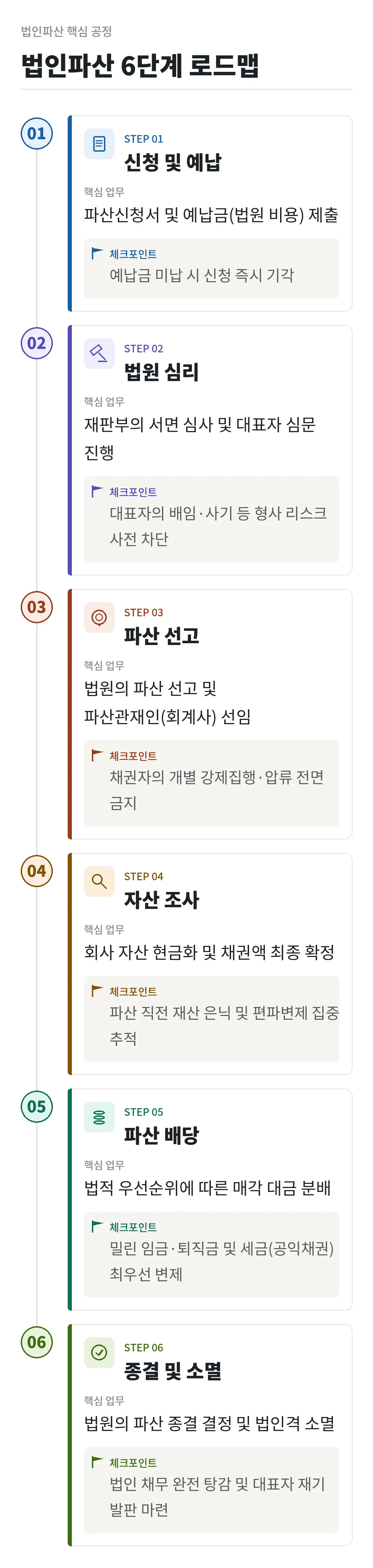
2. Stage-by-Stage Assistance of the Attorney Specializing in Bankruptcy in the Corporate Bankruptcy Procedure

In this case, Daeryun responded strategically at each stage of the corporate bankruptcy procedure.
The Bankruptcy Petition Preparation Stage
✔ Detailed analysis of the financial structure
- Analysis of the account flow over the most recent 1 year
- Structuring of unpaid debts to business partners
- Organizing the records of the representative's provisional payments injected into the company
- Organizing the history of tax demands and attachment notices
✔ Reassessment of the actual value of the assets
- Conservative estimation of the realizable value of inventory assets
- Reflecting depreciation
- Excluding uncollectible accounts receivable
- Confirming whether a security right has been established
Because overvaluing the assets creates a risk that the bankruptcy will be dismissed, the attorney specializing in bankruptcy organized the client company's assets on the basis of their actual realizable value.
Strategic Composition of the Bankruptcy Petition
In corporate bankruptcy proceedings, the petition serves as the court's first basis for assessment.
The bankruptcy attorney designed the petition as follows.
- Explanation of the company's founding history and business structure: demonstrating that the client company, which had previously generated legitimate economic value, had unavoidably reached insolvency, and establishing the integrity and moral credibility of the representative's management
- Specification of the point at which losses arose: clearly identifying the specific point at which the company's deficits deepened to the extent that debt repayment became impossible, thereby proving that this was not fraudulent bankruptcy
- Analysis of the causes of declining revenue: demonstrating that the sharp drop in revenue did not result from the management's negligent operation, intentional concealment of assets, or evasion
- Attachment of materials on attempts at management normalization: obtaining and attaching data proving that the company's self-rescue measures, such as workforce restructuring, asset sales, attempts to attract new investment, and negotiations with financial institutions to extend maturities, had failed
- Clarification of the business suspension status: blocking the accumulation of unnecessary public-interest claims (additional wages, severance pay, rent, and the like) that could arise after the bankruptcy filing, thereby fixing the scale of the corporation's debt
Response at the Bankruptcy Adjudication Examination Stage
If supplementation orders are repeated during the court examination, the proceedings may be delayed.
The bankruptcy attorney swiftly concluded the examination through submission of objective evidence of insolvency, organization of a comparative table of excess liabilities, demonstration of the absence of any prospect for rehabilitation, and proof of the client's efforts to improve management.
Separated Response to Wage Arrears and Criminal Risk
Wage arrears owed to employees may later expand into the personal criminal liability of the representative.
The bankruptcy attorney concurrently determined the arrears amount for each worker, submitted the basis for calculating severance pay, and designed the legal reasoning to block the spread of criminal liability, thereby preventing the expansion of the representative's personal criminal risk.
Organization of the Tax Arrears Structure
The bankruptcy attorney proceeded with the organization of the tax arrears structure as follows.
- Classification of value-added tax arrears
- Confirmation of withholding tax arrears
- Analysis of the possibility of local tax attachment
- Organization of items subject to priority repayment
Corporate Bankruptcy: Requirements to Verify Until the End
3. Corporate Bankruptcy Proceedings Concluded Swiftly with a Declaration of Bankruptcy

The court decided to declare bankruptcy for the client corporation.
In corporate bankruptcy proceedings, management after the declaration is very important.
Daeryun provided the following legal services even after the client company received the declaration of bankruptcy.
- Support in responding to the bankruptcy trustee
- Organization of responses to claim filings
- Cooperation in the asset liquidation process
- Explanation of the distribution structure
What Is Simplified Bankruptcy?
Simplified bankruptcy refers to a determination that the court makes simultaneously with the declaration of bankruptcy when the value of the property belonging to the debtor's bankruptcy estate, that is, the property that can be converted into cash, is recognized as less than 500 million won.
In the case of simplified bankruptcy, no separate auditor is appointed, and the creditors' meeting and similar procedures are omitted or reduced, so the proceedings are simplified and the costs are lower.
A distinguishing feature is that the corporate bankruptcy proceedings can be concluded quickly.
Warning Signs of a Company on the Verge of Bankruptcy
If no response is made at this stage, the situation is likely to lead ultimately to corporate bankruptcy proceedings.
Why a Bankruptcy Attorney Is Needed
Corporate bankruptcy proceedings constitute a complex matter that requires the simultaneous design of responses to criminal liability risk, tax risk, labor disputes, and the personal liability of the representative, as well as a strategy for future recovery.
Daeryun provides an integrated response through the organic collaboration of bankruptcy attorneys, criminal law attorneys, tax law attorneys, labor consultants, accountants, and tax accountants.
If debt structure redesign, negotiations with financial institutions, and a review of internal controls are carried out at the early stage of financial deterioration, there is a possibility of averting the crisis without reaching corporate bankruptcy proceedings.
In practice, blocking all risks that may arise in operating a corporation before they occur is advantageous in every respect, including cost, reputation, and management stability.
That said, if there are warning signs in the company's financial condition, having an assessment conducted at this stage may also be a prudent choice.
If insolvency is suspected, please have the current corporate situation accurately diagnosed.

This content is based on actual cases handled by Daeryun Law LLC and has been partially adapted. All copyrights belong to Daeryun Law LLC.
Unauthorized reproduction, copying or distribution may result in legal action under applicable laws.


Corporate bankruptcy: Want a faster, more detailed consultation?
Consult aspecialized attorney
Related Information
Explore legal information related to this case.
Standards for Corporate Dissolution Costs: From Resolution Methods to the Settlement of Claims and Debts and the Tax Filing Procedure
Criteria to Confirm Before Filing for the Commencement of Insolvency Proceedings
What Problems Arise When Wage Arrears and Tax Delinquency Are Confirmed Together Following a Corporate Insolvency
Daeryun's Key Strengths


Litigation strategy using Daeryun's own AI & IT technology

More than 240 key members

1,200+ cases handled per month
* 2025년 월평균 기준
Complies with Korean Bar Association Advertising Regulations Article 4 (1)
more strengths

Book a legal
consultation with an attorney
All consultations are reviewed by a specialized attorney first,
so they are conducted by appointment only.
Phone consultation
1800-7905
Available 24 hours a day, 365 days a year


Online consultation
We provide tailored
legal services for our clients.

Chat consultation
KakaoTalk channel
Daeryun Law LLC Attorneys
Related Members
View more




Key Case Studies
View more- Decision of bankruptcy
A Corporate Insolvency Attorney Who Obtained a Decision of Corporate Bankruptcy for a Company in Financial Difficulty

- Declaration of Bankruptcy
Incheon Attorney Who Helped a Client Obtain a Declaration of Corporate Bankruptcy
- Declaration of bankruptcy
Daeryun Assists a Corporate Client and Achieves a ‘Declaration of Bankruptcy’
Related Practice Areas
View moreConsult in other languages


Popular Columns
View moreGuide to Corporate Bankruptcy Procedures: Advance Deposits and How to Respond to a Creditor's Bankruptcy Petition
Guide to the Corporate Rehabilitation Procedure and Its Application Requirements
Corporate Bankruptcy Petition: Assessing the Requirements and Preparing the Documents
Corporate Rehabilitation: How to File, Procedural Guide, and the Examiner's Remuneration
Guidance on the Corporate Bankruptcy Procedure, Required Documents, and How to File

Previous
Fleeing After Drunk Driving | Summary Order for a Client Who Fled After Refusing a Breath Test Following Drunk Driving
Next
Case Defending Against a Ten Categories of Gross Negligence Charge | Non-Prosecution of a Client Who Caused a Crosswalk Traffic Accident
View list
Do you have more questions?






