




“Experienced both disabled and non-disabled lives… I will stand on the side of the socially underprivileged.”

2024-04-22
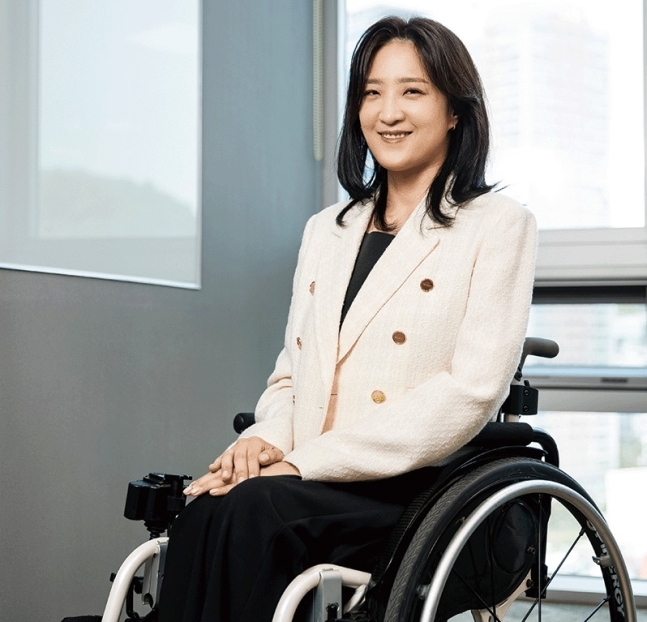
“[Interview] People’s Future Proportional No. 1 Choi Bo-yoon elected”
Choi Bo-yoon (45), the elected candidate who will enter the 22nd National Assembly as the first proportional representative for the People's Future, is a female disabled lawyer. He was diagnosed with physical disability due to a medical accident while at the Judicial Research and Training Institute, and has worked as a lawyer specializing in compensation for damages, working to protect the rights and interests of the disabled and the socially underprivileged. President-elect Choi is said to have applied for nomination for proportional representation directly this time. You have come a long way in politics. How did you get into politics yourself? Ahead of the Day of Persons with Disabilities on April 20, I met Choi-elect at the office of Daeryun Law Firm in Yongsan-gu, Seoul on April 17.
- Why did you enter politics?"As I have an acquired disability due to a medical accident, I have experienced both life as a non-disabled person and life as a disabled person. The difficulties felt by disabled people have become more important. As a lawyer, when protecting the rights and interests of the weak, I have to find a way within the legal framework. While working as a lawyer specializing in damages, I felt that this was not just my difficulty, but that it was a difficulty for many people and an area that needed institutional improvement. The part I proposed was reflected in the '6th Comprehensive Disability Policy Plan' announced by the government last year. At this time, the lives of the weak, including the disabled, were reflected. “I felt greatly rewarded by being able to make an impact, which led me to dream of becoming a politician.”
- It was number 1 in proportion to the people’s future.“I was not a recruited candidate, and I applied for the proportional representation candidate myself. I found out that I was number 1 because an acquaintance told me over the phone, ‘You were elected, you are number 1.’ When I asked him, ‘How did you know?’ he said, ‘There is live news right now.’ I think that (the party gave me number 1) to promote the rights and interests of the weak, and I will try my best.”
- Why is it the People Power Party and not the Democratic Party of Korea?"I thought that a way to improve the lives of all citizens through sustainable welfare could be achieved through the Future of the People. I believed that a virtuous cycle could be achieved in which the lives of marginalized people, including the disabled, were improved as the market economy was revitalized and the national economic power was strengthened. So the value of conservatism touched me more. In particular, I sympathized a lot with the 'Personal Budget System for the Disabled.' Everyone has the freedom to choose according to their individual needs. I hope that the newly introduced system will settle down well."
The personal budget system for the disabled is a system that supports disabled people to flexibly select services according to their needs, moving away from uniform service provision. It was President Yoon Seok-yeol's presidential election pledge, but was adopted as a national task after his inauguration. On March 28, Prime Minister Han Deok-soo announced, "We will conduct a pilot project for the personal budget system and implement it in earnest from 2026." This is a method of freely using goods and services necessary for daily life within the range of 20% of the disabled person's activity support salary.
- You were recently in charge of the ‘medical accident death case of a developmentally disabled person.’"In relation to this, I would like to emphasize 'barrier-free', which means that barriers to disability must be eliminated in medical practice. Medical staff must fully explain medical procedures to people with developmental disabilities undergoing surgery, and it must be at a level that the person concerned can understand. If not, they should have explained it to the guardian. However, in this case, the aftereffects of the surgery that led to the death of the person with developmental disabilities were not explained to the person at all. People with developmental disabilities are often refused medical treatment. Everyone should receive medical services comfortably and their legitimate rights should be guaranteed. “I think.”
President-elect Choi, a legal expert, cited 'empathy' and 'expertise' as his strengths. "I am a disabled person and have met a variety of people through my time at the hospital. While working as a compensation attorney, I met many people and their families who suffered acquired disabilities due to various accidents such as traffic accidents, medical accidents, and industrial accidents. I also continuously communicated with organizations for the disabled, and while attending a welfare center and receiving social security services, I continued to communicate with related workers. Also, because I have accumulated experience as a lawyer for a long time, I think I can play the role of accurately facing reality and finding legislative gaps." Furthermore, I would like to present a reasonable alternative to solve the problem based on legal analysis.”
President-elect Choi is thinking about various issues regarding disability policies even before the 22nd National Assembly begins. When asked about the first bill, President-elect Choi said, "There are many things we are looking into, so I don't know what will come first," and "I am thinking about 'disability aging policy,' 'comprehensive access,' and 'mainstreaming disabilities.' I think we will decide the order by communicating with many people." "As of the end of 2022, 52.8% of registered disabled people are over 65 years old. In the case of disabled and elderly people, there are blind spots due to legislative gaps. Detailed policies are needed to ensure thorough coverage."
Regarding comprehensive access rights, he emphasized, "The European Union (EU) has recently made many efforts to improve accessibility for the disabled, such as establishing the 'Accessible EU Center'," and added, "Our country must also create related systems to meet global standards." "Let's say you're eating a burger for lunch. First, you need information about whether it's a place you can go to for everyone, including people with hearing, vision, and physical and developmental disabilities. You have to use a cane or a wheelchair to get to the restaurant. After arriving, you check whether there's a threshold at the entrance and whether you can go in and sit down, and when everyone can access it, you can finally eat a burger. 'Comprehensive access' including information, transportation, and access to facilities must be possible."
President-elect Choi emphasized 'mainstreaming disabilities,' saying, "There are likely to be many changes in the future in the areas of assistive devices for people with disabilities, as well as the right to mobility and access to information." In line with these changes, the perspective on disability must be reflected in all policies. "If we think twice about how to make a product easy for the disabled or the weak to use, we can develop a product that everyone can use. For example, when it comes to electric vehicles, it is very difficult for the disabled to charge the electric car at a charging station. If all the electric car charging stations are built but are not accessible to the disabled and have to be fixed later, a lot of inconvenience will occur and budget will be wasted. This is why the perspective of the disabled must be included in the early stages of establishing systems and policies for new technologies."
President-elect Choi said that the work of a lawyer is very similar to politics. "It is very similar to politics in that it constantly communicates with clients and actively seeks solutions to problems. However, there is a difference in that legal experts communicate with one client, while politicians meet many citizens and the underprivileged and allow more people to benefit from the system. I believe that politics should resolve the difficulties faced by various socially disadvantaged people in our society, such as women, the elderly, multicultural people, single parents, and young people preparing for independence, as well as the disabled. At the beginning of the election, I wrote a handwritten note. “The pledge was, ‘I will create a better future for all those who are going through hardships.’ I will not lose my original intention and continue to work for their rights.”
[View full article] - “Experienced both disabled and non-disabled lives… I will stand on the side of the socially underprivileged.”


Do you have more questions?






In-Person Consultation Booking
If you have legal concerns, consult with a specialist attorney at the nearest office.
