




International investment dispute ‘90-day cooling off period’… Coupang government investigation is in danger of being stranded

2026-01-26
Differences of opinion between the ruling and opposition parties and ISDS risk during out-of-session periods
The investigation team remains silent for 56 days... Concerns about weakening negotiating power
Forced action and absence are burdensome... National Assembly exit strategy dilemma
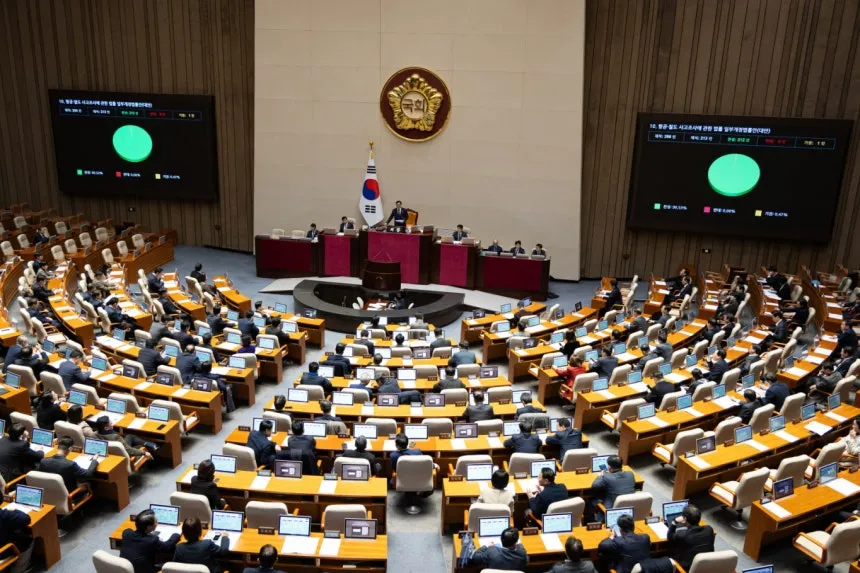
As Coupang's U.S. investors began International Investment Dispute (ISDS) procedures, the National Assembly's investigation into Coupang was in a fog from the beginning. As concerns grow that the political investigation could provide a pretext for international conflict during the 90-day cooling-off period, it is assessed that it has become unclear whether the government investigation will be launched in February. With both the enforcement of the investigation and the gap in response being pointed out as risks, how the National Assembly will design an exit strategy is emerging as a key task.
According to the industry on the 23rd, Coupang's U.S. investment companies, Greenox and Altimeter, submitted a letter of intent for ISDS arbitration based on the Korea-U.S. Free Trade Agreement (FTA), claiming that they suffered damages due to the Korean government's response following the Coupang personal information leak. ISDS is a system in which foreign investors seek resolution through international arbitration when they suffer losses due to the actions of the country in which they invested. A letter of intent to arbitrate is a preliminary procedure to inform the opposing government of its intention before filing formal arbitration.
Following the submission of the letter of intent to arbitrate, the Korean government and U.S. investment companies are entering into a 90-day cooling-off period of negotiations, and the government investigation into Coupang is expected to virtually drift along. The Democratic Party of Korea and the People Power Party submitted a request for a government investigation to the National Assembly's Legislation Department on December 31 last year and the People Power Party on the 8th.
Due to the standoff between the ruling and opposition parties over political leadership during the year-end and New Year holidays and the internal circumstances of each party, an agreement on the agenda was shaky, and a report was made at the plenary session held on the 15th, 15 days after the Democratic Party's submission. The differences of opinion on the scope of the investigation were not narrowed, with the Democratic Party demanding an investigation focusing on Coupang, including information leaks and industrial accidents, and the People Power Party demanding an investigation into the overall personal information protection policy, including the three mobile communication companies and Temu and Ali.
National Assembly blocked by external variables... Concern over 'retaliatory harassment' counterattack
With the National Assembly entering a non-session period ahead of the plan approval process that must determine the scope of the investigation and witnesses, external variables such as ISDS cooling-off period discussions overlapped, making follow-up schedules such as adoption of the government investigation plan difficult. Initially, it was expected that a full-scale investigation would be conducted after the opening of the extraordinary National Assembly in February, but as concerns over trade friction arose, some analysts say that the adoption of the plan itself has become uncertain.
Experts point out that forcing a government investigation during the cooling off period in the ISDS procedure could have a disadvantage in the international arbitration arena. The explanation is that the cooling period is a time to seek an amicable agreement between the parties to the dispute, and if the level of pressure from the National Assembly increases during this period, there is a possibility that the investor side will take issue with this as a coercive measure.
Dong-hoo Son, an American lawyer at SJKP, explained, "During the cooling-off period, the government or the National Assembly's push for an investigation or increased pressure could be considered retaliatory harassment to force investors to submit. From the government's perspective, it is bound to face a dilemma between enforcing domestic law and preventing friction in trade, and it could easily lead to creating an unfavorable situation for itself in an international trial."
Concerns about weakening government bargaining power... ‘Exit strategy’ is important amid uncertainty
Due to the delay in confirming the official facts by the public-private joint investigation team separate from the government investigation, the government faced structural limitations in having to respond without the results of the domestic investigation or political agreement during the negotiation and explanation process with U.S. investment companies. Although 42 days have passed since the investigation team was officially launched on December 13 last year, there has still been no official announcement of investigation results. It has been 56 days since the incident occurred (November 29). It is pointed out that having to respond to international disputes without clearly establishing the facts is weakening the government's negotiating power.
Lee Jeong-hoon, professor of economics at Chung-Ang University, said, "The delay in the investigation team's announcement is a factor that amplifies uncertainty in the market," and predicted, "Investor anxiety arising from the absence of clear investigation results is likely to be passed on to the Korean government in future disputes." He continued, “If there is a situation where the investigation is delayed, efforts must be made to resolve uncertainty by clearly disclosing this.”
If the political foundation that supports the legitimacy and transparency of the government's response is weakened, the risk can spread throughout the industry. This is because this dispute could increase uncertainty about overall cooperation in strategic industries between Korea and the United States, such as semiconductors and batteries. There are concerns that the gap in the National Assembly's response within the 90-day cooling-off period could go beyond the current issue and lead to a decline in external credibility and the spread of trade risks.
Considering public opinion, it is realistically not easy to completely stop the National Assembly's response, so some point out that the National Assembly must plan an exit strategy well. Professor Lee said, “Completely suspending the National Assembly’s functions just by filing for international arbitration is not in line with the legal sentiments of domestic victims and the public,” and suggested, “The National Assembly should continue its original role, including providing relief for damage, while maintaining a cool response that minimizes legal defects.”
Reporter Go Hyeon-sol (sol@mt.co.kr)
[View full article]
International investment dispute '90-day cooling off period'... Coupang government investigation in danger of being stranded (link)

Do you have more questions?






In-Person Consultation Booking
If you have legal concerns, consult with a specialist attorney at the nearest office.
