
CONTENTS
- 1. Claim for Return of the Reserved Portion | The Reserved Portion System

- - Definition of the Reserved Portion
- - The Need for a Claim for Return of the Reserved Portion
- 2. Claim for Return of the Reserved Portion | Persons Entitled to Claim
- - Persons Entitled to the Reserved Portion
- - Reserved-Portion Ratio
- 3. Claim for Return of the Reserved Portion | Calculation of the Reserved Portion
- - Formula for Calculating the Reserved Portion
- - Whether Gifted Property Is Included
- - Scope of Deductible Debts
- - Reference Point for Valuation of Property
- 4. Claim for Return of the Reserved Portion | Requirements for the Claim
- - Requirements for the Right to Claim Return of the Reserved Portion
- - The Opposing Party in the Claim for Return
- - Order and Ratio of Return
- - Statute of Limitations for the Right to Claim Return
- 5. Claim for Return of the Reserved Portion | Method of Claim
- - Method of the Claim for Return
- - Procedure for a Judicial Claim
- 6. Claim for Return of the Reserved Portion | Checklist
- - Support System of the Inheritance Attorney

1. Claim for Return of the Reserved Portion | The Reserved Portion System

A claim for return of the reserved portion is a lawsuit seeking the return of property corresponding to the reserved portion that has been infringed.
 Definition of the Reserved Portion
The reserved portion refers to the minimum inheritance share that is legally guaranteed to be received by an heir.
While the Korean Civil Act recognizes the freedom to dispose of inherited property through a will, it also provides for a reserved portion system that always guarantees a minimum share to heirs.
Accordingly, even though property may be freely disposed of through a will or a gift, a certain proportion can be protected for the purpose of securing the livelihood of heirs and the financial stability of the family.
The Need for a Claim for Return of the Reserved Portion
▷ To maintain the order of the family community against a biased will or gift


2. Claim for Return of the Reserved Portion | Persons Entitled to Claim
The fact that a claim for return of the reserved portion exists does not mean that every heir may file one.
The Civil Act recognizes only certain statutory heirs as holders of the reserved portion, and other heirs or persons who have renounced the inheritance do not have a right to claim return.
Persons Entitled to the Reserved Portion
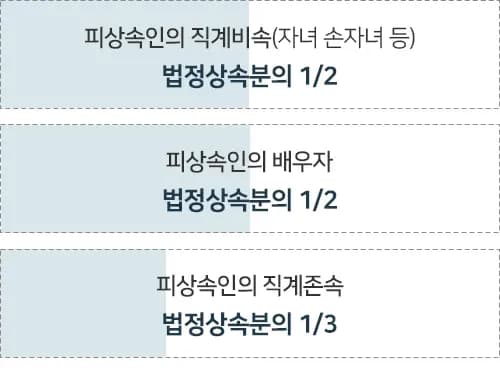
The persons who hold a reserved portion are limited to the following (Civil Act, Article 1112).
▷ The decedent's lineal ascendants (father and mother, grandparents, and the like)
▷ The spouse who is an heir
In addition, an unborn child and an heir by representation are also recognized as holding a right to claim the reserved portion on the same terms as ordinary heirs, and their portion is calculated on the basis of the inheritance share of the person represented (Civil Act, Article 1118).
However, a person who has renounced the inheritance is not an heir and therefore cannot file a claim for return of the reserved portion.
Reserved-Portion Ratio
The reserved-portion ratio of a person entitled to the reserved portion is fixed as follows under Article 1112 of the Civil Act.
Rank | Person Entitled to the Reserved Portion | Reserved-Portion Ratio |
1 | The decedent's lineal descendants | Statutory inheritance share × 1/2 |
2 | The decedent's lineal ascendants | Statutory inheritance share × 1/3 |
- | The decedent's spouse | Statutory inheritance share × 1/2 |
In this case, the decedent's spouse holds the reserved portion together with the first-rank or second-rank persons entitled to the reserved portion.
3. Claim for Return of the Reserved Portion | Calculation of the Reserved Portion

Before filing a claim for return of the reserved portion, the amount of the reserved portion must first be calculated.
The amount of the reserved portion is not calculated simply by multiplying a fraction of the statutory inheritance share. It must be calculated by reflecting the decedent's actual property status, gifts made during life, debts, and special benefits in their entirety.
Under Article 1113 of the Civil Act, the reserved portion in a claim for return is calculated through the following procedure.
Formula for Calculating the Reserved Portion
Whether Gifted Property Is Included
When calculating the reserved portion, certain property among the property that the decedent gave during life is also included.
: In principle, included in the calculation of the reserved portion
• Gifts more than 1 year before the commencement of inheritance
: Included when both parties acted knowing that the reserved portion would be infringed
• Gifts to a co-heir (special benefit)
: Included in full regardless of the timing of the gift
Scope of Deductible Debts
The debts deducted in calculating the reserved portion are limited to the decedent's debts incurred during life (Supreme Court Decision 2012Da21720, rendered May 14, 2015).
: The decedent's own debts, such as loans, taxes incurred before death, and unpaid amounts
• Items not deducted
: Expenses incurred after the inheritance, such as inheritance tax, funeral expenses, and the costs of managing the inherited property
Litigation costs and taxes related to the inheritance are not taken into account in calculating the reserved portion, so care is needed.
Reference Point for Valuation of Property
In principle, gifted property is valued on the basis of the market value as of the date the inheritance commences, and where it is returned in money, it is valued on the basis of the market value as of the date the oral argument is concluded.
In this case, for a right subject to a condition or a right whose period of existence is not clear, the court determines the amount through an appraiser (Civil Act, Article 1113, paragraph 2).
4. Claim for Return of the Reserved Portion | Requirements for the Claim

A claim for return of the reserved portion may be filed where the rights of a person entitled to the reserved portion have been infringed by the decedent's will or a gift made during life.
Requirements for the Right to Claim Return of the Reserved Portion
In order to file the lawsuit, a right to claim return of the reserved portion must have arisen.
∙ That shortfall must have resulted from the decedent's will or a gift made during life
When the above two requirements are met, under Article 1115, paragraph 1 of the Civil Act, the return of that property may be claimed to the extent of the shortfall in the reserved portion.
※ If the decedent's gift was made within 1 year before the commencement of inheritance, or was made while knowing of the infringement of the reserved portion, it becomes a subject of the claim for return of the reserved portion.
The Opposing Party in the Claim for Return
The person who received the gift or testamentary gift that infringes the reserved portion is the opposing party in the claim for return of the reserved portion.
∙ A donee who received a gift during life in infringement of the claimant's reserved portion
Order and Ratio of Return
Under Article 1116 of the Civil Act, a claim for return of the reserved portion is directed first at a person who received a testamentary gift, and only where the shortfall in the reserved portion is not satisfied by the return of the testamentary gifts alone may a claim be made against a donee who received a gift during life.
In addition, where several persons received gifts during life, the obligation to return is divided according to the ratio of the value of the property each received.
Statute of Limitations for the Right to Claim Return
The right to claim return of the reserved portion is subject to a limited period for exercise.
② 10 years from the day on which the inheritance commenced
If a claim is not made within the limitation period, return can no longer be claimed by law, so the timing of the claim is very important.
5. Claim for Return of the Reserved Portion | Method of Claim

The following examines the claim for return of the reserved portion and the method of claiming return of the reserved portion.
Method of the Claim for Return
The return of the reserved portion may be sought by way of a declaration of intent to the opposing party, and where there is a dispute, it may also be claimed through a civil lawsuit.
Procedure for a Judicial Claim
Where a judicial claim is chosen, the defendant is the testamentary donor or the donee, and the family court having jurisdiction over the decedent's place of residence at the time the inheritance commenced becomes the court with jurisdiction.
: The plaintiff seeking resolution of the dispute prepares the complaint and submits it to the court
② Review of the complaint (court)
: If there is a defect in the complaint, a recommendation to correct or an order to correct is issued
③ Service of the copy of the complaint (court > defendant)
④ Submission of the answer (defendant)
: If the defendant denies the plaintiff's claim, the answer is submitted within 30 days of service
(if no answer is submitted, judgment is rendered directly)
⑤ Service of the answer (court > plaintiff)
⑥ Date for organizing the issues
: As the first hearing date, both parties meet the judge early to confirm the issues of the case
⑦ Preparatory proceedings for pleading (court)
: Preparatory proceedings for pleading by written submissions and the preparatory pleading date
⑧ Pleading date
: When the preparatory proceedings for pleading are concluded, a pleading date is set immediately
⑨ Date for concentrated examination of evidence
: After organizing the parties' arguments and evidence, examination of witnesses and examination of the parties
⑩ Judgment
6. Claim for Return of the Reserved Portion | Checklist
This is a civil lawsuit that requires a combined analysis of various factors, such as the composition of the inherited property, the details of testamentary gifts and gifts, and the inheritance status of the person entitled to the reserved portion.
An argument that one simply “received too little” is not enough to prevail. The fact of the infringement and the scope of the return must be proven concretely and objectively.
Item to Prove | Specific Content and Supporting Evidence |
Commencement of Inheritance and Status as an Heir | Proof of the decedent's death and of one's own qualification as a person entitled to the reserved portion |
Records such as the family relation register, the removed family register, and the decedent's death certificate are needed | |
Content of the Inherited Property | Confirmation of the positive and negative property left by the decedent |
Records such as the real estate registration certificate, financial transaction records, vehicle registration certificate, and debt certificates are needed | |
Details of Testamentary Gifts and Gifts | Details of the decedent's gifts during life or testamentary gifts under a will |
Records such as the will, notarized deed, gift contract, account transfer records, and real estate sale deed are needed | |
Calculation of the Amount of Infringement of the Reserved Portion | Calculation of one's own reserved-portion right and of the amount infringed |
Records such as the reserved-portion calculation statement, appraisal report, accounting records, and the statement organizing the inherited property are needed | |
Confirmation of the Opposing Party and the Amount | Specific calculation of who the testamentary donee or donee is and how much must be returned |
Records such as the analysis of testamentary gift and gift details, materials confirming registration and account titles, and appraised-value calculation materials are needed |
Support System of the Inheritance Attorney
This law firm includes a number of inheritance specialist attorneys registered with the Korean Bar Association, as well as specialist attorneys with an average of 10 years of experience.
Systematic support is available throughout the entire process, from analyzing the details of the decedent's gifts during life and testamentary gifts to calculating the subject of return, filing the lawsuit, and enforcing the judgment.
In addition, through collaboration with professionals such as accountants, tax accountants, and judicial scriveners, follow-up management services, including the management and reporting of inheritance tax, can also be provided.
If you need related assistance, you may request assistance from an inheritance attorney at any time.
Related News