
CONTENTS
- 1. Marriage Immigration | Acquiring the Status of a Korean National's Spouse

- 2. Marriage Immigration | The F-6 Visa Concept and Requirements
- - Procedure for Inviting a Foreign National
- - International Marriage Guidance Program
- 3. Marriage Immigration | Confirming the Requirements for Maintaining the Marriage
- - Income Requirements for the Korean Spouse
- - Maintenance and Renewal of Status of Stay
- - Change of Existing Status of Stay
- 4. Marriage Immigration | Acquiring Permanent Residency and Naturalization
- - Simplified Naturalization Through Marriage
- - Restriction and Revocation of Naturalization Approval
- - Family Relations Registration After Acquiring Nationality
- 5. Marriage Immigration | Protecting the Rights of Both the Sponsor and the Immigrant

1. Marriage Immigration | Acquiring the Status of a Korean National's Spouse
Marriage immigration generally refers to the residence status procedure through which a foreign national who marries a Korean national, or a foreign national residing in Korea, may stay in the Republic of Korea.
Korea provides for marriage immigration in the Immigration Act, the Nationality Act, the Act on Registration of Family Relations, and other statutes.
As multicultural members of Korean society, marriage immigrants often aim to acquire Republic of Korea nationality and go through various legal procedures, including extension of residence status, application for permanent residence, and naturalization.


2. Marriage Immigration | The F-6 Visa Concept and Requirements
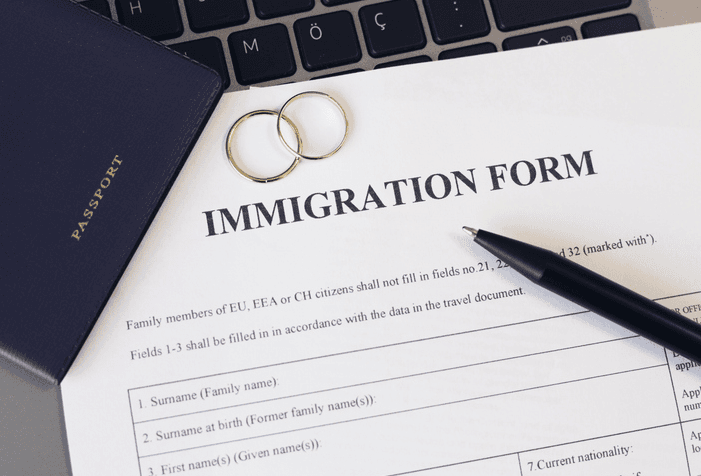
Under the Immigration Act, among long-term residence statuses, the marriage migrant visa (F-6) is a representative residence status issued to foreign nationals who have married a Korean citizen.
The requirements for issuance include whether a genuine marital relationship is maintained, as well as economic capacity, housing requirements, and proof of the marriage.
A person who holds marriage migrant status faces no restrictions on job-seeking or employment, and after residing for two years or more, may also apply to change to permanent residence status.
However, to prevent sham marriages entered into solely for immigration purposes, the review has been strengthened, and where the marriage is a remarriage rather than a first marriage, or where the age gap is excessively large or the period of acquaintance beforehand was short, the submission of additional documents and an in-depth interview may be required.
Even after the visa is issued, the genuineness of the marital life must continue to be maintained.
If the marital relationship breaks down or a sham marriage is discovered, extension of the visa may be denied or the residence status may be revoked.
 Procedure for Inviting a Foreign National
For a foreign national to obtain a visa for the purpose of marriage and cohabitation in order to immigrate through marriage, an invitation from the spouse is required.
In this case, the inviter becomes the foreign national's identity guarantor.
If the foreign national seeking the visa is from a specific country (China, Vietnam, the Philippines, Cambodia, Mongolia, Uzbekistan, or Thailand), the inviter must complete the international marriage guidance program, and must enter the completion number when applying for the visa.
International Marriage Guidance Program
The international marriage guidance program is an educational program completed on the Korean spouse's side in order to improve understanding for the foreign spouse who will come to Korea through marriage immigration.
- Introduction to the systems, culture, and etiquette of the local country related to international marriage
- Procedures for issuing a marriage visa and the screening criteria
- Other matters such as human rights education
However, completion of the program is not required in cases such as where the couple resided and dated in the foreign spouse's country for six months or more, or where the foreign spouse dated while staying legally in Korea under a long-term residence status.
3. Marriage Immigration | Confirming the Requirements for Maintaining the Marriage

The immigration authorities review the following matters with respect to the foreign national who applies for a marriage immigration visa and the sponsor.
Income Requirements for the Korean Spouse
A person who invites a foreign spouse for purposes such as cohabitation in marriage must have an annual income, based on the most recent one-year period, at or above the following amounts.
Category | 2-person household | 3-person household | 4-person household | 5-person household | 6-person household | 7-person household |
Income threshold | 23,595,948 | 30,152,118 | 36,586,638 | 42,649,152 | 48,388,830 | 56,930,568 |
Maintenance and Renewal of Status of Stay
If, after marriage immigration, one wishes to continue staying beyond the designated period of stay, one may obtain permission to extend the period of stay.
In this case, one may submit documents such as a passport, an alien registration card, proof of place of residence, a marriage relationship certificate, and documents that can prove child rearing.
If one is undergoing remedial procedures after suffering harm from domestic violence, a sexual violence crime, a child abuse crime, or human trafficking, an extension of the period of stay is permitted until those remedial procedures are concluded.
Change of Existing Status of Stay
If you wish to change an existing status of stay to a marriage immigration status, you may file an application for permission to change the status of stay.
4. Marriage Immigration | Acquiring Permanent Residency and Naturalization
A foreign national who has acquired status through marriage immigration may, two years after marriage, undergo naturalization procedures and acquire Republic of Korea nationality.
If the person wishes to retain their own nationality, a change of status of stay to a permanent residence (F-5) status, which is close to the status of a national of the Republic of Korea, is also possible.
Permanent residence status may be restricted, however, in the following cases.
- Where, after a sentence of imprisonment or heavier for a violation of the Immigration Act or similar laws, five years have not passed since the completion or remission of its execution
- Where, after a suspended sentence of imprisonment or heavier for a violation of the Immigration Act or similar laws, five years have not passed
- Where, after a fine was imposed and paid for a violation of the Immigration Act or similar laws, three years have not passed
- Where five years have not passed from the date of entry without a visa or in violation of entry inspection
- Three or more violations of the Immigration Act within the last five years
- Where seven years have not passed since departure following an order of compulsory deportation
- Where five years have not passed since departure following an order to depart
Simplified Naturalization Through Marriage
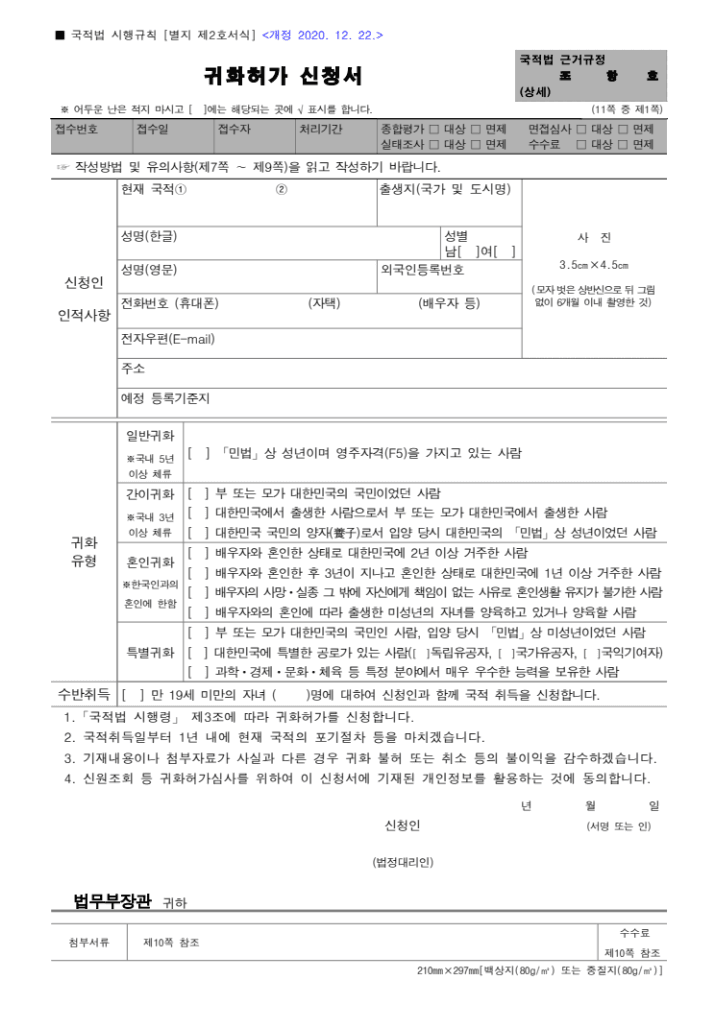
A marriage immigrant acquires Republic of Korea nationality through simplified naturalization based on marriage.
An applicant who is an adult, meets the requirement of good conduct prescribed by statute, and has the ability to maintain a livelihood becomes eligible for naturalization under the following eligibility requirements.
- Marriage to a Korean national + maintenance of the marital relationship for two years or more and residence in Korea
- Three years after marriage to a Korean national + residence in Korea for one year or more
- Death or disappearance of the spouse after marriage to a Korean national, with residence in Korea for a substantial period
- Raising a minor child born after marriage to a Korean national
Restriction and Revocation of Naturalization Approval
If the foreign spouse satisfies the requirements, naturalization is reviewed through an interview and an evaluation of Korean language ability, social adaptation, and other factors.
Naturalization may, however, be denied after a check of criminal records and identity verification.
An applicant for naturalization cannot obtain approval if the applicant does not meet the naturalization requirements, scores below 60 points on the comprehensive evaluation, or is found unsuitable in the interview screening.
In addition, even where a person has acquired Korean nationality through marriage immigration or other grounds, the naturalization approval may be revoked if the cause of the nationality acquisition is rendered void or is revoked.
Family Relations Registration After Acquiring Nationality
When naturalization is permitted, the person is deemed to have acquired Korean nationality and must prepare a family relations register at the competent family relations registration office (such as a district office).
After acquiring nationality, one must renounce one's foreign nationality or make a pledge not to exercise foreign nationality within one year.
In particular, a person granted naturalization through marriage who maintains the marital relationship may make a pledge not to exercise foreign nationality.
5. Marriage Immigration | Protecting the Rights of Both the Sponsor and the Immigrant

Where a dispute related to marriage immigration arises, such as a change of residence status, a defense against revocation of naturalization, or an international divorce due to the disappearance of a foreign spouse, the following supporting documents should be prepared in order to obtain various forms of assistance.
Marriage immigrants are important members of Korean society.
The legal requirements involved in obtaining residence status and acquiring nationality in Korea are not always simple, however.
In particular, where exceptional circumstances arise, such as a foreign spouse falling into an unlawful stay situation or the marital relationship breaking down due to the disappearance of a spouse, it may be difficult for an individual to resolve the matter alone.
In such a case, it is advisable to seek the advice of a legal professional as promptly as possible.
This firm accepts consultation requests on weekends and public holidays, and it has established branch offices nationwide, where attorneys in each field, such as divorce attorneys and immigration attorneys, conduct consultations. If a problem related to marriage immigration arises, you may leave a consultation request at any time.